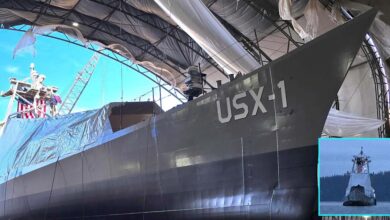
DARPA Confirms the USX-1 Defiant After Reddit Photos Exposed the Pentagon’s Crewless Warship in Puget Sound


A Tugboat, a Tarp, and a Reddit Thread That Forced DARPA to Talk
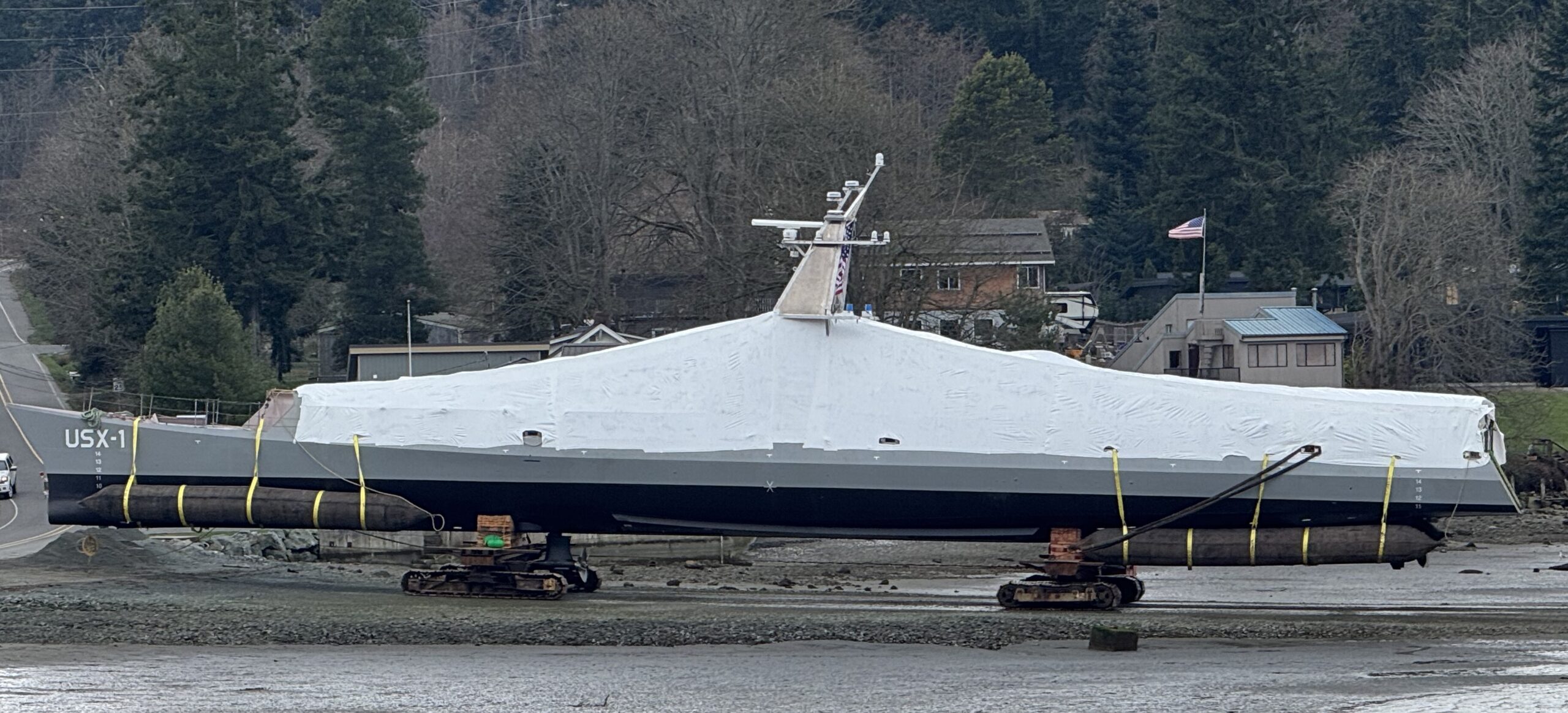
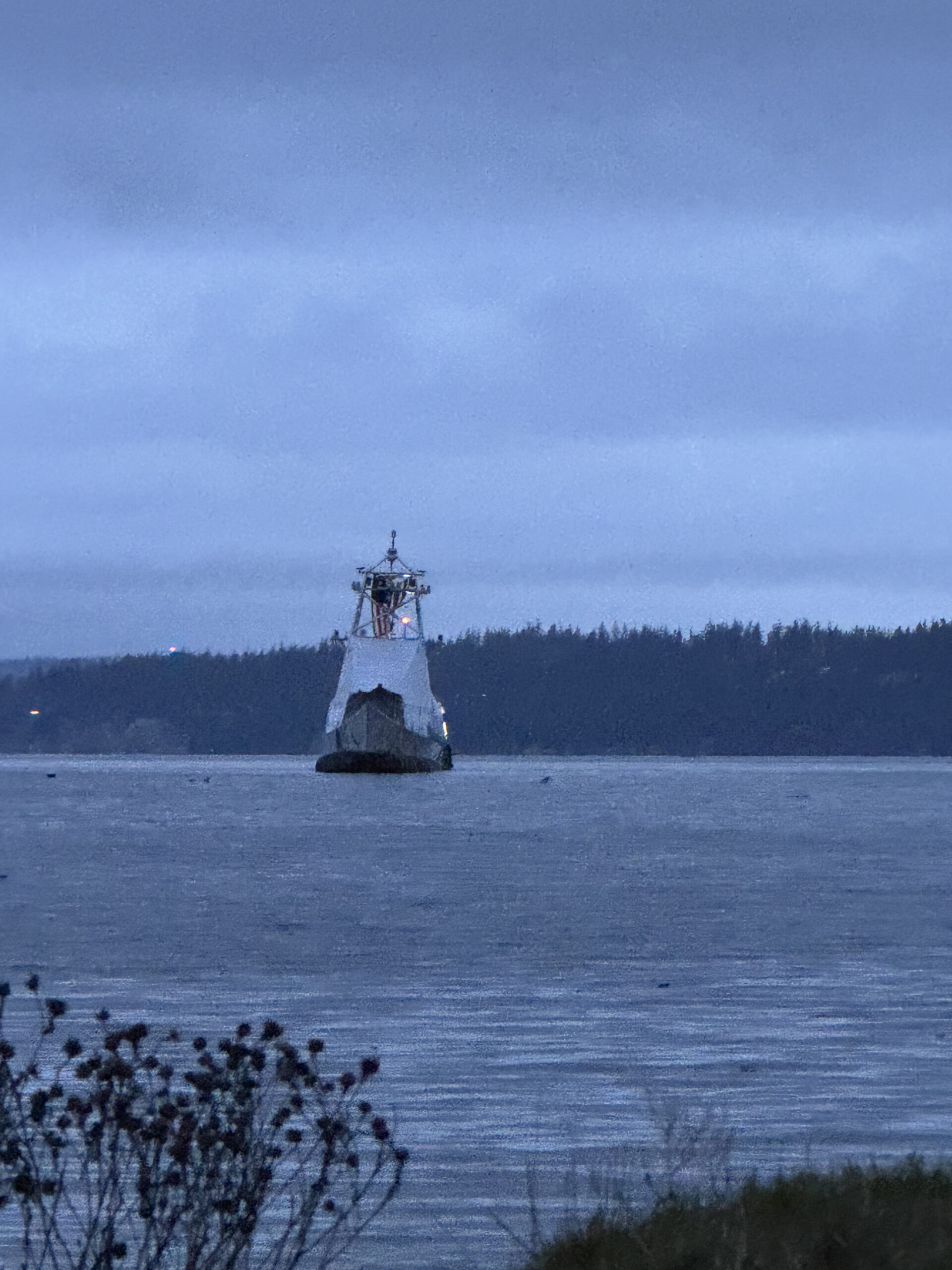
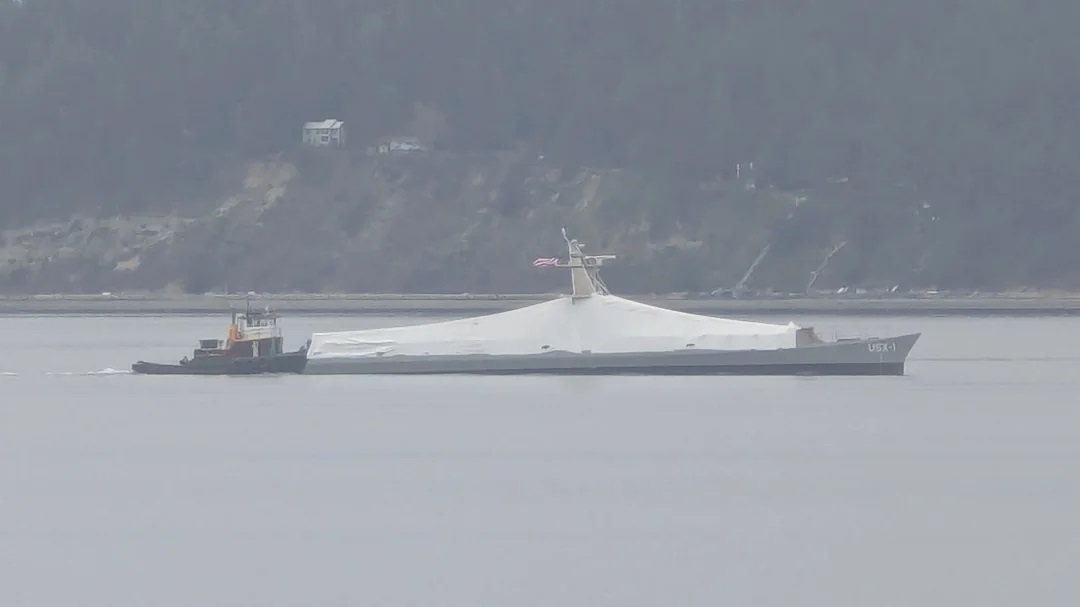
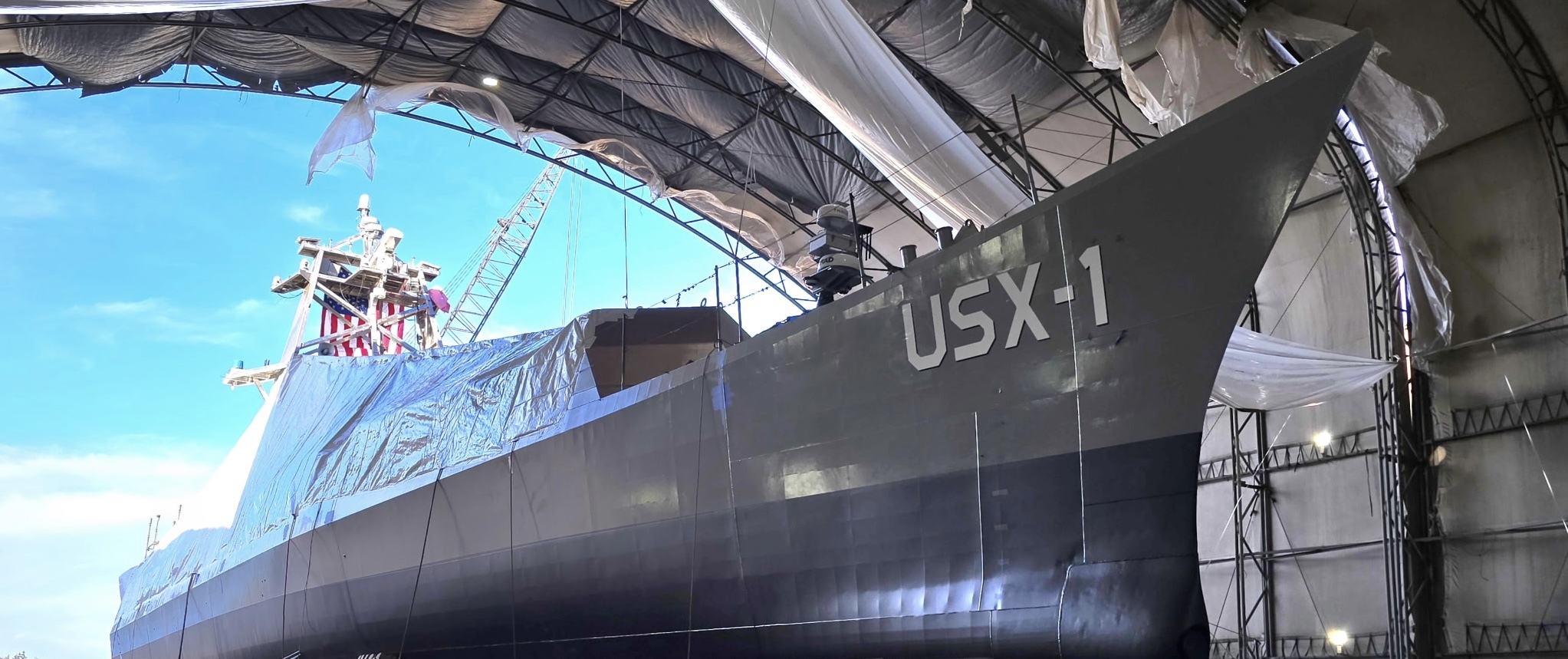
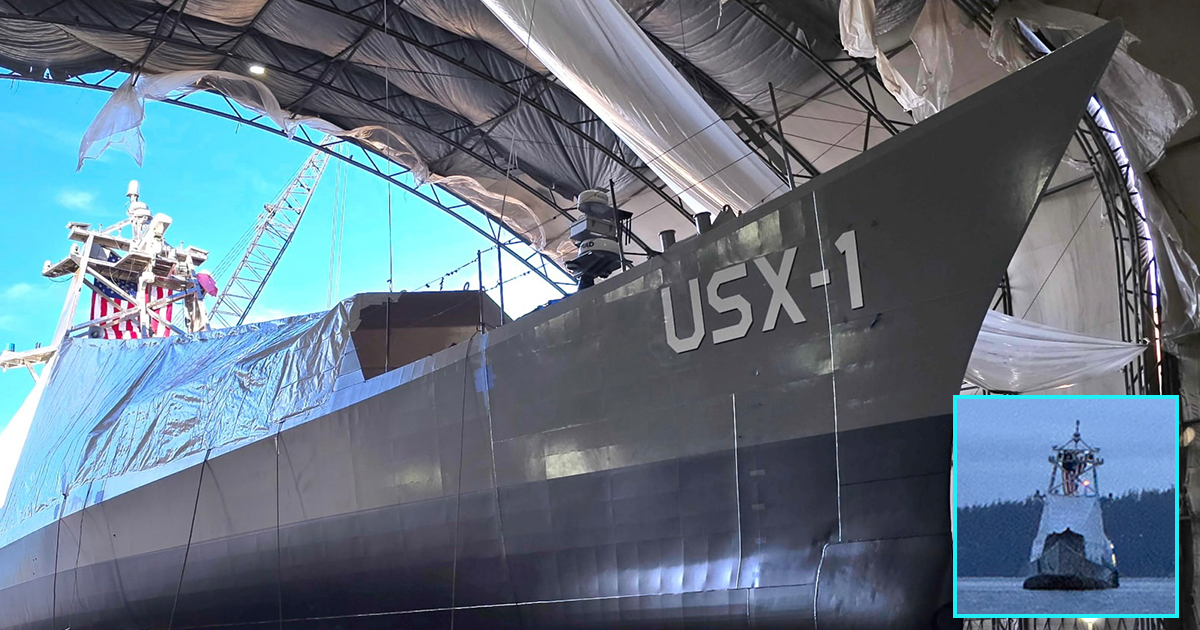
The first public look at the Pentagon’s crewless warship did not come from a press office. It came from a resident on the Washington coast who posted photographs to r/navy after watching a low, tarp-wrapped hull being towed through Saratoga Passage in Puget Sound. The comments guessed everything from a barge to a secret destroyer. Within days, the Defense Advanced Research Projects Agency had to confirm the hull belonged to the United States. The name on the side, once the sheeting came off, was USX-1 Defiant.
The sighting sat a short ride from Naval Air Station Whidbey Island. That geography is why the photos traveled so fast. Sailors and ship-spotters know those waters. A 180-foot object with no windows, no bridge wings, and no obvious crew spaces does not blend in. The AEGIS Alliance has watched the same pattern with other machines the government would rather introduce on its own timetable, including the X-37B spaceplane that spent 434 days in orbit before anyone got a clean look at what it had been doing.
NOMARS Starts With a Blank Sheet, Not a Converted Crewed Hull
Defiant is the prototype for DARPA’s No Manning Required Ship program, known as NOMARS. The premise is blunt. Do not take a conventional patrol craft and rip out the bunks. Design a seaframe that never expected a human to walk its decks. That means no gangways, no galley, no berthing, no ventilation sized for lungs, and no bridge. Program documents describe a vessel optimized for size, cost, reliability, hydrodynamics, and survivability rather than habitability.
Serco won the NOMARS contract in 2022 over a Leidos Gibbs & Cox team. Nichols Brothers Boat Builders in Washington put the hull in the water in early 2025. The ship is about 180 feet long and 240 metric tons lightship. Because nobody has to squeeze past machinery, the beam is only as wide as the largest piece of hardware requires. That geometry is why DARPA keeps saying the hull can be built and repaired at ordinary Tier III yards that already handle yachts, tugs, and workboats. The Navy does not need a nuclear-capable dry dock to keep a medium unmanned surface vessel in the fight.
The reliability target is the part that matters more than the silhouette. NOMARS wants roughly 90 percent availability across a yearlong deployment. A ship with no crew cannot call a machinist’s mate when a pump seizes in a December storm. That is the actual engineering problem, not the viral photos.
What the Ship Has Already Proven on the Water
On August 11, 2025, DARPA held a traditional christening at Everett Ship Repair in Everett, Washington. NOMARS program manager Greg Avicola called Defiant “a tough little ship” that “defies the idea that we cannot make a ship that can operate in the challenging environment of the open ocean without people to operate her.” He said the hull can work in sea state 5 with no performance drop and ride out worse weather, then resume the mission when the storm passes.
The extended demonstration started on September 4, 2025, near Port Angeles. Defiant ran out through the Strait of Juan de Fuca and completed more than 1,100 nautical miles of open-ocean transit in five days, arriving at Naval Base Ventura County Port Hueneme, California, on September 8. Port Hueneme is the Navy’s unmanned surface operations hub. Sailors from Unmanned Surface Vessel Squadron One worked the trials so the fleet, not just DARPA contractors, would have hands-on time with the platform.
During the week of September 17, 2025, the team demonstrated fueling at sea from a crewed support ship without putting a person on Defiant. Lead lines were passed, a probe was connected, and water stood in for fuel. DARPA had previewed the concept in December 2024 with the unmanned vessels Ranger and Mariner. Doing it on the actual NOMARS hull was the point of the California stop. The same window covered high-speed turns, straight-line runs near 20 knots, automated dockings and undockings, and harbor entries and exits.
Winter 2025 and early 2026 were spent on engineering changes in Long Beach. Defiant returned to the water in February. By late March the ship was in final acceptance trials for executive autonomy — perception and navigation — and machinery control software after another 1,000-nautical-mile autonomous transit back toward Long Beach. No public transfer date to the Navy has been posted. The destination office is already named: the Unmanned Maritime Systems Program Office, PMS 406.
Why the Navy Wants a Hull Nobody Lives On
Distributed Maritime Operations is the doctrine sitting behind the hardware. Capital ships are expensive and concentrated. A cheaper medium unmanned surface vessel can scout, relay, carry sensors, or, in later variants, haul missiles without putting sailors on a hull that an adversary would be happy to sink. The War Zone framed Serco’s design as a low-cost missile truck if the Navy chooses that payload. Other write-ups have tied the concept to the so-called “hellscape” idea for crowding the Taiwan Strait with unmanned craft. That mission set is still policy talk, not a published loadout for Defiant.
The political tension is older than NOMARS. Autonomous weapons at sea raise the same questions that follow Pentagon hardware that outruns the official language used to describe it. Who is accountable if the perception stack misclassifies a fishing boat. How does a ship with no crew surrender, render aid, or abort a track. DARPA’s public answers stay inside reliability, sea state, and shipyard throughput. The legal answers will arrive later, in a different building.
Cost is the argument that will sell or kill a production run. If a medium unmanned hull can be welded in a civilian yard that already builds tugs, the Navy can buy numbers instead of uniqueness. If the autonomy stack needs a barge of contractors following it around the Pacific, the savings evaporate. The Port Hueneme fueling test was meant to show the first path is possible. Final acceptance trials off Long Beach are meant to show the second path is not required.
The Internet Forced the Timeline. The Navy Still Owns the Ending.
Reddit did not invent Defiant. It compressed the disclosure calendar. A program that preferred quiet in-water tests in Puget Sound became a national story because a bystander had a camera and a subreddit had an audience. That is now a recurring feature of American military research, whether the object is a sea drone, a spaceplane, or a Cold War satellite the Space Force would rather catalog quietly.
The next milestone is not another viral photo. It is whether PMS 406 accepts the hull as a fleet asset and whether a second ship is ordered from a yard that has never built a destroyer. Until that contract exists, Defiant is still a demonstrator that happened to get famous because someone on a Washington shoreline refused to ignore a tarp.
The AEGIS Alliance will keep following the transfer file. A ship designed to run a year without a soul aboard should not depend on social media to introduce itself. That is exactly how the public met this one.