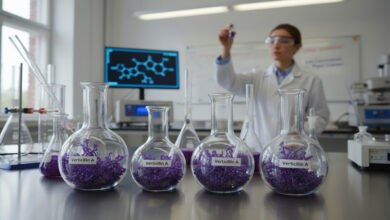
MIT Chemists Finish A 50-Year Synthesis Of Verticillin A, A Fungal Molecule Aimed At Deadly Childhood Brain Tumors



Verticillin A sat in the literature for more than 50 years as a fungal defense chemical that looked useful against cancer and too twisted to build. In December 2025 a team at MIT, working with Dana-Farber Cancer Institute and Harvard Medical School, published the first total synthesis of (+)-verticillin A in the Journal of the American Chemical Society. The molecule is no longer a scarcity problem. It is a starting material.
That is the angle. Discovery in 1970 was not the bottleneck. Supply was. Chemists could not make enough of a clean, defined compound to ask a modern biology question. Mohammad Movassaghi’s group reworked a route he had used on near-neighbors that differ by a few atoms and finally closed the last unstable rings. The AEGIS Alliance is logging a bench win, not a miracle cure. No hospital is stocking this. No trial has been announced as a standard-of-care path.
A molecule that refused to be built
Verticillin A belongs to a family of dimeric epipolythiodioxopiperazines, a sentence that means the fungus packed two nearly identical halves into one dense, sulfur-rich structure. The interesting half for oncologists is the biological activity. The interesting half for chemists is that the same sulfurs that appear to matter in cells also make the compound fall apart on a bench. For five decades the literature could describe the isolate. It could not restock it.
Movassaghi already knew the neighborhood. In 2009 his lab synthesized (+)-11,11′-dideoxyverticillin A, a cousin that differs from verticillin A by two oxygen atoms. Those two oxygens, he later told MIT News, « greatly limit the window of opportunity that you have in terms of doing chemical transformations. » They make the compound more fragile. They change the order in which bonds can be formed. « What we learned was the timing of the events is absolutely critical. We had to significantly change the order of the bond-forming events. »
The new route starts from beta-hydroxytryptophan and runs 16 steps. Alcohols, ketones, and amides go on in a sequence that protects the correct stereochemistry. A pair of carbon-sulfur bonds and a disulfide are introduced early and then masked as sulfides so the fragments can survive dimerization. After the two halves lock, the disulfides are regenerated. Walker Knauss, PhD ’24, is the lead author. Xiuqi Wang at Dana-Farber and Mariella Filbin, research director in the Pediatric Neurology-Oncology Program at Dana-Farber/Boston Children’s, are co-authors. Jun Qi, associate professor of medicine at Dana-Farber and Harvard Medical School, is co-senior author with Movassaghi. The paper is JACS 2025, 147, 50, 46430. The lab announcement is on MIT News.
What the glioma assay actually showed
Diffuse midline glioma, often still discussed under the older DIPG label when it sits in the pons, is a pediatric brain tumor with grim options. Radiation can slow it. Surgery usually cannot remove it. The histone mutation that defines many of these tumors strips a methylation mark at lysine 27 on histone H3. The MIT-Dana-Farber assays asked a narrow question: do verticillin A and designed variants cut the viability of human DMG cells, and do they restore any of that lost mark?
They did, in a dish. The parent compound and derivatives reduced viability. The paper reported increased histone lysine 27 methylation, a chromatin change those tumors often lose. The most susceptible cell lines carried high levels of EZHIP, a protein that interferes with the PRC2 methylation machinery. N-sulfonylated versions of verticillin A and of the dideoxy cousin were more stable and more interesting in the screen than the natural product itself. Movassaghi was blunt about that hierarchy: « The natural product itself is not the most potent, but it’s the natural product synthesis that brought us to a point where we can make these derivatives and study them. »
That sentence is the whole medical story so far. A mechanism sketch in cultured cells is not a survival curve in children. It is not a mouse study, though the team said animal models of pediatric brain cancers are the next planned test. It is not an IND. It is not a hospital protocol. Anyone selling verticillin A as a treatment is running ahead of the paper. The honest claim is smaller and still large: chemists can now change one atom at a time and see which change keeps the glioma signal and drops the toxicity.
Qi put the next job in laboratory language. Identifying targets will « play a critical role in further understanding their mechanism of action, and more importantly, will help optimize the compounds from the Movassaghi lab to be more target specific for novel therapy development. » The group also plans to profile lead molecules across more than 800 cancer cell lines. Funding came from the National Institute of General Medical Sciences, the Ependymoma Research Foundation, and the Curing Kids Cancer Foundation. Those names tell you who is paying for the next chapter. They do not tell you the chapter is finished.
Why synthesis is the story and hype is the risk
Natural products have always been a pharmacy with a supply problem. Taxol needed a bark and then a semi-synthesis. Penicillin needed a scale-up. Verticillin A needed a 16-step answer to a disulfide that kept destroying the route. Once that answer exists, analog chemists can work. Until it existed, biologists were stuck with whatever a fungus felt like making that season, in whatever purity a fermentation could give them.
The risk is the headline that jumps from « cells died in a dish » to « childhood brain cancer cure. » DMG families have been through that jump before. Every promising chromatin drug, every convection-enhanced delivery trial, every viral vector gets a cycle of hope and a quieter follow-up. The AEGIS Alliance science file and the overlapping health desk will treat later mouse data and any IND as the next chapter, not this one. This chapter is a bench win against a molecule that refused to be built.
There is a second risk that has nothing to do with families and everything to do with how drug stories are financed. A total synthesis can become a patent estate. Variants can become a company. None of that is misconduct. All of it can outrun the biology. Readers should watch whether the next papers still include Filbin’s pediatric oncology group or whether the molecule migrates into a slide deck about « platform potential. » The first paper earned the second paper. It did not earn a ticker symbol.
How to read the next publication
Look for animals, not adjectives. If a derivative shrinks an orthotopic DMG model without wrecking the rest of the mouse, that is news. If a paper only adds more cell lines and more enthusiastic verbs, that is a reprint. Look for a target. Qi already said the target work is the point. A compound that raises H3K27 methylation through a defined protein is a candidate. A compound that kills cells through a pile of stress pathways is a toxin with a press office.
Related coverage on this site stays in the same register: a result is a result, and a leap is a leap. Lab-stage medicine belongs next to other bench files such as the original synthesis brief and the site’s sickle-cell treatment file, not next to clinic marketing. The AEGIS Alliance will come back to verticillin A if the animal data appear. Until then the molecule is what Movassaghi said it is — accessible for the first time in fifty years, and finally available in designed variants that biology can actually test.