
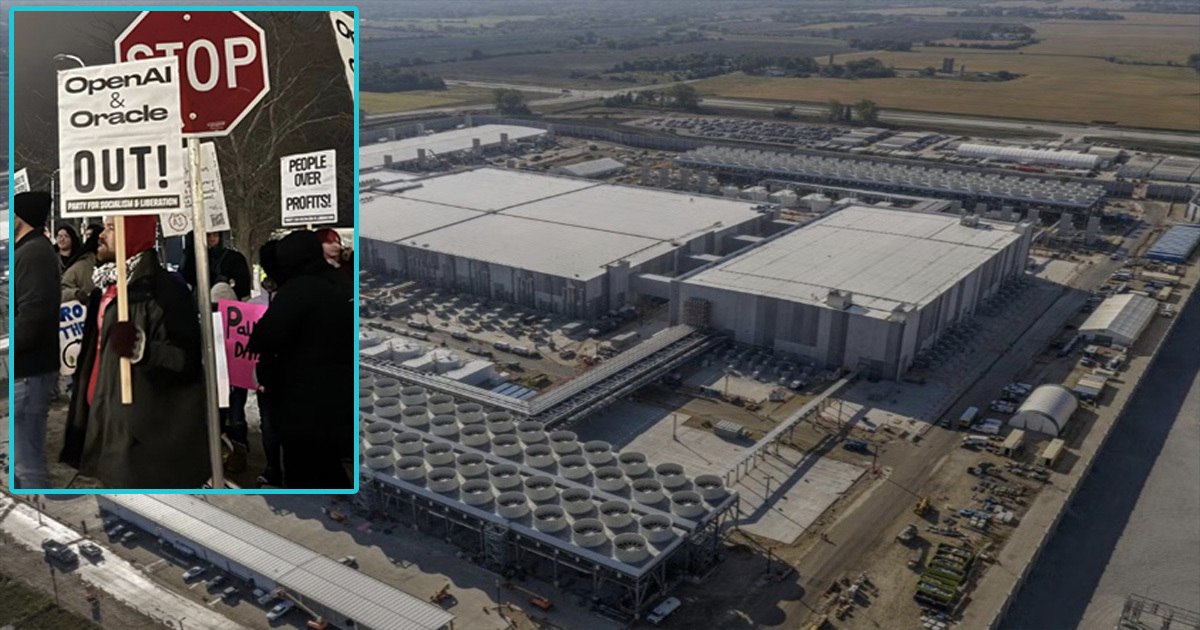
Satya Nadella called Fairwater the world’s most powerful AI data center. Garret Ostergaard called it the reason he could not sleep through third shift. Those two sentences now share a docket in the U.S. District Court for the Eastern District of Wisconsin. On July 1, 2026, Ostergaard and neighbors David Wade and Joy Wade filed Ostergaard v. Microsoft, case 2:26-cv-01169, over noise from the $7.3 billion Fairwater campus in Mount Pleasant. The three live in Sturtevant, not Mount Pleasant — a distinction local outlets had to correct — within about a mile and a half of the plant. The complaint says their houses have been physically invaded, on occasions too numerous to list, by sound from diesel generators and HVAC gear: chillers, cooling towers, air handlers, condenser fans. The proposed class covers more than 1,000 homes in that radius. Ostergaard works around Mount Pleasant’s police department and says the racket forced him off overnight hours.
Microsoft announced the first Fairwater building live in June 2026 after Nadella had already told the public in April that the Wisconsin site was going live ahead of schedule. Company materials describe a 315-acre campus, buildings spanning about 1.2 million square feet, and a cluster of NVIDIA GB200 racks pitched as a single accelerator good for 865,000 tokens a second. Investment in the project was raised to $7.3 billion in September 2025. Local reporting has Microsoft talking about additional halls on the same land, a figure that has floated as high as 15 buildings if the county keeps saying yes. Tokens per second are a vendor metric. Sleep is not. (Wisconsin Examiner, Milwaukee Journal Sentinel)
A Microsoft spokesperson told Wisconsin Public Radio the company is committed to being a good neighbor. That is the sentence every operator uses. The more useful paper is on Microsoft’s own site. An April 15 community update conceded that people north of the plant had noticed a tonal hum from cooling fans, then added that measured levels still met local ordinance. A June 18 update said engineers and consultants had tested the source and started mitigations. The lawsuit filed two weeks after the campus went live is the neighbors’ answer to those updates: meeting a dBA number is not the same as leaving a house habitable. (WPR)
The Meter Was Built for a Different Machine
Facilities-industry coverage at the end of August put a technical point under the politics. The sound neighbors describe is a low-frequency hum. A-weighted decibel monitors — the dBA boxes towns buy to enforce noise ordinances — are designed to mimic human hearing at midrange frequencies. They undercount long-wavelength noise from slow fans, compressor arrays, and large chillers. A plant can pass the ordinance and still put a pressure into bedroom walls at 2 a.m. The complaint treats that gap as negligence: Microsoft could have specified quieter cooling, built acoustic barriers, and run a monitoring plan that measured the frequencies people actually hear in their pillows. Facilities Dive noted at least a half-dozen noise suits against data centers this year, from xAI’s gas turbines in Southaven, Mississippi, to sites in Vineland, New Jersey; Dowagiac, Michigan; North Tonawanda, New York; and Hood County, Texas. None of those files has reached trial. Fairwater is early. It is not unique.
That is the part county boards skip when they hear « AI campus » and « tax base » in the same sentence. The compute crunch that led Google to cap Meta’s Gemini capacity, reported here by The AEGIS Alliance, is why these halls keep landing in townships that still think of themselves as farm-edge. The same week Fairwater’s neighbors sued, a presidential social-media post about Micron collided with a double-digit stock drop, a reminder that the chip-and-campus boom is also a political prop. Our Micron file sits next to this one for a reason. Capacity is being promised faster than the electrical grid, the water table, or the sound ordinance can absorb it.
What the Docket Did After the Press Conference
The AEGIS Alliance does not treat a class-action caption as a verdict. The Eastern District docket already shows how a vendor fights a nuisance case. Plaintiffs amended once in July. Microsoft stacked appearances in early August, including local counsel and out-of-state names. On August 6 the company asked the court for leave to preview a motion to dismiss behind a restricted executive summary. On August 14 Judge J.P. Stadtmueller told the neighbors they could file a second amended complaint by August 31 and said he would decide later whether Microsoft gets to test the pleading with a dismissal motion. That sequence is not a settlement. It is the ordinary first month of a fight about whether a hum is a legal injury.
Microsoft will argue ordinance compliance, construction-phase excuses, and the usual claim that a few sensitive ears do not represent a thousand houses. Plaintiffs will argue invasion of property, lost sleep, and a drop in what a Sturtevant lot is worth once a cooling plant is the horizon. Discovery will decide whether the company’s own April admission about a tonal hum is a gift to the class or just a public-relations paragraph. Until then, the useful fact is simpler. The world’s most powerful AI data center, as the vendor phrased it, cannot contain its own fans.
Ostergaard’s shift change is the detail that will travel. Juries understand a person who cannot sleep. They are less moved by token throughput. If he was already taking noise calls as someone who works around the local police department, the company will have a harder time painting the plaintiffs as people who moved next to a factory and then discovered factories make sound. The Wades’ presence as a household inside the same radius is how class counsel will try to show the problem is not one insomniac. More than 1,000 homes is the number that turns three named plaintiffs into a case Microsoft cannot settle with landscaping. The complaint also seeks injunctive relief above the federal class-action dollars threshold, which is another way of saying the neighbors want the fans quieter, not just a check.
The Human Unit of Measure
Closed-loop cooling and « seamless clusters » are the language Microsoft uses in investor materials. Acoustic walls, low-noise fans, and a monitoring network that records infrasound are the language a nuisance complaint uses. Those two vocabularies are not in conflict as engineering. They are in conflict as cost. A barrier that keeps 60 hertz out of a bedroom is cheaper than a jury, and more expensive than a press release about being a good neighbor. The complaint’s theory is that Microsoft chose the press release.
Mount Pleasant’s bargain was familiar. A county trades quiet and some water for construction jobs, utility payments, and the prestige of hosting a campus with the chief executive’s name on the announcement. The first building is live. The rest of the site is still a drawing. If the drawing really does contain a string of additional halls, the July 1 complaint is a preview, not a capstone. Every extra cooling tower is another source. Every extra generator test is another night. A plant that already hums at ordinance-legal levels will not hum less when it triples.
AI infrastructure coverage likes megawatts, acres, and model names. Nuisance law uses a different unit: whether a person can stay in the house they already paid for. Fairwater forces those units into the same paragraph. Nadella’s April note that the site was going live ahead of schedule reads differently once the neighbors’ July filing is on the table. Ahead of schedule for whom. The cluster came up. The barriers, on the plaintiffs’ telling, did not. The AEGIS Alliance will follow whether local ordinance text and Microsoft’s mitigation memos produce a settlement, a class-certification fight, or a trial about whether a dBA meter is allowed to erase a hum. Related files live on our technology and U.S. news desks.
Tokens per second will keep rising. That is the business. The question Fairwater puts to every board that has a similar packet in front of it is whether the people inside a mile and a half are part of the design or an externality to be managed after opening day. Ostergaard already answered that question with a shift change. The amended complaints are the rest of the neighborhood trying to answer it on paper before the next hall pours concrete.