
Tomorrow Bio Tests a Warmer Whole-Body Tank in Switzerland While Hundreds of Legally Dead Patients Stay in Liquid Nitrogen

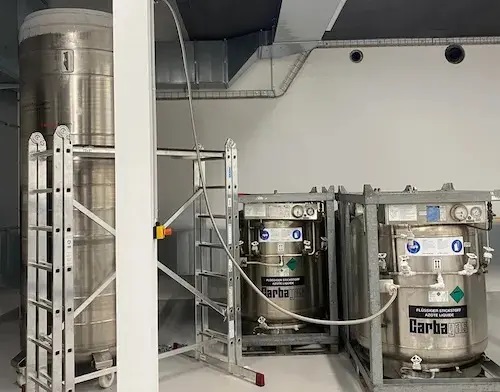
On September 7, 2026, a Berlin company invited the public to watch a tank. Tomorrow.Bio, the cryonics firm that cools legally dead patients toward liquid-nitrogen temperatures and stores them in Switzerland, said a human-sized intermediate-temperature unit had arrived the month before at the European Biostasis Foundation in Rafz. Intermediate temperature storage, or ITS, is meant to hold a vitrified body near -140°C (-220°F) instead of immersing it in liquid nitrogen at about -196°C (-320°F). The company said the unit was in commissioning and long-duration testing, not yet routine patient service, and that it was opening a waiting list. No one on that livestream claimed a person had been brought back.
That distinction is the entire business. A handful of private organizations will, for a six-figure fee, take a body after a physician has declared legal death, replace blood with a cryoprotectant, cool the tissue until it becomes glass-like rather than icy, and keep the patient in a dewar for as long as the organization can pay the nitrogen bill. The pitch is that a future laboratory might repair whatever killed the person. Tomorrow.Bio’s own Biostasis Codex, updated in August 2026 under the byline of co-founder Fernando Azevedo Pinheiro, states the opposite of a miracle brochure: human revival is impossible today because no one can safely rewarm, repair, and restore a cryopreserved person. Co-founder Dr. Emil Kendziorra has written the same caution. Preservation, in their words, keeps open a door that burial and cremation close. It does not walk anyone through it.
A company comparison Tomorrow.Bio published on September 26, 2026, put rough patient counts on that door. Alcor Life Extension Foundation, which performed its first human case in 1976, was caring for about 263 people. The Cryonics Institute, which began in 1977, was caring for about 280. Tomorrow.Bio, which only started human cases in 2023, was listed at about 30. China’s Yinfeng group sat near 20. Australia’s Southern Cryonics, opened in 2023, held 7. Membership, meaning living people who have signed up to be stored later, told a different story: the Cryonics Institute near 2,040, Alcor near 1,535, Tomorrow.Bio past 1,000, Yinfeng near 300, Southern Cryonics near 80. More than 500 human patients worldwide are in cryogenic storage. The number who have been revived is zero.
What the fee actually purchases
A January 2025 BBC Future profile put Tomorrow.Bio’s whole-body price near $200,000. Alcor, based in Scottsdale, Arizona, has long posted neuropreservation, meaning the head, near $80,000 and whole-body preservation near $220,000, plus age-based dues. The Cryonics Institute in Clinton Township, Michigan, has sold a cheaper whole-body package and accumulated the largest living membership. Customers commonly assign a life-insurance policy so the death benefit covers the procedure and a slice of indefinite storage. Monthly dues sit on top. In May 2025 Tomorrow.Bio raised about €5 million and talked about U.S. standby in New York, California, and Florida, coverage it had opened in July 2024. Contracts measured in the hundreds of millions of euros are a sales milestone. They are not a clinical result.
The procedure is a race against the minutes after legal death. A standby team tries to restore circulation with a mechanical chest compressor, drop the temperature with ice, and replace blood with an organ-preservation solution. At a facility, or in Tomorrow.Bio’s case sometimes inside a retrofitted ambulance, technicians perfuse a cryoprotectant intended to limit ice crystals. The goal is vitrification. The body, or only the brain, is then cooled slowly through the glass-transition range so the solid does not crack, and parked in a vacuum-insulated tank. Liquid nitrogen has to be topped up for decades. If the organization fails, the physics does not pause out of courtesy.
ITS is an attempt to change the parking space, not the patient. Alcor has used intermediate-temperature dewars for neuropatients since it received a 14-patient unit in 2008. Whole-body scale is newer and harder. Advocates argue that holding tissue near -140°C, still far below the glass transition, might reduce fracturing compared with a plunge to -196°C. Skeptics note that liquid-nitrogen immersion is crude, passive, and hard to break: if the power fails, the nitrogen still sits there until it boils off. An actively managed warmer tank has more ways to fail. Tomorrow.Bio has been explicit that the Swiss unit is a test article. A test article is not a revival protocol.

The science that moved, and the science that did not
Real laboratory work keeps getting borrowed by the brochure. In 2023, University of Minnesota researchers reported in Nature Communications that they vitrified rat kidneys, stored them for up to 100 days, rewarmed them with magnetic nanoparticles, washed the particles out, and transplanted the organs into rats that then survived on those kidneys. In March 2026, Alexander German and colleagues at the University of Erlangen-Nuremberg reported in PNAS that they had recovered function in adult mouse hippocampus after vitrification. A slice of mouse brain that can show electrical activity again is a serious cryobiology result. It is not a person with a name, a mortgage, and a memory of their own kitchen.
Tomorrow.Bio has said it CT-scans cases at cryogenic temperature to see whether cryoprotectant reached the brain or whether ice remains. That is a quality-control habit other providers have been slower to publish. Kendziorra’s 2026 research plan talked about blood-brain-barrier modifiers to reduce the brain shrinkage seen in low-ischemia cases, and about publishing the first ultrastructure results from microsamples members had consented to. Measuring damage more honestly does not erase it. Ice, toxicity, shrinkage, cracking on rewarm, and the disease that caused legal death are separate locks. A company that admits the locks is more trustworthy than one that sells a wake-up year. It is still selling a wager.
Alcor’s famous patients do advertising that a startup cannot buy. Baseball star Ted Williams and Bitcoin pioneer Hal Finney are in its historical roster. Families have sued over whether a relative’s head should be separated from a body, and critics ask who pays if a trust runs dry. Advocates answer that identity lives in the connectome, the physical map of synapses, and that a well-vitrified brain is a hard drive waiting for a reader that has not been built. Robert A. Freitas Jr.’s Cryostasis Revival, hosted by Alcor, is a nanomedicine thought experiment about what repair would require. Thought experiments do not staff a clinic.
A prepaid warehouse, not a treatment
People who sign these contracts are not enrolling in a proven therapy. Some have a terminal diagnosis and want a last long shot. Most of Tomorrow.Bio’s members, the company has said, sign up with no diagnosis at all. Some are pet owners. The firm has stored companion animals in the same Swiss building as human patients. A frozen cat and a frozen engineer are held by the same temperature. Neither has a published path back to a Tuesday morning.
Geography decides how much brain is left to cool. Every minute after circulation stops is ischemic injury. Standby maps are marketing, and they are also an admission that a death far from a crew is a worse case than a death in a contracted city. Legal death is the on-ramp because, in ordinary jurisdictions, a cryonics team cannot start before a physician says the person is dead. The original cause of death comes along for the ride. A future clinic could refuse a patient whose illness is still fatal. A spouse may be gone. A patient-care fund may have been eaten by inflation or a lawsuit. Ethicists are right to ask who the returned person would be. Cryonics literature tends to wave at nanomedicine as if it were on a shelf. It is not.
The nearer scientific cousin is organ banking, not resurrection. Transplant waiting lists are a measurable crisis, which is why university labs chase vitrified kidneys and hearts. Cryonics companies borrow that language and stretch it across an entire life. Readers tracking medical long shots can compare the difference in The AEGIS Alliance santé et sciences files, including a patient who left a hospital with a titanium heart and a lab result in which light was reported as a supersolid. Those are bounded claims. Cryonics is a bounded claim only if the brochure stops at the tank.
Market notes have valued cryonics technology in the low hundreds of millions and drawn growth lines toward the mid-2030s. Those lines assume paying members, not working reanimation. The pattern will look familiar on The AEGIS Alliance technology desk, where a hypothesis hardens into a checkout page faster than the evidence. Speculation can be interesting. It should not be priced like surgery.
The September 2026 inventory is still steel, nitrogen, and a newer tank that has not yet taken a routine patient. Membership lists are growing faster than revival science. Anyone writing a check near $200,000 is paying for a protocol, a storage plan, and a hope that a later century both can and will finish a job this one has not started. That is a legitimate thing to want. It is not a guarantee, and the companies that say so plainly are describing the product more accurately than the headline that promises reanimation.







Green burial. No toxic, embalming fluid, no metal coffin or concrete vault. Natural, back to the earth.
upload your brain to a cloud more likely to succed than freeze after death cos they just freezing a dead husk whatever was you gone somewhere else