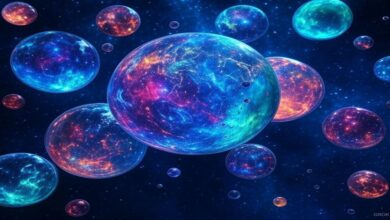


On December 27, 2018, five theorists at Uppsala University published a picture of the cosmos that sounds like a pub argument and is, on the page, a string-theory construction. Souvik Banerjee, Ulf Danielsson, Giuseppe Dibitetto, Suvendu Giri, and Marjorie Schillo argued in Physical Review Letters that a universe with the right kind of acceleration can sit on the skin of a bubble expanding through an extra dimension. 大学的新闻通告 put their claim in one paragraph: the whole universe is accommodated on the edge of this expanding bubble, and all existing matter corresponds to the ends of strings that reach into the extra dimension. They also showed that bubbles of this kind can form inside string theory, and that more than one bubble is conceivable. Other bubbles would be other universes.
The paper’s actual title is less poetic than the headline that traveled. It is “Emergent de Sitter Cosmology from Decaying Anti-de Sitter Space,” Physical Review Letters 121, 261301. The problem they were poking is real. For a quarter century, astronomers have measured an expansion that speeds up. The standard fix is a cosmological constant, denoted lambda, a dark energy that is the same everywhere and the same in every era. String theory has an awkward time producing a stable universe with a positive cosmological constant. A bubble wall riding an extra dimension was one way to get the acceleration without pretending the constant had been sitting there, perfectly tuned, since the first fraction of a second.

That is a model, not a photograph. Nobody has taken a picture of the extra dimension. The useful question is whether the expansion itself is simple enough for a constant to explain, or whether the push changes with time. If dark energy is a true constant, the bubble story is one optional origin tale among several. If dark energy weakens, or strengthens, the constant is the thing that has to go, and every origin tale, including Uppsala’s, has to be rebuilt around a force that evolves.
The Dark Energy Spectroscopic Instrument, mounted on the Nicholas U. Mayall 4-meter telescope at Kitt Peak in Arizona, was built for that test. It can take spectra of thousands of galaxies and quasars in a single pointing and turn those redshifts into a three-dimensional map. In March 2025 the collaboration put out its largest public map yet and said the combined measurements preferred a dark energy that changes. Michael Levi, a cosmologist at Lawrence Berkeley National Laboratory and DESI’s director, told 纽约时报,"这比现在的暗示要多一点". 他添加了"除非暗能量进化——那么,男孩,所有的鸭子排成一行"的一行.
The March 2025 release was not a discovery in the strict sense physicists use that word. DESI by itself did not throw out the standard model. The tension showed up when the map was read together with the cosmic microwave background, supernovae, and weak lensing. The usual five-sigma bar for a discovery was not cleared. What the map did was make a constant look slightly worse than a version of dark energy that was stronger in the past and is milder now.
By late summer 2026 the story had grown a second chapter, and it cuts against anyone who wants a headline that the constant is already dead. A July 30, 2026, full-shape analysis of the Lyman-alpha forest, the hydrogen absorption pattern in quasar light, tightened that particular probe and shifted its central value back toward a constant cosmological constant. The collaboration’s own reading, as carried in the specialist press, was that the evolving-dark-energy hint might fade, or that a more complicated model might be needed to hold every probe at once. A separate 2026 joint analysis that combined DESI’s first-year clustering shape with its three-year baryon-acoustic measurements pulled the disagreement with the standard model down to about 1.4 sigma. The Dark Energy Survey’s Year 6 galaxy-clustering and weak-lensing results, circulated as a preprint in 2026, found no significant preference for a universe with a free dark-energy equation of state over plain lambda. Supernova compilations still lean the other way. A 2026 union of exploding stars, discussed by Tamara Davis and colleagues, still saw a departure from a perfectly fixed dark energy, in a slightly different direction from the 2024 supernova hint, and the authors described the combined preference as interesting and short of proof.

That is what a live measurement looks like. It does not march in one direction for the convenience of a theory. Uppsala’s bubble was offered as a way to get acceleration out of string theory. If the acceleration is not constant, the bubble has to accelerate differently at different times, or it stops being an explanation and becomes a sketch. A September 2026 preprint tried one alternative route, arguing that a “gravitational susceptibility” dip in a modified-gravity model can imitate the phantom crossing that DESI’s simpler two-parameter fit prefers, near a redshift of about 0.4. The point of citing it is not that the preprint is right. The point is that the data are now specific enough for people to fight over the shape of the curve, not over whether the universe expands at all.
Two other “bubbles” get dragged into this conversation and do not belong there. The Local Bubble is a cavity of thin, hot gas around the solar system, blown by supernovae, a few hundred light-years across. Theo O’Neill, then an undergraduate at the University of Virginia, 绘制了磁壳的三维图. It is a superb piece of local astrophysics. It is not an extra dimension, and it is not evidence that neighboring universes are pressed against ours. Quipu, a galactic superstructure reported in 2025 and stretching on the order of 1.3 billion light-years, is a tangle of clusters inside this universe. Size is not a portal.
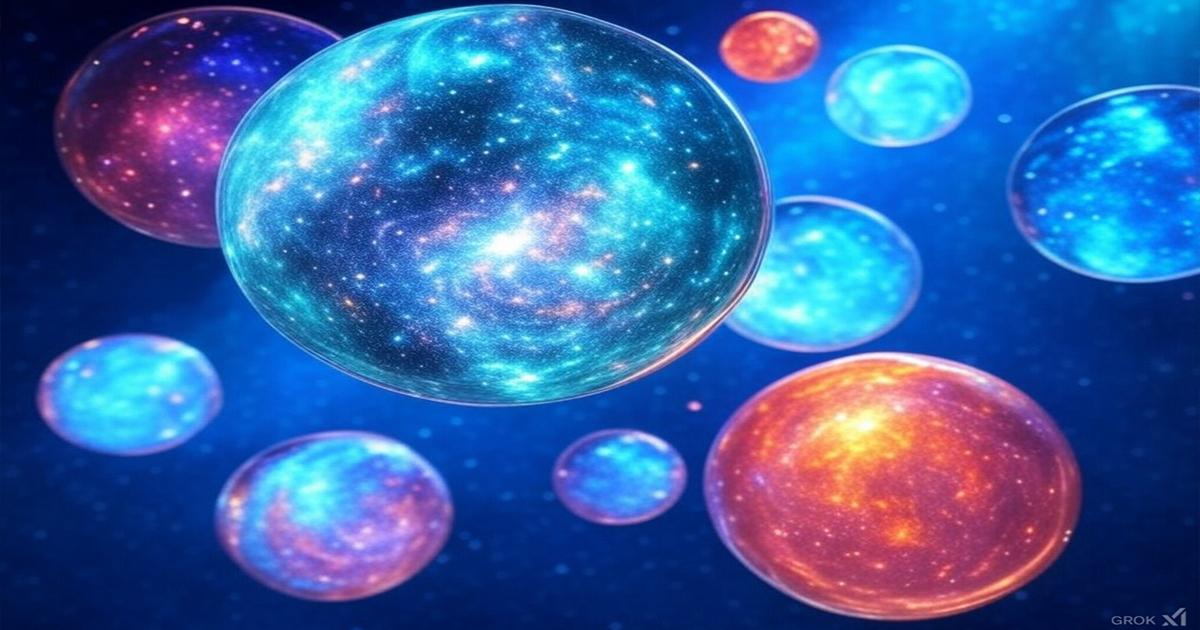
Higher dimensions remain a premise, not a finding. Lisa Randall and other theorists have spent years showing how extra dimensions can hide: curled up too small to probe, or warped so that gravity leaks in a way we have not yet caught in a collider. The anthropic move, which says we live in the rare bubble whose constants allow stars and chemistry, explains the fine-tuning by declaring most bubbles uninhabitable. It also explains almost anything, which is why working cosmologists prefer a number they can remeasure. SPHEREx, NASA’s infrared surveyor launched in March 2025, was built to map the whole sky in 102 near-infrared colors and to reconstruct how structure grew in the first billion years. That is the era when inflation, if it happened in the way bubble models imagine, would have pinched separate regions off from one another. The telescope does not need to “see” another universe. It needs to say whether our expansion history is smooth enough to keep lambda, or jagged enough to retire it.
The AEGIS Alliance’s reading is narrower than the poster version of this idea. We are not living inside a proven multiverse. We are living inside a measurement argument. Uppsala supplied a mechanism that makes acceleration less magical inside string theory. DESI supplied a map that, for a year, made a constant look slightly tired, and then supplied a second probe that tugged part of the evidence back. The fate of the cosmos, freeze or crunch or something less cinematic, waits on which way the next data release leans. Until that release, the bubble is a serious model with a drawing of strings on its edge, and the edge is exactly where the argument sits.
赞助联盟的相关报告包括: 关于意识是否被活化为宇宙的争论, 与暗能量无关,则 将光变成具有超固体特性的东西桌子的其余部分在 科学新闻.






这种思想一直被印度教所包围,为百夫长. 毗湿奴与因缘海.