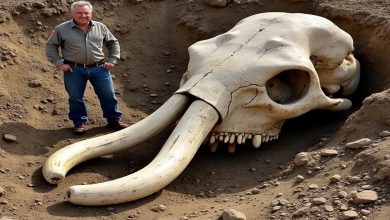

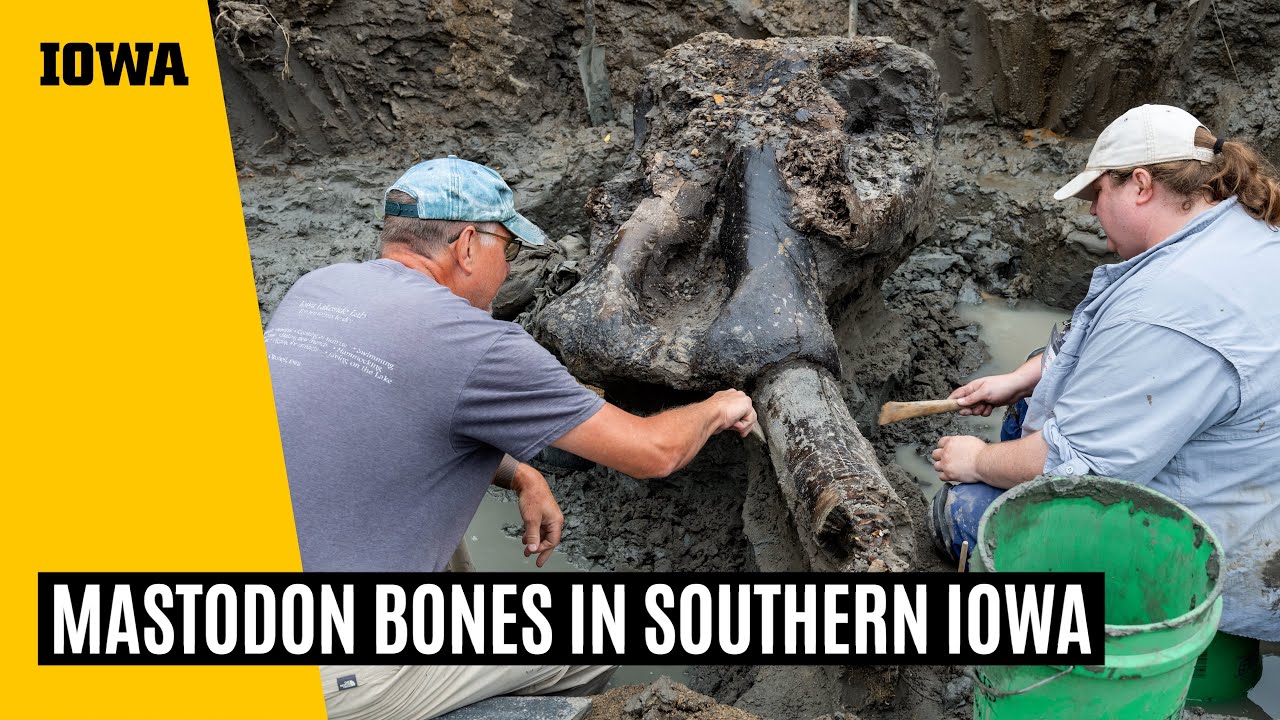
多莉不是石头 看起来像头骨。 她还是骨骼,大约13600岁,她回到了一个邻居在小溪中注意到股骨的县.
University of Iowa archaeologists finished a twelve-day excavation in August 2024 on private land in southwest Wayne County and pulled the first well-preserved mastodon skull ever scientifically dug in the state. Locals had found bone in the fall of 2022. Radiocarbon dating put the animal at about 13,600 years. The crew nicknamed her Dolly. 非洲地理信息系统1,1,3 is writing this as a homecoming, not as another “giant head in the mud” recap. By September 25, 2026, Radio Iowa could say the skeleton was back in Wayne County. Prairie Trails Museum in Corydon scheduled a ribbon cutting for noon on Saturday, September 26. Two years of conservation sat between the creek bank and that door.
还是骨头,这就是为什么实验室花了这么久
State archaeologist John Doershuk, who directs the Office of the State Archaeologist, told Radio Iowa that his team had spent two years strengthening the skeleton so a museum could hold it. “This is the most complete mastodon skeleton we have from Iowa,” he said. Surrounding states have more remains. He also said large parts of Iowa have never been looked at with this kind of attention, and that more finds of this scale are plausible. The age is young in archaeological time. Young enough, Radio Iowa noted, that Dolly is not a fossil in the popular sense. The bone has not been replaced by mineral. It is still bone, fragile once it leaves cold, wet clay, and strong enough for a case only after a preparator has fought the clay for months.
Museum director Brenda DeVore was at the dig. “I remember all the clay and getting it up out of the ground,” she told Radio Iowa. “It’s been a two year process. Time has gone pretty fast. I’m excited it’s coming back to Wayne County.” That is the right ending for a county find. The bones leave for analysis and come home as an exhibit instead of disappearing into a campus basement. Iowa Public Radio’s Talk of Iowa, broadcast September 24, 2026, walked through the same handoff with Doershuk, fossil-preparator consultant Mike Eklund, DeVore, and lead preparator Will Sprengelmeyer, a University of Iowa junior in environmental bioscience. The episode’s frame was blunt: digging the skull out was hard, and keeping waterlogged bone from warping was harder.
一个股骨,一个安静的挖掘, 一个与工具不匹配的日期
Doershuk got the original call after a Wayne County resident heard about an unusually long bone in a creek bed. That bone was a femur. Staff from the Office of the State Archaeologist checked the site in 2023 and came back in August 2024 with a small team and community volunteers. They kept the operation quiet. Fossil sites on private land do not improve when strangers arrive with shovels. The 艾奥瓦大学新闻室 包括一个近乎完整的头骨、来自同一种动物的其他骨头、可能附着的断牙和人造石器。
Mastodons are not mammoths. Mammoths were grassland specialists with high-crowned teeth. Mastodons browsed woods and carried lumpy molars built for twigs and leaves. They lived in North America from roughly 3.5 million years ago until about 10,500 years ago. A 13,600-year date sits inside the window when ancestral Native hunters were already on this landscape. That overlap is why Doershuk talked about cut marks before the first plaster jacket left the bank. “We’re really hoping to find evidence of human interaction with this creature, perhaps the projectile points and knives that were used to kill the animal and do initial butchering,” he said in 2024. “There’s also potential evidence on the bones themselves. There could be identifiable cut marks.”
The honest result is a mismatch, not a hunt scene. Iowa Public Radio reported in February 2025 that conservators had not found clear tool damage on Dolly’s bones. The stone tools from the same excavation dated a few thousand years later than the animal. People used that creek long after the mastodon died. That does not prove they killed her. The AEGIS Alliance would rather keep the negative result than force a spear into a skull that has not shown one. A scientifically excavated, well-preserved skull with a field context and a radiocarbon number was already rare in Iowa. Older collections have scraps. They did not have this.
学生、粘土和扫描可以打开电话
The twelve-day dig was the photograph. The year after it was the reason the photograph still has a subject. In 2025, undergraduates Maya Monk and Mary Haag spent hours on what Haag called “reverse painting,” lifting matrix off bone without taking the bone with it. Monk worked as a research fellow on material still packed against the skull. 爱荷华州的故事 documented that labor in April 2025. Another line of student work built a 3D scan. The University of Iowa Paleontology Repository posted a Sketchfab model so a person who will never stand in Corydon can rotate the skull. The repository’s own notes also point to a July 2026 record of how the crew flipped the skull, which is the unglamorous physics of an object that can crack under its own weight.
Clay holds a shape in a bank and tries to warp bone once the humidity changes. Students who treat that clay as the enemy are doing the same job as any fossil lab, with a state archaeologist down the hall and a county museum on the calendar. Volunteers had already built a wooden frame to carry the fragile skull to Iowa City. Context is the difference between a trophy and a record. Crews photographed bone orientation before they moved anything. The creek stays unnamed on purpose. A posted pin is how the next femur becomes a living-room sale.
剪丝带不能证明什么
It does not prove a specific hunting party killed Dolly. It does not prove Iowa’s first people stood on that exact bank. It does prove that a late Pleistocene mastodon died in a landscape people later used, and that a rural county still has ice-age bone in its creeks if someone knows how to see it. Landowners who call the state archaeologist instead of posting a location are the reason this skull has coordinates in a notebook. Doershuk told local television in 2024 that by about 13,000 years ago the region would have been a workable place for hunter-gatherers: ice off the land, game moving through river corridors. Dolly is a dated point on that map. She is also a teaching object. A child in Corydon can see the difference between a browser and a grazer without a paragraph about cusp patterns.
欲让地球科学邻居访问此文件的读者可以从AEGIS联盟的作品开始 地球深处的两个巨型结构下页 常规 和 美国新闻. Dolly is not a controversy specimen. She is a dated skull with a student crew, a consultant preparator, a museum director who helped lift her out of the clay, and a public scan. Wayne County gets the exhibit. Iowa City keeps the analysis. The ribbon at Prairie Trails Museum was the county’s receipt for a bone that refused to turn to stone.