NASA’s Psyche Laser Sent 13.6 Terabits From Deep Space, Then Mars Flung the Spacecraft Toward a Metal Asteroid

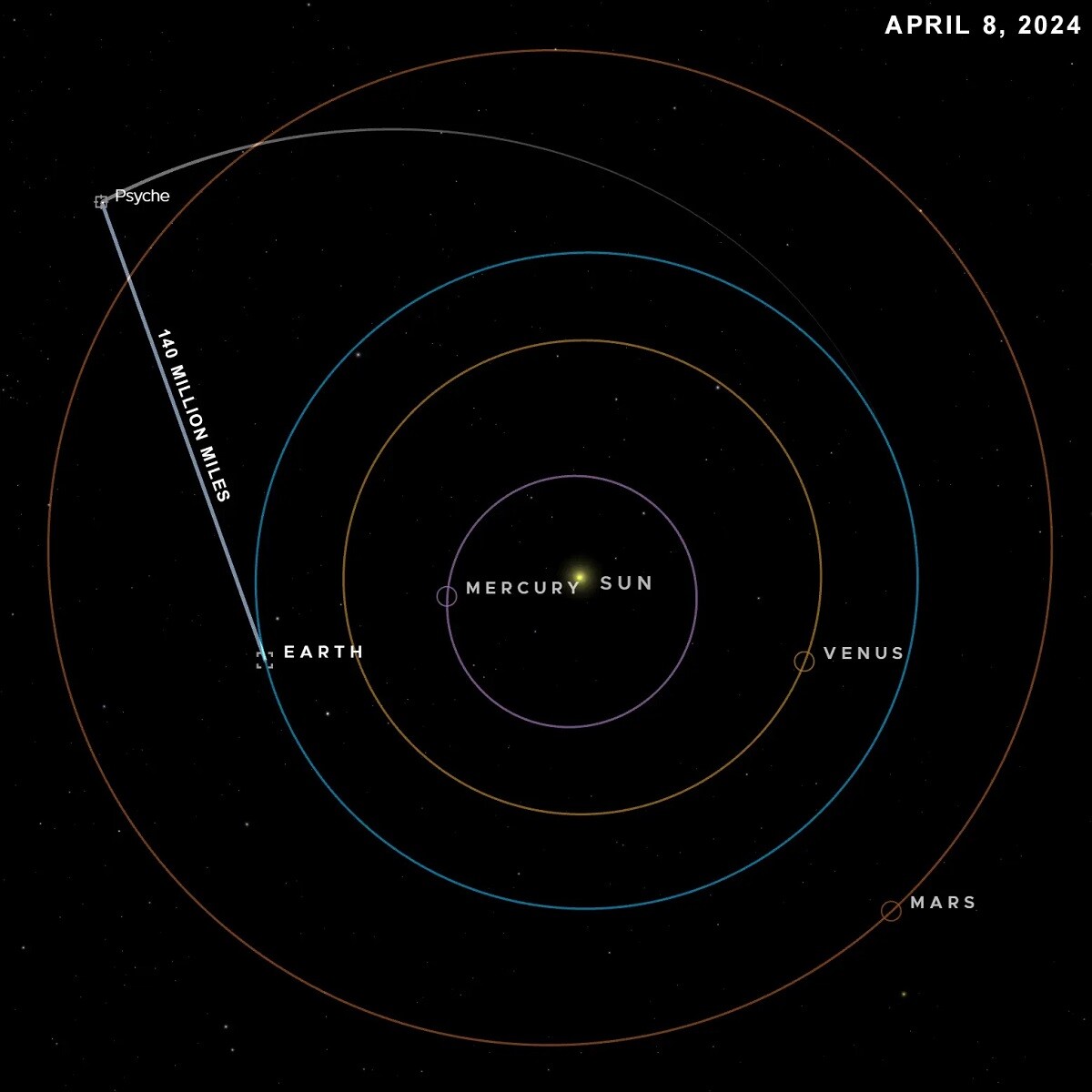
Le 8 avril 2024, un laser infrarouge proche a quitté le vaisseau spatial Psyché de la NASA d'environ 140 millions de kilomètres, une fois et demie la distance entre la Terre et le Soleil, et les photons atterri. L'instrument d'envoi était Deep Space Optical Communications, DSOC, une démonstration technologique boulonnée à une sonde dont le vrai travail est un astéroïde métallique. La radio transporte des données spatiales depuis soixante ans. Un laser est un rayon plus serré, plus facile à perdre, et, quand il se verrouille, assez vite pour qu'un futur équipage sur Mars puisse envoyer de la vidéo au lieu d'une goutte d'immobiles. Cette réussite d'avril a déplacé les données d'essai jusqu'à 25 mégabits par seconde. Pour garder la comparaison honnête, Psyché a également envoyé une copie des mêmes données techniques sur sa radio ordinaire, de sorte que les deux tuyaux pourraient être notés côte à côte.
« This achievement showcases our commitment to advancing optical communications as a key element to meeting our future data transmission needs, » then-Administrator Bill Nelson said at the time. Dr. Abi Biswas, DSOC’s project technologist at the Jet Propulsion Laboratory, put it in mission language. The experiment was there to pave a road for Artemis and, later, for people on Mars. The road turned out to be shorter than the spacecraft’s cruise, and longer than anyone’s skepticism. DSOC flew on Psyche from launch on October 13, 2023, worked past every goal the project had written down, and was switched off as a demonstration on September 2, 2025. The spacecraft kept going. In May 2026 it used Mars itself as a slingshot. The confirmation that the slingshot had worked came the old way, by radio.
A Cat, Then a Record Past Mars
La pièce du DSOC est arrivée tôt. Le 11 décembre 2023, l'émetteur laser de vol a diffusé une vidéo de 15 secondes ultra haute définition d'un tabby orange nommé Taters à la poursuite d'un pointeur laser. Taters vit avec un employé de JPL. Le fichier avait été chargé avant le lancement. Il a laissé l'engin spatial d'environ 19 millions de miles, environ 80 fois la distance de la Lune, au maximum de 267 mégabits par seconde, un taux de haut débit domestique, et a pris 101 secondes pour atteindre le télescope de hale de l'observatoire palomar de caltech dans le comté de San Diego. Le lien vers le bas de cette passe a été décodé en temps réel. L'équipe de projet de JPL a vu une vidéo de chat arriver de l'espace profond et l'a traitée correctement comme un résultat d'ingénierie.
The distances after that stopped being a stunt. In the summer of 2024 DSOC held a link from around 240 million miles and then from nearly 290 million miles, about as far as Mars ever gets from Earth. On December 3, 2024, it downlinked Psyche data from about 307 million miles, 494 million kilometers, farther than the average Earth-Mars gap and a record for optical communications. Peak rates told the same story in reverse. Nearer in, the ground laser receiver saw 267 megabits per second. Out around 249 million miles the downlink was still 8.3 megabits per second at the peak, with a sustained rate of 6.25. That is the number that matters for a Mars mission at its farthest, not the cat video at its closest. Over the two-year prime experiment the ground terminals took in 13.6 terabits. The flight terminal pointed with microradian accuracy. The kilowatt-class uplink lasers at JPL’s Table Mountain facility near Wrightwood, California, did it without lighting up an aircraft or a satellite by accident. A superconducting nanowire detector array caught photons that had crossed a large piece of the inner solar system.

NASA closed the books on September 2, 2025, with a 65th and final pass. The spacecraft was 218 million miles out, about 2.34 astronomical units. Acting Administrator Sean Duffy said the demo had put high-definition video from Mars inside the realm of hardware rather than slogans. Biswas was more cautious about a sequel. Redundant radios on Psyche made another laser pass unnecessary for the mission itself. There was no approved plan to turn DSOC back on. The earliest window anyone was willing to name, if a sponsor found the money, was late summer or early fall of 2026, after Psyche’s Mars flyby. That window has now arrived. Public updates from NASA after the flyby describe a healthy spacecraft, a good trajectory, and a return to solar-electric thrusting. They do not describe a laser link switched back on.
Mars as a Dress Rehearsal, Radio as the Witness
On May 15, 2026, Psyche passed 2,864 miles above the Martian surface, 4,609 kilometers, high enough to miss the atmosphere and low enough for gravity to matter. Navigators at JPL had set the aim point so Mars would hand the probe about 1,000 miles per hour and tilt its orbital plane by about a degree relative to the Sun, with no propellant spent on the turn. Don Han, the navigation lead, said the Doppler from NASA’s Deep Space Network, watched in real time, confirmed the boost. Bob Mase, Psyche’s project manager, said the spacecraft was on the path it needed for a rendezvous with asteroid 16 Psyche in the summer of 2029, with orbital insertion targeted for August. Sustained thrusting on the solar-electric engines, the Hall thrusters that sip power from the arrays and accumulate speed slowly, was set to resume later in the fall of 2026.
The flyby was also a dress rehearsal. The team pointed the science instruments at a planet they already know so they could trust those instruments at a world they do not. The multispectral imager, a pair of cameras, returned a crescent Mars on approach at about 5:03 a.m. Pacific on May 15, then a fuller disk after closest approach, including the double-ring crater Huygens in the southern highlands. A time-lapse stitched from the month of approach, pass, and departure became the public face of the encounter. The gamma-ray and neutron spectrometer and the magnetometer were exercised against Martian ground truth. NASA’s account of the flyby said the instruments behaved as designed and added a few measurements from a geometry other orbiters do not have. No one expected a new Mars. They needed a calibrated spacecraft.

The irony is the useful one. DSOC was built because radio is too thin for the data a human Mars mission will want to send home. The maneuver that actually bent Psyche’s path in 2026 was verified by that same radio, the Deep Space Network doing what it has done since the 1960s. Laser communications did not fail. They finished a demonstration, exceeded it, and then sat dark while the probe they rode on kept using the older pipe. JPL lists DSOC’s status as past. A July 2026 engineering write-up of the ground laser terminal said the same thing in more technical language: the two-year campaign showed optical links can support Mars and beyond, and turning a demo into an operational system is a different job, still ahead.
The Asteroid at the End of the Cruise
Sixteen Psyche, the destination, is a large body in the main belt between Mars and Jupiter, and the reason the mission exists. If it is the stripped core of a planetesimal, an early planetary building block, it is the closest thing NASA can orbit to the metal under our own feet. The spacecraft will map it, read its composition with the spectrometer, and measure any magnetic field. Arrival in August 2029 is the science. Everything before that, including a cat video and a gravity assist, is the getting there. Other countries are not waiting. In August 2026 Chinese researchers reported a two-way laser link across the Earth-Moon distance, on the order of 248,000 miles, with a downlink around 100 megabits per second. That is cislunar, not deep space. It is still a sign that the radio era’s monopoly is being contested from more than one flag.
The AEGIS Alliance has covered the other half of this problem, which is not speed but bookkeeping. A faster downlink does not help if you have lost track of what is already up there. The Space Force’s reacquisition of a Cold War balloon satellite that had been missing for 25 years is that catalog, in one object. The military’s own laser work showed up again when the X-37B went back up with a laser-communications test after a 434-day flight. And the question of what anyone would eat at the far end of a high-bandwidth link is still the one in the Wageningen study of crops in fake Martian dirt, where a tomato doubled and a carrot lost. Bandwidth does not grow food. It does decide whether the people eating it can show Earth what they are doing in something better than a postcard.
Psyche’s laser has already answered the question Nelson posed in April 2024. The photons arrived, the cat arrived, the record distance arrived, and 13.6 terabits of proof are on the ground. What has not arrived is a program that treats that result as the new default instead of a finished experiment. The spacecraft is healthy, the Mars pictures are in, and the metal world is three years out. The radio will carry the cruise. The laser is the part NASA has not yet decided to need again.
More of this beat is on The AEGIS Alliance’s Sciences bureau.