TikTok Went Dark in the United States and Showed What a Sale-or-Ban Law Does to a Phone


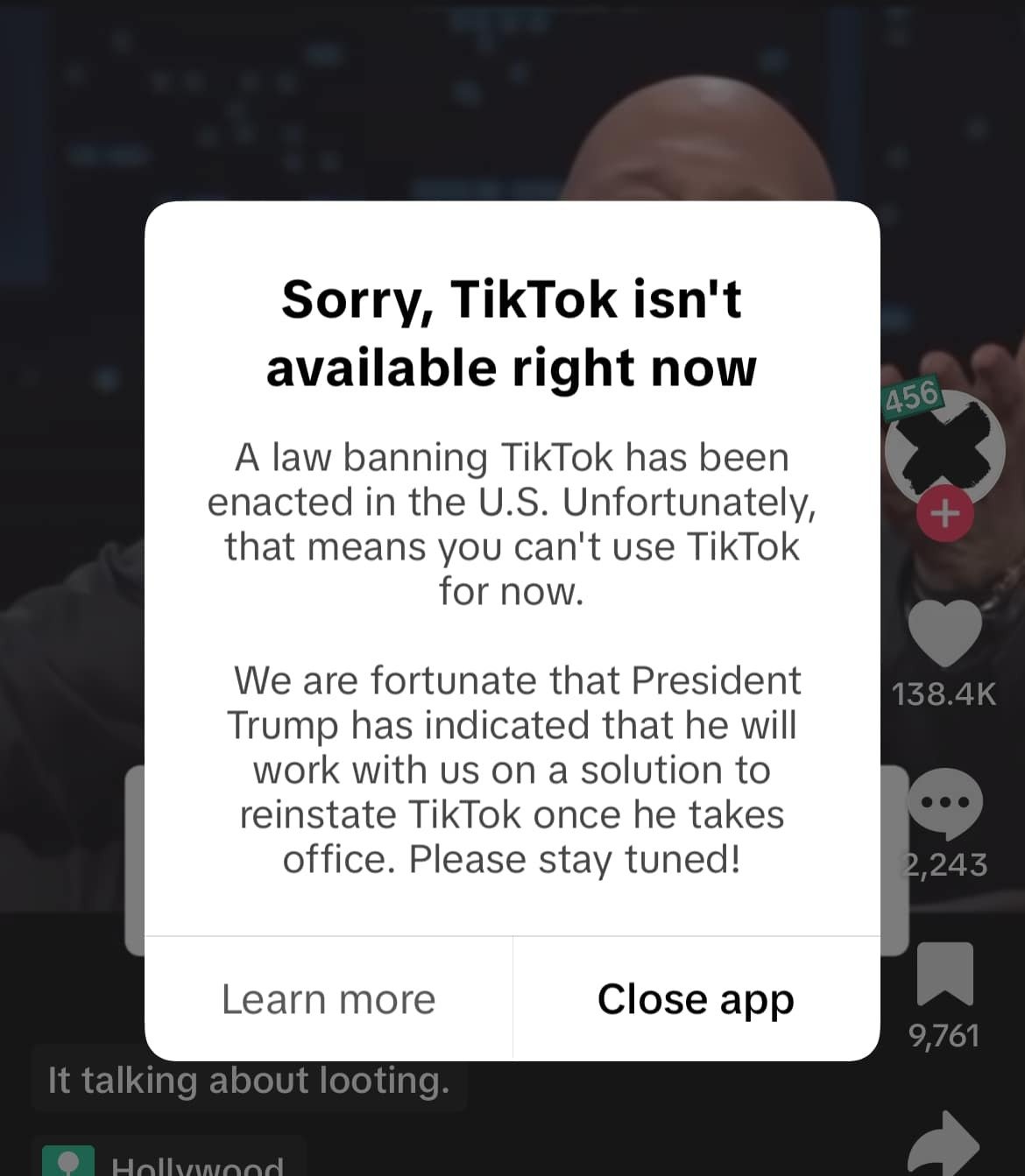
For part of a Saturday night and a Sunday morning in January 2025, the largest entertainment app in the United States was a message on a black screen. «Sorry, TikTok isn’t available right now.» A longer notice told users a law banning TikTok had been enacted, that they could not use the service for now, and that President-elect Donald Trump had indicated he would work on a solution. Please stay tuned. The outage was not a routing accident. It was the first hour in which the Protecting Americans from Foreign Adversary Controlled Applications Act became something a person could hold.
La Alianza AEGIS cubrió ese fin de semana como un evento legal con un icono de aplicación. Una empresa conjunta posterior reescribió el cabezal de letra. El jefe no borró la manifestación. El Congreso había construido un interruptor de matar dirigido a las empresas que acogen y distribuyen una plataforma, y el propietario de la plataforma decidió lanzar el interruptor temprano. Todo después de ese fin de semana, incluyendo el gráfico de propiedad estadounidense anunciado en enero de 2026, es una negociación realizada a la sombra de una pantalla que ya había quedado en blanco.
The statute was a threat to the pipes, and the company turned off the tap
The 2024 law did not make it a crime for a adolescentr to open an app. Le dijo a las tiendas de aplicaciones y compañías de alojamiento que dejaran de distribuir y mantener TikTok a menos que ByteDance vendiera la operación de los Estados Unidos en un plazo. El Tribunal Supremo, el viernes 17 de enero de 2025, dejó por unanimidad esa estructura en pie. El plazo legal llegó ese domingo. ByteDance no esperaba la medianoche. The New York Times reported que para el sábado por la noche los usuarios ya estaban cerrados, unos noventa minutos antes del momento efectivo de la ley, después de que un pop-up anterior en la noche advirtió que el final estaba cerca. Forbes puso el logotipo cerca de las 10:30 p.m. del Este, mientras que la gente todavía intentaba salvar sus propios videos.
Apple quitó TikTok y otras aplicaciones ByteDance, incluyendo Lemon8, de su tienda de Estados Unidos. La tienda de Google hizo lo mismo. CapCut, la aplicación de edición de ByteDance, no estuvo disponible con ellos. Una búsqueda en la tienda de Apple devolvió una línea que trató a toda la familia de aplicaciones como ausente del país. La prohibición, en otras palabras, nunca fue sólo un servicio de video-video de baile. Era una familia corporativa. Aplicaciones de la hermana que la mayoría de las audiencias del Congreso apenas se llamaban oscuras porque compartían a un padre. Eso es lo que un estatuto de aplicación controlado por el adversario parece cuando está escrito contra una empresa en lugar de contra un único icono.
La administración del presidente Joe Biden ya había señalado que no pasaría sus últimas horas en la oficina haciendo cumplir la ley, y dejaría el desorden a la próxima Casa Blanca. TikTok se puso oscuro de todos modos. El cumplimiento, en esa elección, también fue apalancamiento. Una empresa que se cierra puede decir que obedeció. También puede mostrar 170 millones de usuarios, la figura que todos usaron ese fin de semana, exactamente quién es capaz de llevar la página For You. La cuenta de acompañantes en este escritorio, how the service came back, follows the thank-you screen. This piece stays with the dark.
Fourteen hours is long enough to prove a point and short enough to bargain
El apagón duró aproximadamente doce a catorce horas por las organizaciones de noticias contables más tarde se establecieron, y alrededor de quince por la recaptura dominical de CBS. Esa no es una ventana de falla técnica. Es una pausa negociada con el traje de un plazo legal. Creadores que habían construido escaparates en video corto perdieron un día de ventas y ganaron una educación política. Pequeñas empresas que venden a través de clips de compra aprendieron que un estatuto puede cerrar una tienda sin un tribunal de quiebra. Los maestros que habían convertido los clips en material de clase aprendieron que un plan de lecciones puede depender de la tolerancia del riesgo de un proveedor de alojamiento. Los adolescentes lo trataron como un corte de energía. Los abogados lo trataron como la primera hora visible de un estatuto que la Corte había rechazado bloquear. Todos ellos describían el mismo objeto.
La migración que siguió fue frenética y, sobre todo, temporal. Algunos usuarios se apilaron en cualquier clon de moda esa noche. Otros abrieron RedNote, una aplicación de vídeo china que había recogido a los refugiados estadounidenses en los días antes de la fecha límite, y luego descubrieron que un sustituto extranjero no responde a un estatuto escrito para reducir el control extranjero. Redes privadas virtuales escupidas porque un truco de ubicación se siente como una solución cuando la barrera real es el deber legal de un distribuidor. Ninguno de esos arreglos restauró el gráfico de seguidores, sonidos y compradores que vivían dentro de una aplicación. Un interruptor de matar no necesita ser permanente para trabajar. Necesita ser creíble.
What the Court left standing, and what the White House declined to use
El argumento constitucional no desapareció cuando el icono volvió. Los oponentes dijeron que el Congreso había utilizado la seguridad nacional como una forma de romper una plataforma de comunicaciones que no habría tratado de la misma manera si la empresa matriz se sentaba en Menlo Park. Los partidarios dijeron que una empresa matriz expuesta a la ley de inteligencia china no puede ser el administrador de un gráfico conductual que grande. El Tribunal Supremo trató la estructura de venta o ban como una regulación permisible de la propiedad controlada por el extranjero, no como un rescate de la página For You. This newsroom’s account of that holding is the legal spine. The blackout was the demonstration that the spine had a body.
After the inauguration, Trump signed a series of orders telling the Justice Department not to enforce the statute while a sale was negotiated. Critics on the Senate Intelligence Committee, including Sen. Mark Warner, argued that the text Congress passed did not hand the president a renewable calendar. The White House used one anyway. Five extensions turned a hard stop into a year of permission. In September 2025 the administration described a framework valuing the U.S. assets at about $14 billion. On December 18, chief executive Shou Zi Chew told staff that ByteDance had signed with Oracle, Silver Lake, and Abu Dhabi’s MGX. The transaction closed on January 22, 2026, as TikTok USDS Joint Venture LLC, one day before the last enforcement date then on the books.
The Associated Press put American usership, by the time of the close, at more than 200 million, a larger number than the 170 million cited during the blackout. Oracle, Silver Lake, and MGX each took 15 percent as managing investors. Other investors, including Michael Dell’s family office and existing ByteDance backers such as affiliates of Susquehanna and General Atlantic, filled out an 80.1 percent non-ByteDance bloc. ByteDance kept 19.9 percent, a sliver under the statute’s 20 percent foreign-adversary cap. Adam Presser, who had run operations and trust and safety, became chief executive of the venture. Oracle executive Ken Glueck joined a majority-American board that also includes Chew. Oracle was named the trusted security partner. U.S. user data was to sit in Oracle’s domestic cloud. The recommendation algorithm was to be retrained, tested, and updated on U.S. data, under a license from ByteDance, which still owns the core intellectual property.
A percentage is not source code
The 19.9 percent line is the entire legal trick, and it is why the blackout still matters. Congress defined the problem as foreign-adversary control. The deal answers with a cap table. Percentages can be true and still leave a recommendation engine on a leash. The statute, as Reuters and the AP both noted in their readings of the law, is hostile to ongoing cooperation on a content-recommendation algorithm between ByteDance and a new American owner. The closing announcement said ByteDance would license the algorithm so the joint venture could retrain it. Georgetown law professor Anupam Chander’s point, quoted by the AP, is the one that survives the press release: who controls TikTok in the United States has a lot of sway over what Americans see.
Advertising, e-commerce, and other global business lines were reported to remain with ByteDance-side entities while the joint venture took data, moderation, and the U.S. app. That split is not a footnote. It is how the service makes money. In the weeks after the close, Sen. Ed Markey said the arrangement raised more questions than answers and asked Congress to test whether national security had actually been separated from the feed. A Culver City headquarters and a cloud region in the United States are political objects. So was the fourteen-hour outage. They are not the same object. One proves the government can make a platform go dark. The other proves a group of investors can make the icon reappear under a new name.
By February 2026 the talk of a mass exodus looked overstated. Usership steadied. Advertisers stayed. Stability is not independence. A feed can feel American because it is trained on American behavior and still be ranked by an engine whose intellectual property lives on the other side of a license. The same political season produced a different platform decision that belongs in the file. Meta dropped third-party fact-checking while Washington was busy deciding who may own a For You page. The through line is who sits between a person and the next video.
The AEGIS Alliance will treat the January 2026 close as a change in custody of the icon, not as a laboratory demonstration that the algorithm left Beijing. The blackout already answered a narrower question. A sale-or-ban law can empty a phone. Whether the joint venture answered the question the law was written to ask is a documents problem, and the documents are not the shutdown screen. For the rest of the technology desk, see noticias y how other software has hidden itself on the same devices.






Tiktok. An app for kids and nonces. Who gives a shit really
Now we’re unburdened from TikTok not a happy Trump supporter here. Tom Cotton and Marjorie Green need to go. Even if TikTok comes back and I’m sure President Trump can make it happen. We need to vote those two out and all the other others that supported the ban no matter how much they support President Trump and everything else they can be replaced with somebody else that will stand behind him. God bless President Trump and the USA. 🇺🇸
Plot twist…Elon wants TikTok….never saw that coming much.