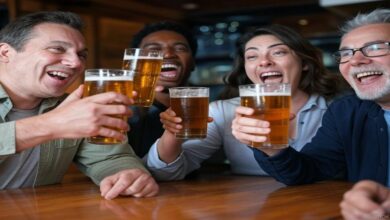
Cold Beer Tastes More Like Ethanol Because Chain-Like Clusters Take Over Near 41 Degrees

Ein kaltes Pint schmeckt nicht wie ein warmes Pint, und der Unterschied ist, dass nicht nur Blasen flach werden. Am 1. Mai 2024 schrieb ein Team unter der Leitung des Materialwissenschaftlers Lei Jiang am Technischen Institut für Physik und Chemie der Chinesischen Akademie der Wissenschaften mit dem Baijiu-Chemiker Dong Zhao, veröffentlichte ein Papier in der Zeitschrift Materie that treats the alcohol-by-volume number on a label as a map of molecular clusters rather than a bartender’s habit. The title is plain: „Ethanol-water clusters determine the critical concentration of alcoholic beverages.“ First author Xiaotao Yang, with Jia Zheng, Xianfeng Luo, Hongyan Xiao, Peijia Li, Xiaodong Luo, and Ye Tian, measured how ethanol and water organize themselves as the mix gets stronger and as the temperature moves. The work started, Jiang’s institute later said, in the practical puzzle of why Chinese baijiu is bottled at particular strengths and why people warm it.
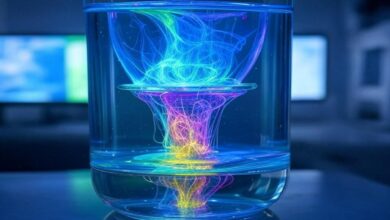
Ethanol and water do not dissolve into a featureless soup. Hydrogen bonds tug the two liquids into repeating shapes. At low ethanol fractions, the alcohol sits in symmetric tetrahedral clusters, pyramid-like cages built around water. Raise the ethanol and the molecules start linking end to end in chains. The chain-like population grows as the drink gets stronger. Professional tasters have long called the chain-rich regime more „ethanol-like“: hotter, more burning, more obviously alcoholic. The pyramid-rich regime tastes wetter and less like solvent. The paper’s claim is that the steps between those regimes line up with the alcohol strengths civilization actually bottles.
A droplet on graphite, not a tasting panel
Das Experiment fordert niemanden auf, zu schlucken. Das Team legte Tropfen Ethanol-Wasser-Mischung auf hoch orientierten pyrolytischen Graphit, eine sehr flache, wasserabweisende Kohlenstoffoberfläche, und maß den Kontaktwinkel, den Winkel des Tropfens kante macht mit der oberfläche. Wenn Ethanol und Wasser ideal gemischt wurden, sollte dieser Winkel glatt rutschen, da der Alkoholanteil stieg. Das war nicht der Fall. Der Winkel bewegt sich in Schritten. Die Ränder der Stufen fielen in Konzentrationen, die den bekannten Regalen entsprechen: Bier und Apfelweingebiet, Weingebiet, dann die befestigten und destillierten Bänder, wo Shochu, baijiu, whisky und wodka live. Hochfrequente Protonen-Kernspinresonanz, molekulardynamische Simulationen und abgeschwächte Totalreflexions-Infrarotspektroskopie wiesen alle auf die gleiche Strukturänderung hin. In jedem Schritt ist eine Clusterfamilie stabil. Am Rande dreht sich die Bevölkerung um.
Temperature shoves the flip. Cool a 5 percent solution and an 11 percent solution toward 5 degrees Celsius, about 41 degrees Fahrenheit, and the chain-like structures become more prominent even though the alcohol percentage has not changed. That is beer and light-cider country. Jiang put it without romance: at low temperature the tetrahedral clusters become the minority, „and this is why we drink cold beer.“ The same physics run backward for high-proof spirits. Warming shochu or baijiu pushes the mixture toward the ethanol-like taste that those drinks are built to show. Cooling mutes them. A lager in a frozen mug and a small cup of warm baijiu are not two cultures being quaint. They are two ways of parking a cluster population where the drinker wants it.
Die Chinese Academy of Sciences summary ist explizit über den kommerziellen hinweis. Wenn kettenartige Cluster das sind, was Menschen mit einem alkoholischen Geschmack meinen, könnte ein Hersteller diesen Geschmack bei einem niedrigeren Ethanolanteil erreichen, indem er die Temperatur wählt, anstatt mehr hinzuzufügen alkohol. Das Papier ist kein Rezept und keine gesundheitsbezogene Angabe. Es ist ein materielles Argument, dass die alten ABV-Kategorien auf das Phasenverhalten stolperten.

Carbonation, aroma, and the other reasons a warm lager disappoints
Cluster sind nicht der einzige Grund, warum ein Patio-Bier schief geht, wenn es sitzt. Kalte Flüssigkeit enthält mehr Kohlendioxid, so dass das gleiche Bier bei 40 Grad schärfer und lebendiger ist als bei 60. Aromamoleküle bewegen sich in der Kälte langsamer, weshalb ein Bier, das kurz vor dem Einfrieren serviert wird, dünn schmecken kann: Hopfen und Malz erreichen nie die Nase, und die Nase ist am meisten Geschmack. Die amerikanische Homebrewing-Anleitung, die erscheint, wenn diese Zeitung lokale Nachrichten trifft, bringt die meisten Stile irgendwo zwischen etwa 38 und 55 Grad Fahrenheit. Lager und Pilsner leben am kalten Ende. Schwerere Ales, Stouts und Gersteweine werden wärmer geöffnet, so dass das Aroma aus dem Glas kommen kann. Das Matter-Papier annulliert diesen Rat nicht. Es erklärt ein Stück davon. Bei etwa 41 Grad wachsen bei einem 5-Prozent-Bier und einem 11-Prozent-Bier ein größerer Anteil an kettenartigen Ethanol-Clustern, die als stärker alkoholischer Charakter gelesen werden. Drücken Sie das gleiche Bier auf Raumtemperatur und die Pyramiden kehren zurück, die CO2-Blätter und die Fehler, die die Kälte verborgen hatte - papierartige Oxidation, Zuckermais, eine schmutzige Gärung - haben eine gelegenheit zu sprechen.
What later work did to the tidy staircase
Im Dezember 2025 untersuchte eine Überprüfung in Supramolecular Materials Fluoreszenz- und NMR-Studien von Ethanol-Wasser-Clustern in Bier, Whisky, Sake, Shochu und Wodka und behandelte Yangs treppe als neue baseline. Wasserstoff-Bindungsfestigkeit, die Überprüfung festgestellt, ist nicht eine Funktion von ABV allein. Ester, organische Säuren, Phenole und Metallionen ziehen alle die gleichen Bindungen. Ein mathematisches Modell, das auf Protonen-chemischen Verschiebungen basiert, hat bereits versucht, diese Zutaten mit dem Bindungsnetzwerk in Bier zu verbinden. Das praktische Ergebnis für eine Brauerei ist umständlich und nützlich: Zwei Biere zu 5 Prozent können auf verschiedenen Clustermischungen sitzen, wenn eines mit Estern beladen und das andere gestrippt wird. Geschmackstafeln sagen das seit einem Jahrhundert. Die Spektren beginnen sich zu einigen.
A preprint posted to arXiv on May 25, 2026, by Xinyue Jiang, Yating Shang, Jianhui Li, Zhaoyong Zou, Yanxia Zuo, and Yuqun Xie goes further, and it should not be confused with a rerun of the Matter experiment. Working with a 50 percent ethanol-water mixture, far above beer, they argue that some of the famous oddities of the mixture — the way the volume shrinks, the large negative excess entropy — are fingerprints of an arrested phase transition rather than a calm equilibrium. By rocking the liquid through periodic temperature swings, they drove a path from small ethanol clusters to water-containing droplets, then to needle-like flakes, then to micron-scale ordered aggregates. Fluorescence, two-dimensional correlation analysis, and NMR were the witnesses. The preprint is not peer-reviewed tasting science, and it is not about a pint. It does crack the assumption that an ethanol-water glass is a settled structure you can label once and forget. If clusters can be pushed, stalled, and reassembled by a temperature cycle, then the „right“ drinking temperature is not a single number on a style guide. It is a history. How fast the bottle was chilled, how long it sat, whether it was warmed and cooled again, all become part of the structure in the glass.
Baijiu producers already behave as if that were true. Many traditional processes rest the spirit, dilute it to a chosen strength, and serve it warm, not because a marketing department likes ceramic cups but because the chain-like population at those strengths and temperatures is the flavor they spent the distillation chasing. Beer, younger and fizzier, stumbled into the opposite corner: refrigerate hard, and the chains show up at a strength that would taste watery if you left it on the counter. The Matter authors said the industry could use the map to hit an ethanol-like taste with less ethanol. A lower-ABV beer that is cold enough to sit on the chain-rich side of the step might taste „stronger“ than a warmer beer with more alcohol. Whether that is a public-health idea or a labeling problem depends on who is holding the glass.
A map, not a commandment
Nichts davon ist medizinischer Rat, und nichts davon macht Ethanol sicherer, weil die Cluster elegant sind. Das brennende Gefühl, das das Papier verfolgt, ist immer noch das brennende Gefühl eines Lösungsmittels auf der Schleimhaut. Was die Arbeit wegnimmt, ist das Achselzucken, dass Trinktemperaturen reine Folklore sind. Die Kontaktwinkeltreppe ist zu regelmäßig und landet zu nah an den Flaschen, die bereits auf dem Regal stehen, um ein Zufall der Kultur zu sein. Die Leute sortierten Getränke in kalt und warm, lange bevor jemand einen Kernmagnetresonanzmagneten besaß. Der Magnet hat sie dabei gefangen.
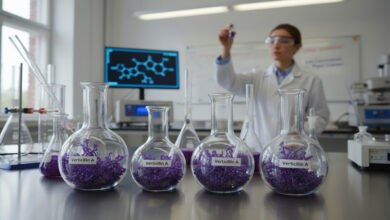
The AEGIS Alliance covered a more athletic version of the same obsession when wine merchant Tom Gilbey tasted 25 glasses during the London Marathon and still finished. For the physics that starts as a bar argument and ends in a journal, see Wissenschaft und Gesundheit. A different kind of molecular surprise, the synthesis of a fungal anticancer compound after half a century of failure, is in The AEGIS Alliance’s account of verticillin work. The Cell Press paper remains the primary document, and ScienceDaily's Write-up quotes Jiang in full context. The preprint that says the mixture may not even be at rest is arXiv: 2605.25457.
Gießen Sie das Lager kalt, wenn das der Geschmack ist, den Sie jagen. Erwärmen Sie den Baijiu, wenn Sie die Ketten wollen, für die die Destillation gebaut wurde. Sagen Sie sich nicht, dass es bei der Temperatur nur um Fizz geht. Bei 41 Grad hat der Alkohol seine Form verändert, und die Form ist der Geschmack.






Zusätzlich zu dem, was der Artikel sagt, ist es bewiesen, dass Gerüche und Aromen bei kälteren Temperaturen verringert werden, da sich die Moleküle nicht so schnell bewegen, also ein Grund, warum Bier könnte besser schmecken, wenn cool einfach sein könnte, weil es weniger schmeckt.
Makes me wonder if beer actually tastes good at all if it needs to be cooled down to be enjoyed.
Jody Parker I remember a while back my neighbor brought 2 bottles of beer over to my house, but they were warm, and he seriously told me „oh, I didn’t know you liked your beer cold.“ Who wouldn’t want it cold? lol.
Real men drink Ales – lagers are for those that can’t stand the taste of real beer – so they drink cold lagers – that can’t be tasted.