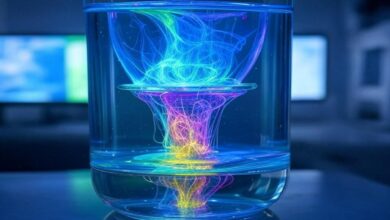
Forskere tvinge polariton lys ind i en supersolid, der holder en krystal form og strømme uden friktion


Light is not supposed to hold a shape. In a paper published in Nature on March 5, 2025, a team led by Dimitrios Trypogeorgos at CNR Nanotec in Lecce, Italy, reported that it can. The study, titled “Emerging supersolidity in photonic-crystal polariton condensates,” describes laser light forced into a state that is rigid like a crystal and frictionless like a superfluid at the same time. Physicists call that combination a supersolid. Until this experiment, the cleanest examples lived in clouds of ultracold atoms. This one is made of light dressed as matter.
A supersolid breaks two symmetries at once. It has a repeating density pattern, which is what makes a solid a solid. It also flows without viscosity, which is what makes a superfluid a superfluid. That pairing sounds like a word game until a lab measures both signatures in the same sample. The Lecce group, with colleagues in Italy, Austria, and the United States, including Manuele Landini at the University of Innsbruck, says it did exactly that.
Polaritoner er tricket, ikke magi
The team did not freeze a flashlight. They fired a laser at a gallium arsenide semiconductor etched with microscopic ridges, a photonic-crystal waveguide. Photons in that lattice coupled so strongly to excitons in the semiconductor that the two stopped being separate objects. The hybrids are called exciton-polaritons. Those quasiparticles condensed into a topologically protected “bound state in the continuum,” a trick that slashes energy loss and lets the condensate live long enough to be studied.
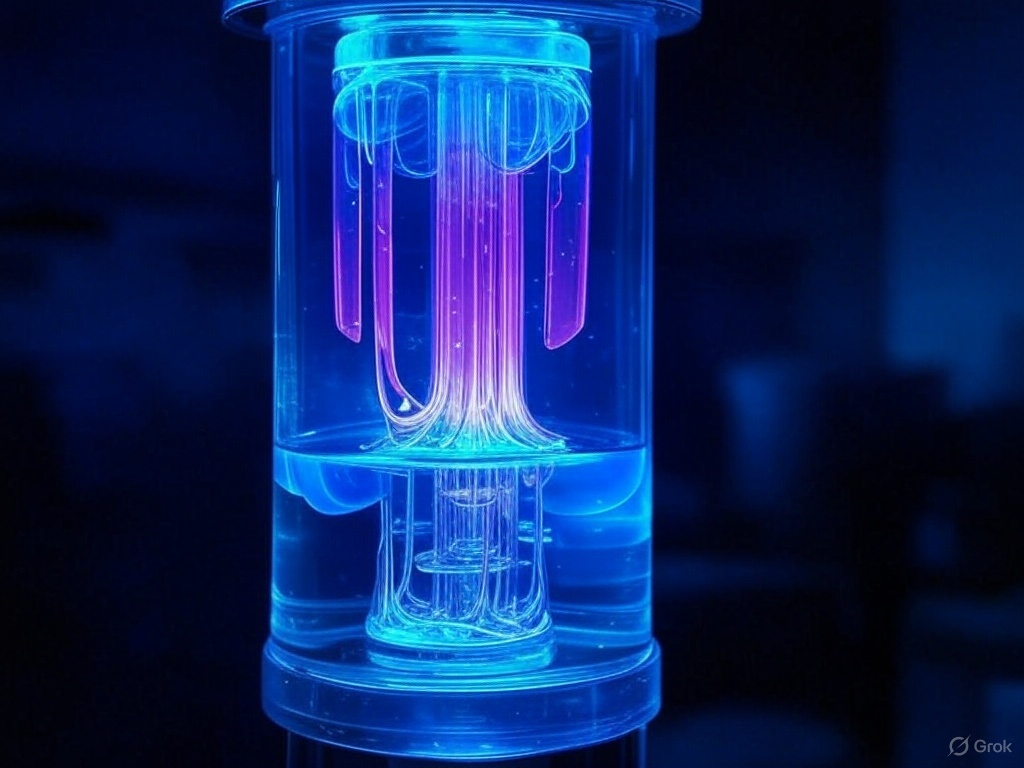
The ridges did the rest. They forced the polaritons into a periodic, crystal-like pattern while the condensate kept flowing without friction. The group measured a density modulation — the fingerprint of broken translational symmetry — to a few parts in a thousand. That number is the difference between a pretty interference picture and a claim that belongs in Nature. Related theory work published in Physical Review Letters the same winter laid out how a driven-dissipative polariton condensate can show the same double symmetry breaking that helium and cold atoms made famous.
Trypogeorgos kaldte resultatet "temmelig awesome", som ikke er en teknisk betegnelse og stadig matcher stemningen. Dario Gerace ved universitetet i Pavia sagde, at holdet kun havde ridset overfladen. Daniele Sanvitto, også i den italienske gruppe, formulerede det som en principdemonstration, ikke en gadget.
Hvorfor lys slår et fortyndingskøleskab
Atomic supersolids usually need temperatures within a fraction of a degree of absolute zero. The polariton version is still a cryogenic, specialist setup. It is not a desk toy. It is also not a magneto-optical trap the size of a room that takes a day to reload. Photons can be injected, tuned, and read out with optics that already exist in any serious photonics lab. That is the practical shift. A state that used to be a once-a-year cold-atom result can now be rebuilt on a chip-scale waveguide.
The EU-funded Q-ONE and PolArt projects, which back parts of this work, run through 2027 and 2028. Those grants are aimed at quantum optical networks and neuromorphic polariton accelerators, not at a museum piece. Follow-on explainers through late 2025 treated the Nature paper as a platform, not a one-off. Citation counts climbed into the dozens within a year, the usual sign that other groups are trying to copy the recipe or poke holes in it.

Hvad en fotonic supersolid kunne være til
Nobody is shipping a supersolid processor. The honest applications sit one layer down. A condensate that holds a spatial pattern and still flows is a candidate for low-loss photonic memory, for sensors that read tiny forces as shifts in that pattern, and for analog simulators that let theorists watch a supersolid without building another cold-atom machine. Quantum communication groups care because a structured light field can carry more than a binary pulse. Quantum computing groups care because stability is the tax they pay on every extra qubit.
Disse anvendelser vil dø i udvalget, hvis staten ikke kan holdes, flyttes eller kobles til noget, der ikke er en brugerdefineret GaAs ridge. Det er det næste papir, ikke det her. Lecce-resultatet besvarer et smallere spørgsmål: kan lys parkeres i samme eksotiske fase, som atomer indtager? Målingen siger ja.
AEGIS Alliance har fulgt andre laboratoriehistorier, der lyder som science fiction indtil metodesektionen dukker op, fra debatter om, hvorvidt universet selv har struktur vi knap nok måle til at arbejde på maskiner, der erstatter et svigtende hjerteDen fælles tråd er ikke hype. Det er et kontrolleret eksperiment, der overlever peer review og derefter skal overleve replikation.

Den påstand værd at forsvare, og den, der ikke er
Headline writers like the phrase “scientists turned light into a solid.” That sentence is useful and slightly wrong. The object in the chip is a polariton condensate, a hybrid that is part photon and part semiconductor excitation. Take the lattice away and the supersolid goes with it. That does not make the result smaller. It makes it honest. Matter-light hybrids are how a lot of modern photonics already works. Putting one of them into a supersolid phase means the toolbox just gained a state that textbooks used to reserve for helium-4 arguments.
Skeptics will want a second lab to print the same modulation depth on a different tool set. They should. Driven-dissipative systems can mimic order without owning it. The Nature paper’s answer is the precision of the density measurement and the topological protection of the bound state. Copy that, or fail to, and the field will know whether Lecce opened a door or decorated one.
Until then the record is simple. In March 2025 an international group showed that a photonic-crystal polariton condensate can be solid and superfluid at once. Grants are still paying people to push that state toward networks and accelerators. Replication attempts will decide whether the density modulation is a robust phase or a lucky alignment of ridge geometry and pump power. If other waveguides print the same number, textbooks will have to add a photonic branch next to the helium chapter. If they cannot, the Nature figure remains an elegant one-off. The AEGIS Alliance will treat the next replication, not the next metaphor, as the update that matters, because a crystal made of light is only a breakthrough if someone else can build it in the dark.