
Cryonics virksomheder opkræve omkring $200,000 at fryse lig i flydende nitrogen uden bevist måde at bringe dem tilbage

A handful of private companies will, for a six-figure fee, take a legally dead body, drain its blood, pump a medical-grade cryoprotectant through the vessels, cool the remains to about -196°C (-320°F), and lower the wrapped patient into a tank of liquid nitrogen. The sales pitch is blunt: death is a timing problem, and a future laboratory might someday repair whatever killed the person. No laboratory has revived a cryopreserved human being. No laboratory has revived a whole human organ after years in a dewar. The AEGIS Alliance treats that gap as the story, not a disclaimer buried under a membership brochure.
Berlinbaseret i morgen. Bioo, grundlagt i 2020 af tidligere kræftforsker Dr. Emil Kendziorra og ingeniør Fernando Azevedo Pinheiro, markedsfører sig selv som Europas første formål-bygget cryonics lab. A Januar 2025 BBC Fremtidig profil put whole-body preservation at about $200,000. Company updates through early 2026 said membership had crossed 1,000 people across dozens of countries, with patients and companion animals stored at the European Biostasis Foundation site in Rafz, Switzerland. Public tallies have moved around — roughly 20 to 30 human patients and about 10 pets, depending on the month and the page doing the counting. Standby crews and retrofitted cryo-ambulances are supposed to start cooling as soon as a physician declares legal death. The firm opened U.S. standby coverage in July 2024 in New York, California, and Florida and spent the following year talking about wider dispatch. A 2026 quality plan on the company site talks about faster response times and tighter procedures. It does not promise a waking date.
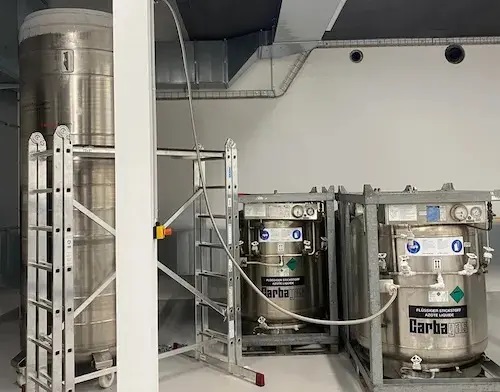
Hvordan proceduren sælges, og hvad den rent faktisk gør
Cryonics operators describe a sequence that sounds like a hospital transfer until it does not. After legal death, a standby team tries to restore circulation with a mechanical chest compressor, drop the core temperature with ice or a cooling board, and replace blood with an organ-preservation solution. Later, at a facility, technicians perfuse a cryoprotectant mix intended to reduce ice-crystal damage. The goal is vitrification: turning tissue into a glass-like solid instead of a bag of frozen shards. The body, or in some contracts only the head, is then cooled further and moved into a vacuum-insulated dewar. Liquid nitrogen is topped up for as long as the organization stays solvent.
That last clause is not a joke. Storage is a multi-decade bill. Members commonly assign a life-insurance policy to the provider so the payout covers the procedure and a share of long-term upkeep. Monthly dues sit on top. Tomorrow.Bio has advertised membership funding through insurance plus ongoing fees in the tens of dollars a month. Alcor Life Extension Foundation in Scottsdale, Arizona, posts neuropreservation near $80,000 and whole-body preservation near $220,000, with age-based annual dues. The Cryonics Institute in Clinton Township, Michigan, has long sold a cheaper whole-body package and, by industry tallies in 2025, held more than 2,100 living members and more than 230 patients. Alcor’s public figures in the same window put living membership above 1,400 and human patients in the mid-200s. Across the field, more than 500 people worldwide are now in dewars. None of them have come back.

Alcors berømte patienter og den videnskabelige protest
Tomorrow.Bio is a new brand on an old wager. Alcor has stored patients for decades. Its roster has included baseball player Ted Williams and Bitcoin pioneer Hal Finney. Those names do advertising work that a Berlin startup cannot buy. They also freeze a public argument in place. Families have fought in court over whether a relative’s head should be separated from a body. Critics have asked who pays if an organization folds. Advocates answer that identity lives in the connectome — the physical map of neurons and synapses — and that a well-vitrified brain is a hard drive waiting for a reader that has not been invented.
Den ærlige version af videnskaben er smallere. Greg Fahy 's gruppe på 21. århundrede medicin engang vitrified en kanin nyre og transplanteret det tilbage. I 2023, University of Minnesota forskere rapporteret i Naturkommunikation that they vitrified rat kidneys, stored them up to 100 days, rewarmed them with magnetic nanoparticles in a process they call nanowarming, washed the particles out, and transplanted the organs into rats that then lived on those kidneys. That is a real step for transplant logistics. It is not a restored person. A kidney has one job. A human mind is a wet computer that begins dying the moment blood stops. Ice, shrinkage, cryoprotectant toxicity, and the original disease all leave damage. Rewarming a whole body without cracking tissue is an unsolved engineering problem, which is why even friendly researchers talk about organ banking first and “revival” later, if at all.
Market research shops have started putting dollar figures on the field. One 2025 industry note valued the cryonics technology market in the low hundreds of millions and projected growth through 2034. Those forecasts assume paying members, not working resurrection. Southern Cryonics in Australia and a scatter of smaller groups have joined the membership race. The business model is the same everywhere: collect insurance assignments now, store patients for a timescale no current executive will live to see, and hope a later generation of medicine is both willing and able to finish the job.
Hvad kunderne faktisk køber
People who sign these contracts are not buying a proven medical treatment. They are buying a protocol, a tank, and a story about time. Some are patients with terminal diagnoses who want a last long-shot. Some are healthy longevity enthusiasts who treat cryonics as a backup drive. Some are pet owners who cannot stand the idea of burying a dog and walking away. Tomorrow.Bio’s public materials put companion animals in the same Swiss building as human patients. That detail is useful because it strips the mystique. A frozen cat and a frozen software engineer are stored by the same physics. Neither has a published revival protocol.
Legal death is the on-ramp. In most jurisdictions a cryonics team cannot start until a physician has declared the person dead. Every minute after that is ischemic damage. That is why the companies talk so much about standby teams, GPS alerts, and hospital cooperation. It is also why a death far from a team is a worse case than a death in a contracted city. Coverage maps are marketing documents. They are also admission that geography decides how much of a brain is left to freeze.
Ethicists raise a different clock. If revival ever worked, who would the returned person be? A surviving spouse may be gone. Money in a patient-care trust may have been eaten by inflation or litigation. A future clinic might refuse to treat someone whose original cause of death is still a death sentence. Cryonics literature tends to wave at nanomedicine and whole-body repair as if those tools were already on a shelf. They are not. Related coverage on medical long shots sits in The AEGIS Alliance sundhed og videnskab filer, herunder rapportering om en patient, der efterlod et hospital med et titaniumhjerte - en anordning, der er ægte, testet og stadig sjælden.
The better comparison for cryonics is not heart replacement. It is a prepaid warehouse ticket. Customers pay now so that a body can sit at liquid-nitrogen temperature while research on organs, not people, slowly improves. University labs are trying to bank kidneys and hearts because transplant waiting lists are a measurable crisis. Cryonics companies borrow that research language and stretch it across an entire human life. The stretch is the product.
Læsere, der følger teknologi indsatser, der løber ud af beviserne vil genkende mønsteret fra andre skriveborde på AEGIS Alliance, herunder Teknologinyheder og ældre videnskab funktioner såsom arbejde med om selve universet har en form for samvittighedDe stykker beviser ikke kryptering. De viser, hvor hurtigt en hypotese kan hærde ind i en salg side.
Indtil videre er opgørelsen enkel. Lig i stål. Nitrogen på en leveringsplan. Medlemsfortegnelse, der vokser hurtigere end videnskaben. Ingen udgang. Enhver, der skriver en check på 200.000 dollars, bør være klar over, hvilke fakta de betaler for.










Grøn begravelse. Ingen giftig balsameringsvæske, ingen metalkiste eller betonhvælving. Naturligt, tilbage til jorden.
uploade din hjerne til en sky mere tilbøjelige til at suge end fryse efter døden, fordi de bare fryse en død skøge hvad var du gået et andet sted hen