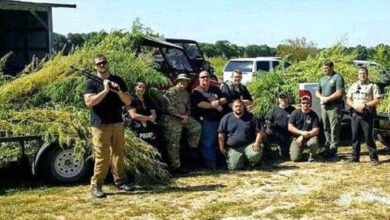

In September 2017 the Jasper Police Department in Missouri posted a victory lap and then deleted the racetrack. Officers said they had cut down one of the largest marijuana grows in the area, something like 288 to 290 plants, worth about $100,000 once dried. The Missouri National Guard had put a helicopter over a backwoods field off County Road 110. Jasper police worked with the Jasper County Sheriff’s Office, the Barton County Sheriff’s Office, and the Lamar Police Department. The plants went onto a landscaping trailer. The photographs went on Facebook.
The comments arrived faster than a lab. “That’s hemp,” one of the blunter lines read, and the thread ran past a thousand replies. People congratulated the task force for seizing the raw material of rope. The department took down the post. The page itself did not survive the joke. Chief Chad Karr later told the Riverfront Times, in an account picked up by the 堪萨斯城之星, that the post was not meant as a brag about a pile of pot. It was a message aimed at a suspected methamphetamine dealer investigators thought was tied to the field. Show-Me Cannabis executive director John Payne looked at the tall, budless stalks and called them wild hemp, which would mean nobody was farming them and the street value was close to nothing. A defense point made at the time by attorney Dan Viets was simpler than botany. If the plants were ditch weed, growing because the seed was already in the ground, there was no cultivator to charge.
Experts also said the embarrassing part out loud. Hemp and marijuana are the same species. You cannot reliably separate them by sight until a plant is late in flower, and you cannot separate them by smell at all. In 2017 that scientific fact was almost legally irrelevant in Missouri. Both plants were prohibited. The cops had not invented a crime so much as they had invented a press release. The internet punished the press release, which is a different thing from punishing a bad search.
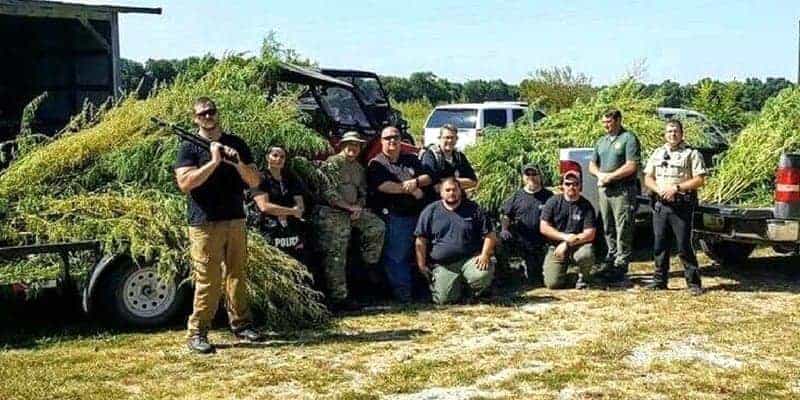
同样的姿势,在法律把工厂一分为二之后
Congress then made the Jasper mistake a national occupational hazard. The 2018 Farm Bill defined hemp as cannabis at or below 0.3 percent delta-9 THC and left marijuana on the other side of that line. Officers who had been trained to treat every serrated leaf as a felony were handed a statute that required a number their noses could not produce. Field tests of that era were built to detect cannabis, not to measure a percentage. In November 2019 the NYPD’s 75th Precinct posted about seizing 106 pounds of what it called marijuana from a FedEx shipment. The shippers were licensed Vermont hemp farmers. The boxes were bound for a Brooklyn CBD shop. Prosecutors later dismissed the case after laboratory work said hemp. CBS New York’s report on that seizure is the video above. Texas troopers and South Carolina deputies walked into the same ditch. A 2019 South Carolina traffic stop turned up more than 150 pounds that tested as hemp. In 2023 a Charlotte arrest over intoxicating but then-legal THCA products ended with charges dropped and an officer suspended.
The pattern did not retire. In September 2026 Pot Culture Magazine wrote up a Tennessee case in which the defense said officers treated a hemp limit as if it were an order of magnitude tighter than the statute, seized 216 pounds, and booked the driver. The number in the headline, 0.03 percent instead of 0.3, is the whole story in miniature. A decimal point is now the difference between a farm product and a jail intake. Jasper’s helicopter did not have a decimal point. It had a field and a Facebook account.
Missouri voters moved the ground under that field twice. Amendment 2 in 2018 legalized medical cannabis. Amendment 3 in November 2022 legalized adult use. The plant the Jasper officers stacked on a trailer can now be sold, in licensed form, down the road. The money is no longer theoretical. KCTV5 reported in February 2026 that the Missouri Cannabis Trade Association put 2025 legal cannabis tax collections at $255.57 million, with $151.72 million to the state and $103.84 million to local governments that host dispensaries, against a much smaller early forecast. A separate 多数政策倡议备忘录 published September 28, 2026, cited the state treasurer for a different window: $87 million in combined medical and adult-use marijuana taxes from July 2025 through April 2026. Those figures are not the same pile of money counted twice. One is a trade group’s full-year 2025 total, state plus local. The other is a partial fiscal stretch of state tax. Both are a long way from a $100,000 Facebook estimate pinned to wild stalks.
立法机关随后伸出援手并抓住了hemp一面. 州长Mike Kehoe签署了关于2026年April 23的2641号住宅法案, 创立了法规所称的"醉酒大麻控制法案". 报告的营养展望 that hemp businesses and a trade group sued in the U.S. District Court for the Western District of Missouri to stop it. Their claim is that the bill talks like the new federal hemp definition and then, in another section, declares hemp-derived cannabinoid products to be marijuana, saleable only by businesses that already hold a Department of Health and Senior Services marijuana license under the state constitution. The practical date on the products the law lists by name, including synthetic cannabinoids, smokable and vapeable THCA flower, and solid edibles over the natural delta-9 level, is November 12, 2026. Beverages were written to follow the federal clock.
That federal clock moved, slightly. Congress had set a new hemp definition that would push products over 0.4 milligrams of THC per container out of the hemp category and back toward marijuana, which is still Schedule I federally. President Donald Trump signed H.R. 6500 on September 2, 2026, now Public Law 119-103, delaying most of that federal change by a month, to December 11, 2026. Cannabinoids the plant cannot make naturally stayed on the November 12 date. Missouri’s contingency clause means the beverage slice of HB 2641 rides with the federal delay, while the enumerated non-beverage products do not. A 哈克法律小组 2026/9月的法律分析 laid the two calendars side by side and noted that a funding fight in Congress, or a ruling in Jefferson City, could shove either date again. The Senate’s farm-bill text, as described by industry accounts in late September, did not even use the word hemp, which leaves the negotiation between chambers as the last obvious place to rewrite the December line.
None of that statutory machinery would have saved the Jasper post, because the plants were probably not a product at all. It does change what a bad photograph costs. In 2017 the penalty for being wrong on Facebook was mockery, and the penalty for being right was still a seizure, because the plant was illegal either way. In the fall of 2026 the same photograph could be a licensed crop, a hemp commodity under 0.3 percent, an intoxicating product that becomes marijuana on November 12, or ditch weed that was never anyone’s inventory. The leaf does not say which. 亨普的工业工作那些跟高低无关的人 是这个论点的一部分 从来不需要药房执照 AEGIS联盟还跟踪了另一个分类账: 联邦大麻酚专利 改为 俄亥俄州第一周合法销售.
Jasper’s deleted post remains a clean little exhibit. A helicopter, four agencies, a trailer, a round number, and a comment section that knew the plant better than the caption. The comment section was funny. The decade after it was a fight over who is allowed to be wrong in public when the evidence is a green stalk and the statute is a percentage. Police accountability, in this case, started as a reply under a photo. The cases that followed are on The AEGIS Alliance’s 警察问责制 办公桌和办公桌 美国新闻 文档。






纯蓝薄线宣传
甚至"点击"这个 我可以告诉你, 已经几十年了, 他们做了一个假烧堆 并保留了大麻。
洛尔似乎是职业调查员 连大麻都没有
记住,警察只是个邪恶的恶魔
再来个白痴警察 对于一个所谓的自由国家来说,太多了。
一如既往的蓝细线宣传
出版物不负责任