熱容量のカーブは退屈で、まだ壊れた対称を隠すことができます。 ユタビウムジアンチモニドは、すでに通常のタイプI超伝導体として提出されました。 に 23 9月 2026, 物理的な見直しの手紙 インタビュー この結晶がすべての電気抵抗を失うと、磁場は磁石がスイッチ無しで内部に表示されます。 ペーパー, インド科学教育研究所の片谷とRavi Prakash Singhによって導かれる, 分割するために知られている最初のタイプとしてそれを識別します 自分自身で時間会話の対称。
タイプiの超伝導体が普通として扱われるなぜか
Textbooks split superconductors along two axes that people keep mixing up. Conventional versus unconventional is about how electrons glue into Cooper pairs. Type I versus type II is about what an outside magnetic field does. A type I superconductor expels that field completely, the Meissner effect, until one critical field kills the superconducting state in a single step. A type II superconductor lets field lines in as vortices and stays superconducting across a much wider window. Almost every famous case of unconventional pairing has lived on the type II side. YbSb2, the chemical shorthand for ytterbium diantimonide, was supposed to sit on the dull side.
ジアンチモニド結晶がゼロ抵抗に到達する方法
The collaboration did not invent the compound. Single crystals were grown by a modified Bridgman method, checked with X-ray and Laue diffraction, and confirmed in the nonsymmorphic space group Cmcm. The atoms form quintuple layers stacked along one crystal axis and held by weak van der Waals forces. Resistivity falls to zero at a critical temperature of 0.95 kelvin, about minus 272.2 degrees Celsius, less than one degree above absolute zero. At 0.1 kelvin the critical field is only 51 gauss, five thousandths of a tesla.
What the bulk probes did show is a clean, single transition. Specific heat jumps at 0.95 kelvin and fits a fully gapped curve with weak electron-phonon coupling. An earlier report had hinted at a second transition. This campaign, using specific heat together with muons, does not see one. Thermodynamics, read alone, would let a referee stamp the sample as a textbook type I superconductor and move on. The muons would not let that stamp stand.
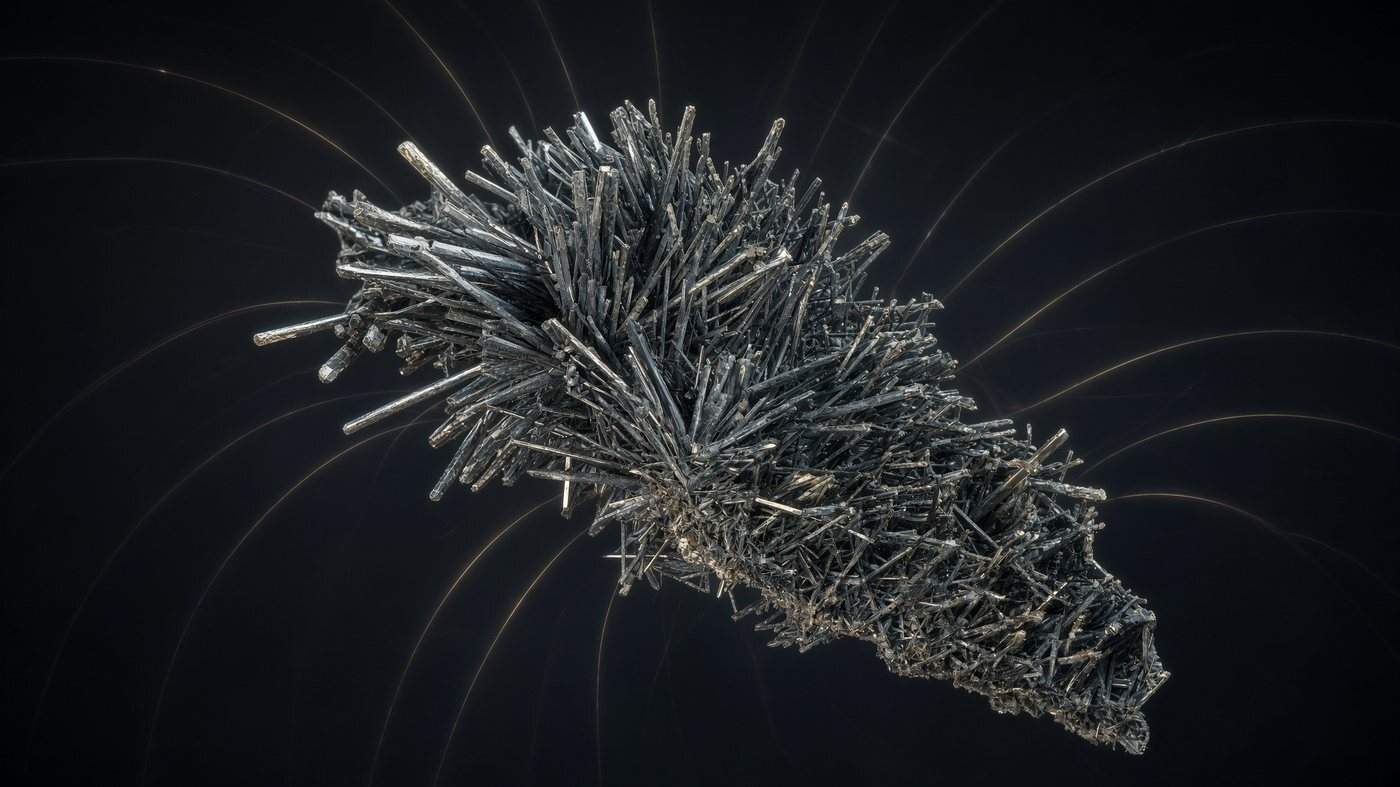
ムオンスピン分光法は、自発的な磁場を見つける
Muon spin relaxation is a bluntly physical idea. A muon, a heavy cousin of the electron, is implanted in the crystal and left to spin in whatever magnetic field it finds. When it decays, the positron’s direction reports that spin. The runs were made at the ISIS Neutron and Muon Source at Rutherford Appleton Laboratory, with Adrian D. Hillier. Joel Barker at the University of Warwick joined the theory side. At the Indian Institute of Technology Kanpur, Amit Agarwal and Sudeep Kumar Ghosh, with Dibyendu Samanta and Pushpendra Yadav, handled the electronic structure. On the Bhopal side the experimenters included Shashank Srivastava, Poulami Manna, Suhani Sharma, and Priya Mishra.
In zero applied field, the muon relaxation rate rises just below the transition, while the nuclear dipolar width stays put. From that extra relaxation the group estimates a spontaneous internal field of about 0.44 gauss. Earth’s own field, depending on where you stand, is a fraction of a gauss to a little more than half a gauss. The field inside YbSb2 is in that same whisper of a range, and it appears only after the resistance has already vanished.
ybsb2の対称的な対称的なブレイクの手段は何時
Time-reversal symmetry is not a claim that the laboratory clock runs backward. It is a statement about the equations. Most microscopic laws look the same if the sign of time is flipped, and a magnetic field does not, because currents and spins reverse with that flip. A spontaneous magnetization that shows up only in the superconducting state means the paired state itself has picked a direction in time. 物理学雑誌, in a synopsis published the same day as the letter, said the result offers a platform for unconventional pairing “free from the influence of exotic phenomena that are often seen in type-II superconductors.” A type I crystal that still grows its own field is, oddly, the cleaner room.
Transverse-field muon runs back the type I label up. At 0.1 kelvin and 20 gauss, the field inside the sample peaks near 4 gauss, the scale of nuclear dipoles in a Meissner state, while a separate peak sits on the sample holder at the applied field. At 40 gauss a secondary peak appears near 51 gauss, the critical field, swollen by demagnetization. At 100 gauss the crystal is normal and the spectrum collapses to one sharp line. There is no flux-line lattice. A full energy gap means it costs energy to break a pair. It does not mean the pair is a conventional spin singlet.
完全にギャップを帯びた超伝導体でのスピントリプルペアリング
The pairing they argue for puts electrons on the same atomic site but on different orbitals, antisymmetrically in orbital space, so the pair carries a net magnetic moment. The state is called an internally antisymmetric nonunitary triplet, or INT. In ordinary BCS theory the two electrons in a Cooper pair have opposite spins and the moments cancel. Here they do not. Strong spin-orbit coupling, the authors write, rules out the nodal states that break time-reversal symmetry in better-known compounds. A symmetry analysis points at this INT state as the most probable ground state.
Ybsb2はdracの鼻ラインが付いているz2のトポロジカル金属です
Density-functional calculations add a second identity. YbSb2 is a Z2 topological metal with a Dirac nodal line, protected by a glide-mirror symmetry, running near the Fermi level. The Fermi sheets are quasi-two-dimensional. Topology in the normal metal is not the same thing as topology in the superconductor, but it is the stage the pairing calculation uses. Other collective quantum states, including the 超固体に光を回す実験室の努力同じパターンに従う。
Gapless の mainana の表面モードはまだ予測です
The surface story is where the printed letter and the preprint need to be read against each other. The manuscript posted to arXiv on 12 January 2026 said the INT state hosts gapless Majorana surface modes and treated that calculation as establishing a topological superconductor. The version 物理的な見直しの手紙 actually printed is more careful. An effective model, it says, suggests the state may host those modes, “pointing to the possibility of topological superconductivity.” A Bogoliubov-de Gennes calculation shows a full gap in the bulk and a zero-energy branch at one surface point. That is a prediction. Photoemission and scanning tunneling microscopy, which the authors list as future work, have not mapped it.
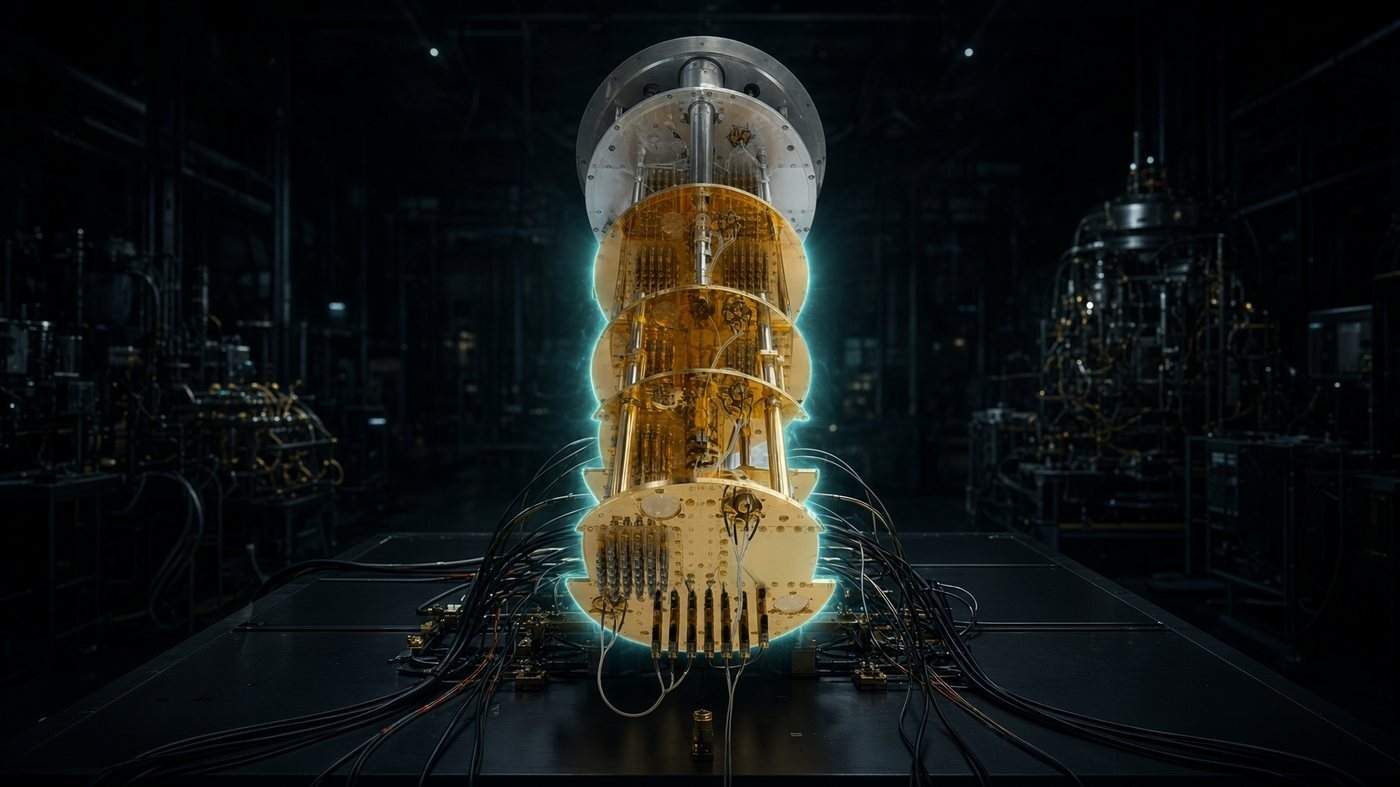
マカマナモードは、量粒子の感覚で独自の抗粒子です。 2021年にMicrosoft社製ナノワイヤー紙が再建されました。 同社がメジャーナ1と呼ばれるチップを発表した後、 科学報告 that independent experts met the claim with skepticism. Jay Sau of the University of Maryland told the magazine, “There is definitely a toxic cloud around the word ‘Majorana’ because of all this.” In June 2026 the BBC reported that physicist Henry Legg, writing in Nature, argued Microsoft’s checking software contained coding errors and that the quasiparticle was still unproved. “Something was making noise, but it didn’t look like the breakthrough Microsoft had claimed,” Legg said. Microsoft has stood by its conclusions. A calculated surface branch in a 0.95-kelvin crystal is not a qubit, and it should not be recruited into a product launch.

なぜこのタイプiの超伝導体は量子装置ではないです
The letter does not hide a narrower loose end. Tunnel-diode oscillator data can make the upper critical field look higher than the bulk value, and the authors note that surface superconductivity may be inflating that one probe. Bulk specific heat and the muon spectra still show a single phase. Muons see a field. They do not name the interaction that produced it. The honest ending of the paper is a call for more muon work, photoemission, and tunneling, not a device roadmap.
Set next to the quantum-computing marketing cycle, the scale is the most useful number in the letter. A spontaneous field of 0.44 gauss will not shield a data center, and a critical field of 51 gauss will not levitate a train. The gain is taxonomic. A material can be fully gapped and type I, and still carry a pair moment that picks a direction in time. Treating “conventional” and “type I” as synonyms would have buried this result. The サイエンスデスク, , テックデスクと、 国際ファイル AEGIS Allianceは、その引数をビューで保持し、より広い方向に ニュース.
The crystal will stay a laboratory object. It has to live in a dilution refrigerator, colder than the 2.7-kelvin afterglow of the cosmic microwave background, and the field it grows is comparable to the planet’s own. A superconductor the community had decided was ordinary turned out to be magnetically lopsided, and only a muon beam built to notice a fraction of a gauss could tell.