The question under Oxia Planum is whether any chemistry that looks like ours, if it is still down there, began on Earth, began on Mars, or began in the same cold scatter of rock and ice. On 2 June 2026 a paper in Icarus mapped a clay unit more than 600 kilometres across, through more than a kilometre of elevation, from the rover’s landing region toward Mawrth Vallis. The ExoMars Rosalind Franklin rover, built by Airbus in Stevenage, is the first machine planned to drill two metres into that clay. Launch is no earlier than late 2028. Touchdown is planned for 2030.
Susanne Schwenzer, professor of planetary mineralogy at the Open University and an interdisciplinary scientist on the mission, stated the sharper version of the bet. “If life emerges the moment it can, maybe it emerged there and then came here. If life is the same there, it may be that we are all from the same ancestor,” she said. “Is panspermia possible? Is it possible for life to travel from one planet for another? We don’t know but these are all questions we have to answer.” A borehole is not a family tree. It is the sample deep enough to make the question real.
Why the Rosalind Franklin Rover Has to Drill Past a Sterile Crust
Mars once held lakes, rivers, and possibly a deep ocean, under an atmosphere and a magnetic field. That window overlaps the Late Heavy Bombardment, roughly 4.1 to 3.8 billion years ago, when impacts could have delivered amino acids. Mars then cooled faster than Earth. The dynamo failed, the magnetic shield collapsed, and the solar wind stripped air and water. By about 3.7 billion years ago the surface was dead. Cosmic rays have since broken organic molecules in the top layer into fragments a lab would struggle to call a fossil.
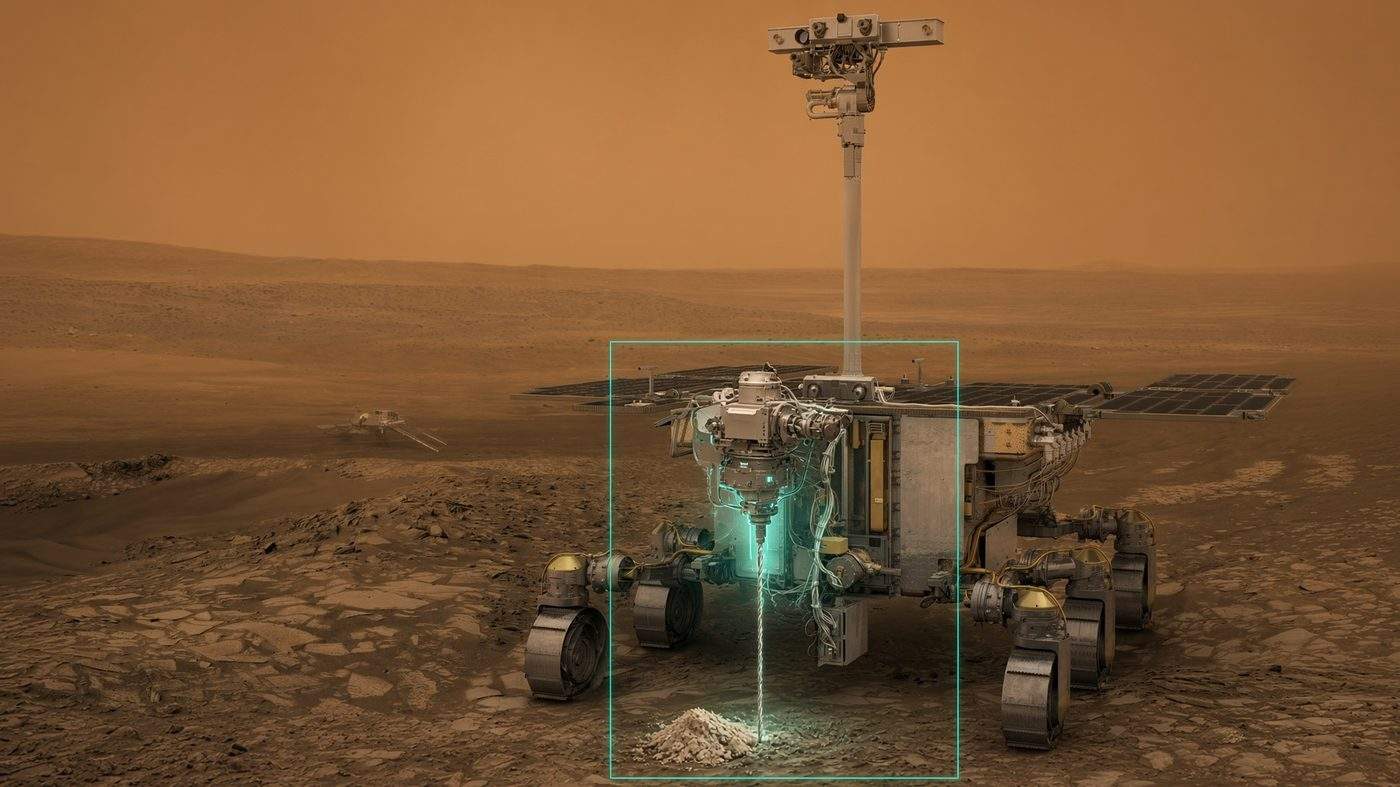
The European Space Agency notes that the deepest hunt for organic molecules on Mars is still about 15 centimetres, a mark set by the Viking landers. Later rovers abraded rocks and scooped dust. Rosalind Franklin’s drill couples three extension rods until the string is two metres long, and the sequence runs without a hand on the switch. An infrared look at the borehole wall records minerals as the bit passes. The sample drops, in Martian gravity, onto a collecting arm and into the Analytical Laboratory Drawer.

ESA’s planning figure is about 70 metres of driving in a Martian day. Commands leave the Rover Operations Control Centre in Turin, and a radio signal takes between four and 21 minutes each way. In the opening days of October 2026, Airbus and ESA rehearsed that lag with a prototype called Charlie during an eight-day trial in the Tabernas desert near Almería. Panoramic cameras, the WISDOM radar, and the Enfys infrared spectrometer were tied into the Turin loop.
Oxia Planum Clay Is a Regional Water Record
The landing ellipse sits near 18 degrees north, on the eastern edge of the Chryse basin. Inès Torres Auré of the University of Lyon, lead author of the Icarus study, said Oxia Planum’s clays formed first, about four billion years ago, and predate those at Mawrth Vallis, some 300 kilometres away. A cratered paleosurface between the units marks a pause, then a shift in water chemistry. ESA’s account of the paper, dated 4 June 2026, treats that sheet as the oldest target in the sequence.
Jorge Vago, the ExoMars project scientist, did not shrink the scale. “Because the area is so large, we are not talking about a localised occurrence, but rather a regional or global process that would have required immense amounts of water,” he said. Elliot Sefton-Nash, the deputy project scientist, added that warmth and nutrients on an early Martian seabed could have been habitats. The paper separates a basal magnesium-rich smectite from a later iron-rich nontronite that is widespread at Mawrth Vallis and only patchy southeast of Oxia Planum. The rover cannot walk 600 kilometres. It can test whether the orbital story survives a core.
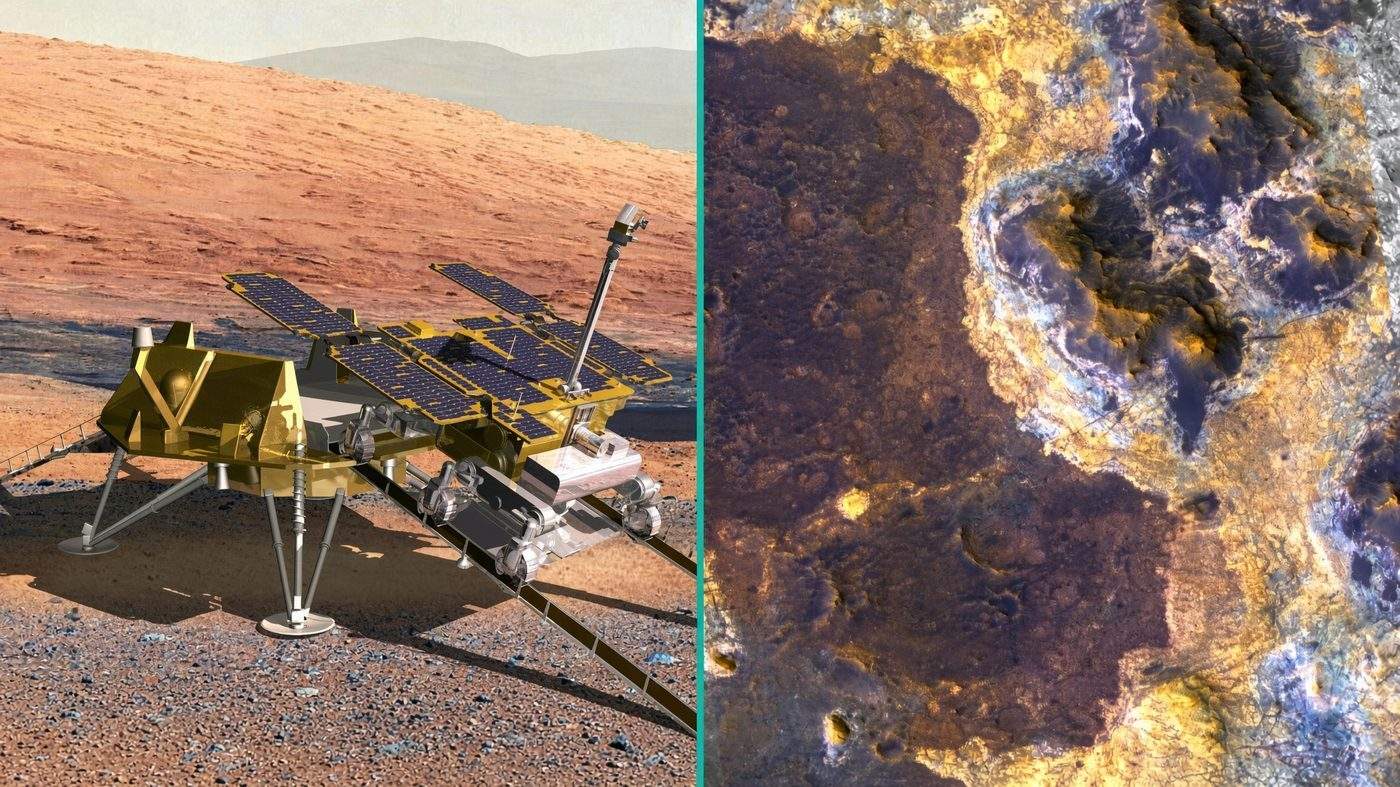
A typical Mars transfer lasts about nine months. This cruise runs closer to two years so touchdown falls in northern-hemisphere spring, with sunlight on the solar arrays and clear of global dust storms. NASA’s Jet Propulsion Laboratory helped European engineers through earlier parachute failures. The main canopy, about 35 metres across, is heat-sterilised in the Netherlands so Earth microbes do not become the life the drill claims to find.
A DNA Pioneer’s Name on a Machine Built to Read Chemistry
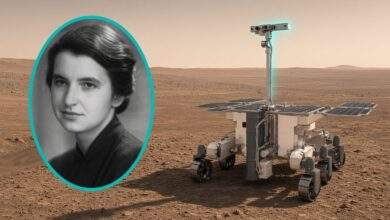
The rover carries the name of Rosalind Franklin, whose X-ray work at King’s College London, including Photograph 51, showed the helical structure of DNA. James Watson and Francis Crick built the famous model with data that included hers, and the Nobel Prize went to them after her death. The UK Space Agency has described the name as a link between a Mars life search and a scientist whose measurements changed how life on Earth is described. The link holds only if the instruments ask a molecular question.
PanCam, from University College London’s Mullard Space Science Laboratory, builds the maps that pick a drill site. Enfys, the infrared spectrometer tied to Aberystwyth University, reads minerals the wheels can reach. A Raman laser spectrometer checks chemical bonds once a sample is inside. NASA supplies the mass spectrometer and key electronics for MOMA, the Mars Organic Molecule Analyzer. WISDOM checks whether the surface mineral continues downward. CLUPI photographs cuttings before they enter the lab. With the rest of the Pasteur payload, eight instruments in all, they are a field kit for a claim orbit cannot settle.
The Launch Politics Kept Moving
Airbus finished the flight rover in Stevenage and delivered it to Thales Alenia Space in 2019. A 2022 launch was real enough that the vehicle was waiting. After Russia’s full-scale invasion of Ukraine, ESA ended the partnership with Roscosmos, which had been supplying the descent hardware. On 30 March 2025 ESA selected Airbus to design a European landing platform, with Stevenage on the structure, the braking propulsion, and the landing gear. The UK government said the contract would support about 200 skilled jobs. Sener has pointed to flight legs in the fourth quarter of 2026. In September, ESA showed leg deployment and backshell separation as hardware that had already moved.
The American share nearly vanished for a reason that had nothing to do with parachutes. In 2025 the Trump Administration proposed cancelling NASA’s contributions to Rosalind Franklin, inside a wider attempt to gut science missions. Those pieces are the launch, the braking engines, the radioisotope heater units that keep the rover alive through Martian nights, and the mass spectrometer inside MOMA. Cutting them would have left Europe with a finished rover and no honest way to land it or read its most important samples. Congress rejected the cuts in the fiscal year 2026 NASA budget. On 16 April 2026 NASA cleared the Rosalind Franklin Support and Augmentation project, known as ROSA, for implementation, and named SpaceX’s Falcon Heavy to fly it from Launch Complex 39A at Kennedy Space Center. It is the fourth rocket written into this programme. A rover that cannot stay warm does not drill.
What a Matching Molecule Would and Would Not Prove
Benoît Pouffary, who heads exploration preparation, research, and technology at ESA, has said the quiet part. “I do believe that life may have happened on Mars, it seems something that is credible,” he said. “Today our view is of Earth as a little world alone but if we find evidence there was life in another time, and another area of our solar system, it suggests life is everywhere, absolutely. The way we imagine our universe would be changed forever.” Schwenzer called that prospect “almost frightening to think about, because it changes everything.”
A chemical match is not a pedigree. Amino acids can form without a cell, and a film in a clay pore can look organised without being anyone’s ancestor. Panspermia also has a direction. Rock leaves Mars more easily than it leaves Earth, and meteorites from Mars already sit in collections here. A Martian origin for terrestrial life is a hypothesis with a transport path, not a verdict this rover can sign. The drill can say whether complex organics sit below the irradiated skin of one clay sheet that formed when both worlds were wet.

Work on Earth that only pretends to be Mars is the useful comparison. A PLOS ONE greenhouse trial found a tomato could double its fruit in simulated Martian soil while other crops failed, a result The AEGIS Alliance reported when NASA later paid menu prizes that still do not grow a meal in perchlorate. A laser on Psyche has already moved terabits across a Mars-like distance. Neither answers whether Oxia Planum was ever alive. The サイエンスデスク, , technology deskと、 国際ファイル will keep the borehole and the budget together, inside the wider ニュース. A shared ancestor has to survive a mass spectrometer. An empty core would mean this seabed did not keep a chemistry we recognise. The rover still has to roll down a ramp in the Martian spring of 2030, carrying the heaters the Trump Administration was prepared to strike from the page.