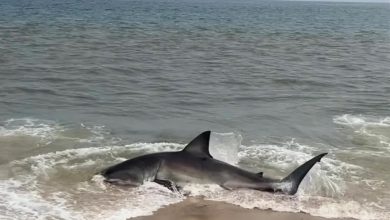
California Visitor Liza Phillips and Houseguest Ted Rock Push a Live Great White Shark Off Low Beach in Siasconset After It Was Pinned Helpless in the Surf

A California visitor tossing a football on Low Beach in Siasconset thought her father had spotted a whale. Liza Phillips ran closer, saw the black eye and the jaws, and realized she was standing over a live great white shark pinned in the August 16, 2024, surf. The animal was sand-scraped, its fins caught, its skin raw from being dragged across the beach. Great whites force water over their gills by swimming. Once a large white is beached, oxygen debt starts immediately. The AEGIS Alliance is keeping the clip in the wildlife file because the rescue was improvised, filmed, and then held up against what marine teams actually want beachgoers to do — and because Nantucket has kept producing white-shark video ever since.
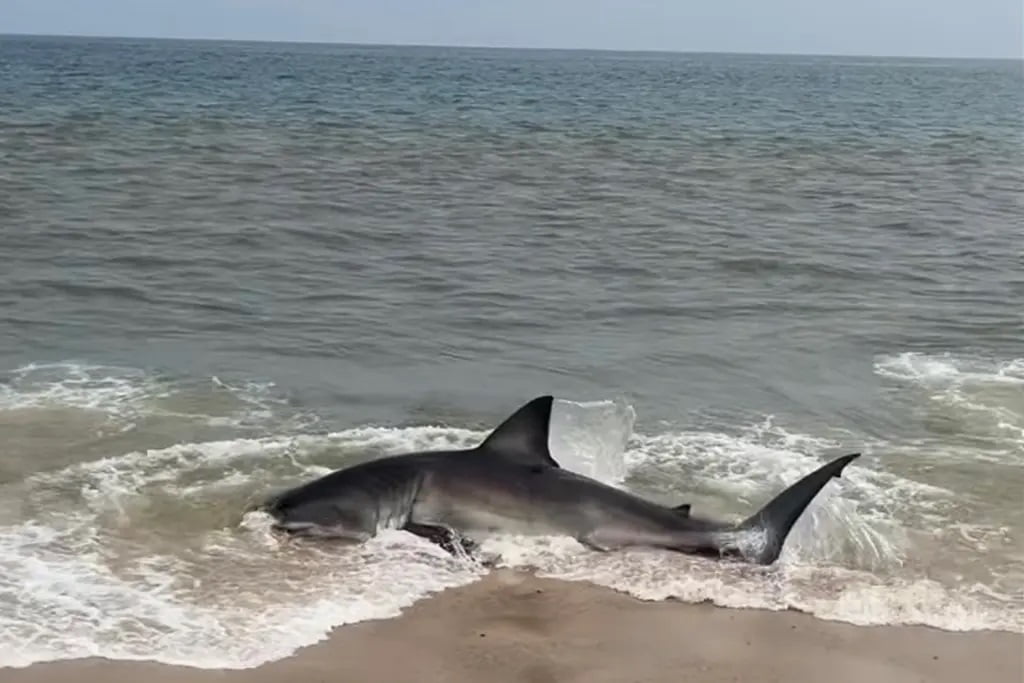
Phillips told the Nantucket Current the fish was helpless. She and houseguest Ted Rock watched for several minutes, hoping it would free itself. It did not. They waded in. They rolled and shoved the shark while staying off the mouth. Phillips went nearly underwater for the last push. The fish caught a wave and swam off. “You don’t expect yourself to feel bad for a great white shark because they are such apex predators and so scary,” she said. She hoped it would tell its “shark friends” she was a friend.
To WCVB she was more specific. “You think of a great white as a predator, a beast, a monster, but watching it in that position, I was like, ‘Oh my God, this is really sad.'” She said the animal was in a weakened state and that a shove-and-run did not feel crazy “because there was no way it was going to turn around and bite my leg off.” That is a visitor’s read of a stunned fish. It is not a protocol.
What response teams want instead of hands on the snout
Wildlife teams still tell the public not to put hands on a large shark. Call a marine-animal response group or local authorities. Keep people and dogs back. Do not stand over the mouth. Do not grab the gills. Do not treat the rescue like a souvenir. Phillips and Rock got away with a successful push. Other beachgoers will not. A ram-ventilating predator in six inches of water is still a predator. The right move on most Massachusetts beaches is a phone call, not a shoulder in the surf.
Nantucket sits in a white-shark corridor fed by a recovered seal population. The island’s south and east shores see animals that follow gray seals the way trucks follow a highway. Low Beach in ‘Sconset is pretty. It is also a place where a white can end up in water too thin to swim. Phillips was on a tight schedule — family, football, a flight — which is how a lot of tourist videos get made. The original Instagram reel remains at C-xm-4puZlE.
The island did not stop producing shark tape
The Atlantic White Shark Conservancy kept tagging animals through 2025 and 2026. WWLP reported that a 10-foot female named Marty became the first newly tagged white of the 2026 Cape Cod season. The Conservancy said she was tagged on July 16, 2026, and then pinged repeatedly off the upper Cape, including North Truro. The name is a partnership gag — Marty is also a Stop & Shop store robot — but the pings are not a joke. They are a map of how often a white uses the same water that fills Nantucket beaches in August.
In June 2026 the island produced a different kind of clip. Angler Elliot Sudal hooked a young great white on the south shore, hauled it onto the sand, pulled the hook, and sent it back in seconds. The Guardian and local outlets ran the footage because it looked like a man wrestling a maneater. Sudal said he posted it to show a fast catch-and-release, not a stunt. Set next to Phillips’ 2024 rescue, the two videos make the same point from opposite directions: people on Nantucket will put their hands on a white shark, and the island’s waters keep giving them the chance.
That is the policy problem hiding under the applause. Massachusetts has spent a decade telling swimmers to download Sharktivity, heed the flags, and treat Cape and Islands beaches as seal country. The message works until a fish is flopping in the shore break and a visitor decides empathy is a plan. Phillips’ clip is moving. It is also a tutorial that response teams did not ask for. The next person who copies it may meet a fish that is not exhausted.
Why a beached white cannot wait for a pretty wave
Ram ventilation is not a metaphor. A great white that cannot swim cannot breathe the way a reef shark can sit still and pump. Sand in the gills makes it worse. Time on a beach in August sun makes it worse again. The window to get a large white into water deep enough to stroke is short. That is why trained crews use slings, boats, and people who have done it. That is also why a football game on Low Beach turned into a rescue: the fish was out of time, and the only people standing there were tourists with phones.
None of that makes Phillips a fool. It makes the island a place where wildlife protocol and vacation instincts collide. The AEGIS Alliance is not scolding a woman who shoved a dying shark into a wave. We are putting the clip next to the official advice so readers can see both. Call first if you can. Stay off the mouth. Do not make the animal’s last minutes a crowd scene. If you do go in, you are accepting a risk that no viral video can underwrite.
For more wildlife reporting from The AEGIS Alliance, see Environment, the Louisiana beach dolphin file, and the sea lion haul-out file that tracks what happens when marine animals and people share the same sand. Related science and coast reporting also lives under Science and U.S. News.
Phillips said she wanted the shark to survive. It did, at least long enough to disappear into a wave. Marty is still pinging off the Cape. Sudal’s fish went back in. Low Beach will look empty again until the next white misses the depth. The AEGIS Alliance will keep the 2024 rescue in the open because it is both a kindness and a warning, and those two things travel together on a Nantucket tide.