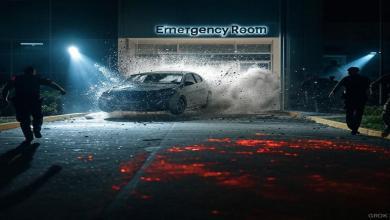
April Love Asked Police for a Hospital, Then Drove a Kia Through Inspira Bridgeton’s Ambulance Doors

The ambulance bay at Inspira Health Center Bridgeton is built so a stretcher can come through the sliding doors and reach a treatment hallway without crossing the public lobby. Just before midnight on December 31, 2024, a white 2017 Kia used that path in the wrong direction. Bridgeton police say April Love, 38, of New Castle, Delaware, drove the car through the ambulance-entrance doors and about 60 feet down the interior hallway. A security officer jumped clear and suffered a minor injury. No patient and no visitor was hurt. Love stayed at the scene. She was not injured in the crash. Patient care in the rest of the building continued.
That sequence is strange enough to travel as a holiday oddity, and early headlines treated it that way. The affidavit of probable cause, reported by NJ.com, 6abcet Breaking AC, tells a longer night. Hours earlier, Love called New Jersey State Police from Seabrook and asked to be taken to a hospital because she was in crisis after an argument involving her mother-in-law. Troopers responded. She then declined to be transported. She told them she wanted to drive herself and wanted an escort. They left. She later told detectives she found her keys, struck two other vehicles while leaving Seabrook, and drove toward Bridgeton, about five miles away, still looking for help.
When she reached Inspira, the affidavit says, she believed no one was going to help her. She drove through the double doors. Police found her afterward uncooperative and seated in a chair, not behind the wheel. She was arrested and taken to the Cumberland County Jail. At a brief video appearance the next day she was in a wheelchair. The criminal complaint put the damage at about $135,000. Those facts are allegations until a court adopts them. They are also specific enough, and sourced to a sworn statement, that the story cannot honestly be written as a driver who simply missed a parking lot.
What broke, and what kept working
Inspira’s statement, given to several Philadelphia and South Jersey newsrooms, is the operational half of the night. Ambulances were diverted until about 3:30 a.m. on January 1 while the damaged entrance was secured and a temporary ambulance door was arranged. The walk-in emergency entrance stayed open the entire time. The health system said patient care at the center was not affected. That claim is plausible and still worth reading carefully. A divert order means a heart attack or a trauma that would have come to Irving Avenue went somewhere else for four hours on New Year’s Eve, one of the busiest nights a small emergency department sees. Nobody in the hallway was struck. The regional system absorbed the miss. Both sentences can be true.
Video recorded inside the hospital, aired by CBS Philadelphia and described by reporters who saw it, showed the Kia wedged in the corridor, glass and door hardware on the floor, the car too wide for the hall and therefore stopped by the walls themselves. Telemundo 62 in Philadelphia ran a short report naming Love, the 60-foot distance, and the ambulance entrance. The pictures explain the mischief charge better than a paragraph can. A sliding door system and the wall finishes behind it are not cheap, and a car that travels 60 feet indoors has already passed the point where a bollard would have mattered. The security officer’s minor injury is what turned a property case into an assault-by-auto count. He was not a bystander on a sidewalk. He was the person whose job is to be in that bay when something comes through the doors.
The charges are a stack, not a story
Bridgeton police and the court records cited by NJ.com and 6abc list three core counts: assault by auto, endangering another person, and third-degree criminal mischief. Some accounts add traffic counts tied to the drive itself. Third-degree criminal mischief in New Jersey is the grade that fits damage on the scale alleged here, above $2,000 and into six figures. Assault by auto, at the fourth-degree level described in early court papers, is the charge New Jersey uses when a driver hurts someone with a vehicle without the mental state required for a more serious assault. Endangering covers the people who were in the path, including a guard who had to dive out of it. Love remained at the scene, which cuts against any claim that she tried to vanish. It does not erase the two vehicles she allegedly struck in Seabrook before she ever saw the hospital.
She told police she had been asking for help and did not believe she would get it. That statement is relevant to why the car was aimed at a hospital rather than at a random storefront. It is not, by itself, a defense, and it is not a full explanation of the two earlier collisions. Crisis and criminal liability are allowed to occupy the same night. New Jersey’s mental-health system and its criminal code do not merge just because the destination was an emergency department. If she wanted admission, the troopers in Seabrook were the lawful route, and the affidavit says she turned the transport down. If she was too impaired by distress to make that decision well, that is a fact a judge can hear at a detention review or a later competency or sentencing proceeding. It is not a fact that rebuilds a $135,000 bay door.
A bay door is a design argument
Hospitals have spent two decades arguing about vehicle attacks, usually after a deliberate ramming aimed at a crowd. Bridgeton does not look like those cases. One car, one driver who stayed, no manifesto, a prior call for help. The design lesson is still sitting in the repair bill. Ambulance entrances are open by purpose. A bollard line that stops a Kia also stops a stretcher if it is placed badly, and it slows the ambulance it was meant to protect if it is placed well but locked. Many emergency departments compromise with planters, a short throat of driveway, and a door that faces a circle rather than a straight run. Inspira Bridgeton’s bay, on the evidence of how far the Kia traveled, gave a driver a straight shot once the glass gave way. The walls eventually did the work a barrier did not.
The security officer is the other half of that design. He was close enough to be hit and fast enough not to be. His minor injury is a data point for every hospital risk meeting that treats « car through the bay » as a slide in a binder. The four-hour divert is the other data point. A rural or small-city emergency department cannot shrug off a lost ambulance door on New Year’s Eve the way a downtown trauma center with three entrances might. Cumberland County has a thin set of options after midnight. Sending rigs elsewhere was the correct call. It was also a tax on every other department that absorbed them.
What the public record still does not contain
Love was held at the Cumberland County Jail in the first days of January 2025 pending further appearances. No later public report located for this account describes a plea, a dismissal, or a sentence. Until one of those appears on a docket the county or a newsroom publishes, the honest status is the one police announced on New Year’s Day: charged, detained at least initially, alleged to have caused six figures of damage and a minor injury, and on record as having asked for hospital help earlier the same night before refusing a ride. Anyone writing her motive past that sentence is guessing.
The night also sits inside a duller problem than a viral crash clip. People in psychiatric distress call police because police answer. Troopers in Seabrook answered. The ride she was offered was the intervention. What happened after they left is the gap every crisis-response study warns about and almost none of them close: a person who will not get in the patrol car, a set of keys still in the house, and a hospital five miles away that can be reached by the same vehicle. Bridgeton police then did the only job left, which was to investigate a car inside a building. Inspira did the job of keeping the walk-in side open while the bay was rebuilt in miniature before dawn.
Readers following other New Jersey criminal files can see how a holiday enforcement action looks when the targets are predators rather than a single driver, in the reporting on Operation Bad Santa. A different kind of emergency, a plane into a building on the other side of the country the next day, is covered in the account of eleven people hurt in a Southern California warehouse strike. The health-system side of American crisis care, including the strange calls that interrupt treatment, comes up in the reporting on a surgeon interrupted mid-procedure by an insurer.
More coverage is filed under crime news, santé, U.S. newset nouvelles étranges.






Hey …..who wants to talk about hacking ??? Anyone
https://videyco.id/BreakingNewsUpdate