Lund’s Niels Bohr Garage Wears Danish Rotor Tips While the Heavy Blade Roots Wait to Become Noise Walls

https://www.youtube.com/shorts/60Jm71I_BF8
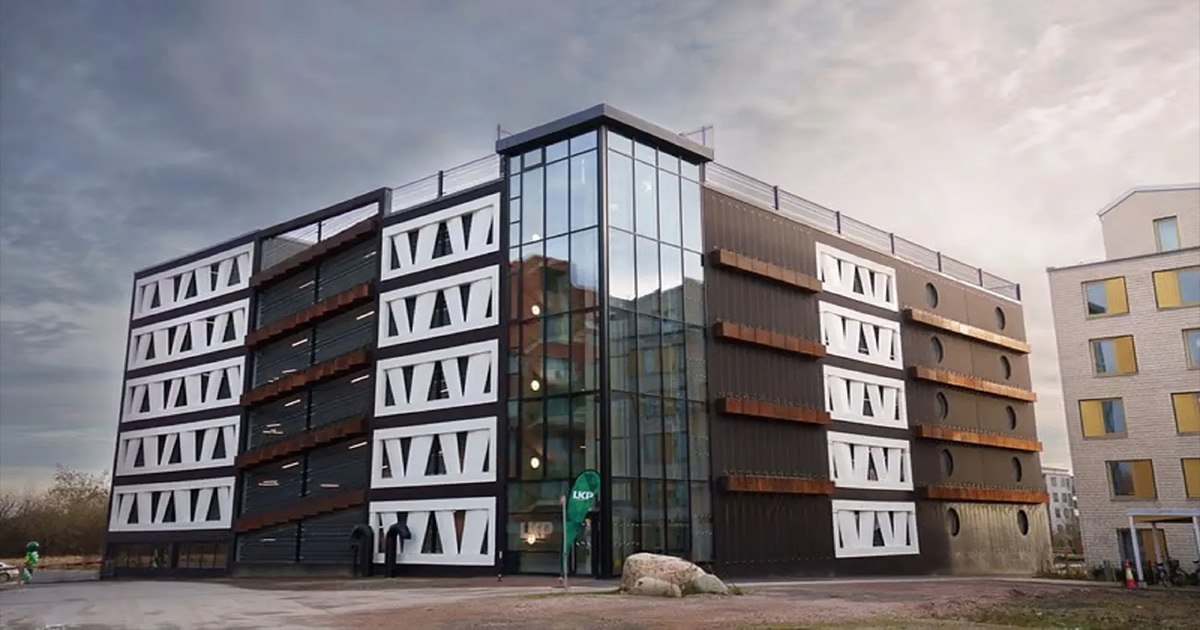
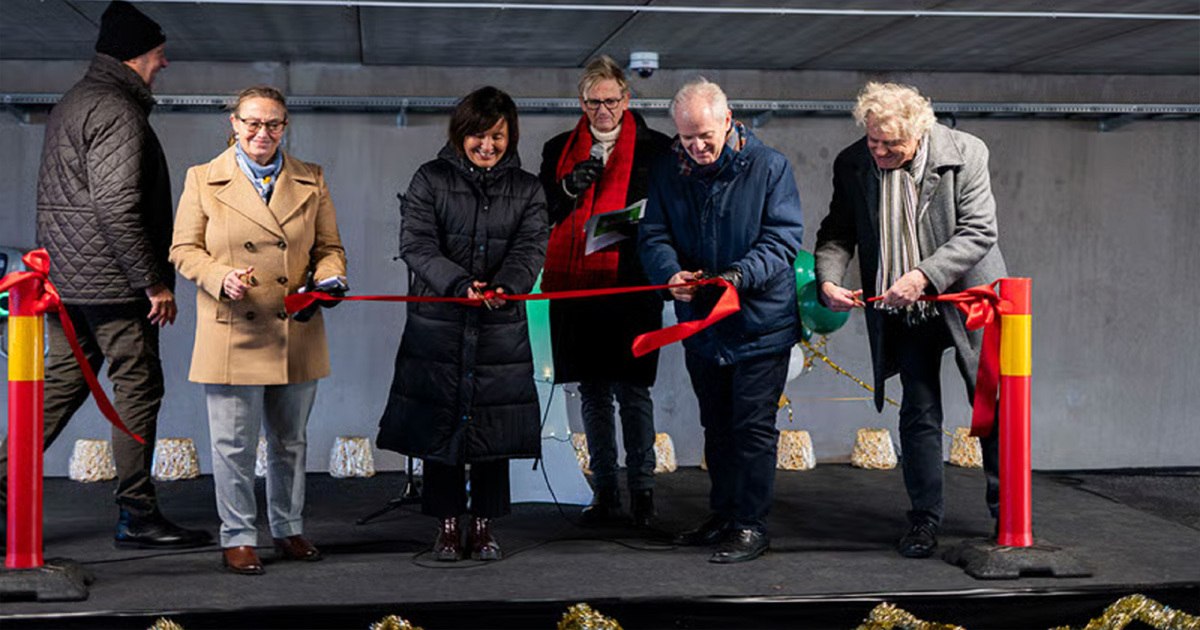
Los consejos de 57 rotores daneses están haciendo un trabajo para el que nunca fueron moldeados. Son la piel del parque automovilístico Niels Bohr en Lund, un garaje municipal de cinco plantas en Brunnshög que Lunds kommunala parkeringsbolag abrió en diciembre de 2025 y que Vattenfall todavía llama al primer aparcamiento en Europa construido de esta manera. Las cuchillas no sostienen los suelos. Son muro cortina, cortadas desde el extremo estrecho de los rotores que pasaron alrededor de dos décadas sobre Nørre Økse Sø en Jutland. Lo que las fotos de la acera salen es la mitad más pesada. Una revisión sueca de investigación publicada a principios de 2026 dice que cada hoja tenía unos 23 metros de largo, que tres paneles de tres metros fueron vistos de la porción delgada para la fachada, y que las secciones de raíz, a unos 13 metros cada una, todavía están sentadas con LKP en Lund, asignadas para una vida posterior que incluye barreras de ruido.
Esa división es el verdadero diseño. El arquitecto Jonas Lloyd de Lloyd's Arkitektkontor quería que la pared se mantuviera reconocible. Su oficina llama al enfoque sostenibilidad visible. Se supone que un conmutador debe ver fibra, curva y ojales y entender que el revestimiento solía cosechar viento. Las raíces, gruesas y torpes, nunca iban a hacer una bonita elevación. Son el problema del inventario que el corte de cinta no solucionó.
A demolition planned around a parking deck
La granja salió del servicio en 2023. El retiro físico corrió a 2024, y el momento es por qué el garaje existe en absoluto. Un estudio de diseño circular hospedado en el portal DiVA de Suecia describe una colaboración entre Vattenfall, la firma danesa de desmantelamiento Kingo, y la oficina de Lloyd que funcionó en paralelo con el proyecto de investigación CIRCUBLADE de 2022 a 2024. Debido a que el garaje ya estaba en la tabla de dibujo, las cuchillas podrían ser cortadas para un edificio conocido en lugar de ser picadas para un vertedero o un horno. Veintiún turbinas suministraron las 57 hojas donadas Vattenfall. Más tarde, los escritos internacionales, incluyendo una característica de septiembre de 2026 que envió las fotografías de nuevo, han dicho 19 turbinas. La compañía y la cuenta del arquitecto son los que coinciden con la cuchilla con la pared.
LKP corre aproximadamente 28.000 espacios a través de Lund. Niels Bohr es un aparcamiento de corta estancia y larga estancia para un distrito construido alrededor de laboratorios, viviendas, y los campus de investigación MAX IV y ESS. La casa tiene 365 puestos, 40 de ellos con cargadores EV, una matriz de techo y una batería para que los coches puedan tomar energía después de la oscuridad sin arrastrar la red. Las plantas se sientan en el mismo plano que el laminado. Nombrar el edificio después de que Niels Bohr vincule una corriente de residuos danés a un parque científico sueco sin pretender que cualquiera de los países ha terminado el problema de desmantelamiento.
Paul Myllenberg, jefe ejecutivo de LKP, ha dicho que la idea levantó cejas dentro de la compañía y que la realidad superó las expectativas. Anne Mette Traberg, directora de país de Vattenfall para Dinamarca, llamó al garaje terminado visible y prueba concreta de que la sostenibilidad puede satisfacer costos, horarios y seguridad. Esas tres pruebas son las que reutilizan los trucos generalmente fallan. Lund los pasó una vez, en un edificio, con piezas donadas y un contratista que conocía la lista de corte antes de que las turbinas golpearan el suelo.
Why the pretty half is the easy half
A blade is glass or carbon fiber locked in a thermoset resin. Heat does not soften that resin. It chars. The U.S. Department of Energy has said for years that about 90 percent of a turbine’s mass already has a scrap path. Towers and copper go back to market. The leftover tenth is almost always the blade. In the American plains, early retirements were sawn into sections and buried, including in Casper, Wyoming. Lloyd has said a magazine story about that burial pile is what turned a waste headline into a façade.
Chemical recycling, cement kilns, and resins designed to unzip on command are the industrial answers. Vestas and Siemens Gamesa have both published processes. None of them is cheap enough, or common enough, to swallow the first generation of European onshore farms coming down in the same decade that offshore blades longer than a football field are going up. Reuse skips the factory. It also skips scale. A city can clad one garage. It cannot clad a fleet.
Vattenfall has banned landfill for its blades and has promised to reuse, refurbish, repurpose, or recycle every blade, nose cone, and nacelle cover by 2030. The company has already turned laminate into ski cores, insulation, and solar-panel frames, and it has turned at least one nacelle into a tiny house. Lund is the first time the parts are large enough, and public enough, that a stranger can argue about them from a sidewalk. The company operates more than 1,400 turbines. When those rotors come down, the photogenic tenth will still need more than one municipal deck.
The roots, and a Dutch screen that actually got measured
LKP still had material after the façade went up. The company ran a public contest for ideas and offered a month of free parking to the winner. That is a press stunt. It is also an admission. The DiVA review is more specific than the contest copy. The remaining root sections are in Lund and are planned for a later stage, including as noise screens. Roots are the heavy end. A 2024 materials paper that tracked this exact cutting plan put the tip-side façade stock near 170 three-metre pieces and sent the 13-metre roots toward a barrier concept. The garage used the light end. The loud end is still in the yard.
The Netherlands has already tested whether that second job is real. On July 2, 2025, startup Blade-Made and Rijkswaterstaat unveiled a 60-metre Blade Barrier along the A58 near Oirschot, built from two whole retired blades and a cut section, varying between three and four metres high. On February 3, 2026, the road authority said the first measurements put the screen’s noise reduction in the same range as a standard concrete barrier about 3.3 metres tall. Monitoring on cost, safety, maintenance, and durability runs through the end of 2026. Acoustic parity on a test stretch is not a procurement program. It is the first number a highway agency can put next to a brochure.
If Lund’s roots follow that path, the garage stops being a one-off sculpture and becomes the tip of a two-product system: façade panels from the slender laminate, barriers from the root. If the roots stain in a yard for another five years, the contest was the strategy. Other concepts in the same research lane imagine blades standing the full height of a building, on the order of 160 blades, with a construction start discussed for 2026. That is a different structural bet than Lloyd’s infill. It is also a reminder that architects are still drawing the third life while the second life is only half installed.
What a driver is actually buying
Brunnshög is one of Sweden’s largest development zones, planned around research infrastructure and a tram. A multi-storey garage looks like a contradiction until the chargers and the battery are counted. LKP is not arguing that cars should vanish. It is arguing that the cars that remain should lean on local generation, and that the box that stores them should not be dead concrete. The same habit shows up in older reporting from The AEGIS Alliance, from an iceberg-shaped tower sold as a climate machine to the quieter fact that battery prices have fallen far enough to change what a parking deck does at night.
Critics of blade reuse have a fair maintenance point. Laminate that spent twenty years in a Jutland wind field will keep taking ultraviolet light and freeze-thaw cycles on a Swedish façade. Fasteners need inspection. If a panel delaminates over a travel lane, the eye-opener becomes a claim. Lloyd designed the blades as infill, not structure, which limits how far a failure can travel. That is competent engineering. It is not a template you photocopy onto every municipal deck in Europe. Coatings weather. A 20-metre curve is a nightmare to truck through a historic center. Insurance still has to stamp a non-standard cladding.
The public argument is larger than Lund. The climate cases moving through U.S. courts are aimed at oil and gas, but the same audience is watching whether wind’s own trash pile undercuts the industry’s pitch. A garage that shows its rotors is a useful photograph. A measured noise screen in North Brabant is a more useful number. Neither one absorbs the volume coming off the hubs. Cement kilns and unzippable resins will still have to carry the bulk. Drivers in Brunnshög will decide the rest the way drivers always do: whether the stall is close, the charger works, and the ramp is not a wind tunnel. Fifty-seven tips that were headed for a pit are now a wall. The roots are still waiting for their second job. That waiting pile, not the ribbon, is the test Vattenfall’s 2030 pledge has to pass.
For more circular-design reporting from The AEGIS Alliance, see the environment desk y el science coverage that follows how energy hardware actually leaves the field.