Jeffrey Epstein’s 1997 Address Book Holding 221 Names Absent From the Later FBI Volume Sold for $10,000 in Elkton

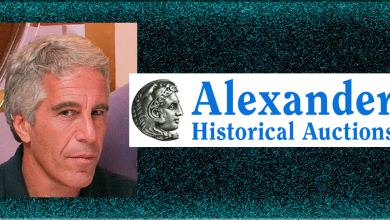
A 64-page address book tied to Jeffrey Epstein sold on April 2, 2025, for $10,000 at Alexander Historical Auctions in Elkton, Maryland. The estimate that day was $20,000 to $30,000. Earlier talk had floated six figures. Owner Bill Panagopulos had already named the problem. Moments before the bidding, he told the Cecil County newspaper the house had tried to sell the notebook with a large reserve and that he had called it radioactive. «There are people who won’t even touch it, right?» The hammer price held at $10,000 through the day. A contact list that collectors once priced like a relic moved for the cost of a used car.
The book is not the circa-2004 volume the FBI used and Gawker published in 2015. A handwritten note dates this copy to October 1997. It is Gestetner-bound in black plastic, 4.5 by 5.25 inches, with 386 printed entries, two extra lines in a childlike hand on the last page, 94 handwritten checkmarks, and five names highlighted in yellow. Donald Trump is one of the highlighted names. The auction house said all five were well-known financial and industrial figures, and that it did not know what the marks meant. Business Insider’s comparison of the two volumes found 1,731 names together, with 221 appearing only in the earlier book.
A name on a page is not a charge. Alexander Historical Auctions said so in the lot. Except for people already tried and convicted, the house said it had no indication the listed individuals committed Epstein’s crimes. The house’s own notable list still startles anyone reading it after 2025, because it includes Health and Human Services Secretary Robert F. Kennedy Jr., the late Senator Edward Kennedy, and attorney Alan Dershowitz, alongside Trump. Appearance proves that a number was written down. It does not prove a crime, a dinner, or a flight. People contacted by reporters over the years have denied meaningful relationships with Epstein. Treating every printed line as a co-conspirator does his collecting for him.
A Sidewalk, an eBay Listing, and a Forensic Exam
The provenance is stranger than the price. Musician Denise Ondayko of Manhattan’s East Village said she found the book on a sidewalk in the 1990s and kept it. After Epstein’s death in 2019 she listed it on eBay. Christopher Helali, later described as the American Communist Party’s international secretary, bought it for $425. Panagopulos said almost nobody believed it was real, and that Helali cared more about the story than the resale. Helali brought in Business Insider. The newsroom spent months on the pages and had forensic examiners at Applied Forensics study the binding. The examiners’ work, and calls to numbers inside the book, are why the object stopped being a sidewalk souvenir.
What the journalists described was a working directory, not a souvenir. Entries ran to alarm codes, modem lines, car phones, a horse stable, and staff beepers for estates Epstein held in that decade. His Paris apartment, bought in the early 2000s, is absent. Little St. James, the island he acquired in 1998, is absent too, though the book lists a contact for the wife of the man who sold it. Relatives’ addresses matched public records. More than a dozen prominent people who had never been publicly tied to Epstein told Insider, on the record, that they had met him in the 1990s. Meeting a financier in 1996 is not trafficking. It is also the method later civil filings described: access first, leverage later.
Helali had wanted a buyer who would chase claims that Epstein was useful to foreign intelligence services, a theory that has circulated for years around Ghislaine Maxwell’s father, Robert Maxwell, and around Israeli and other services. Those claims remain allegations. The plastic pages do not prove them. They prove that someone in Epstein’s orbit kept a dense directory before the Florida plea, the island’s fame, and the 2019 jail death. Offers near $100,000 in 2024 spooked or failed. An August 2024 sale in Cecil County did not close. The April 2025 auction was unreserved. At least one trade database still labels the lot as passed. The Elkton newspaper and the outlet cllct both reported a completed $10,000 sale. The AEGIS Alliance is using the local paper’s account of a finished transaction, and noting the mismatch so readers do not treat a stale listing as a second ending.
A Different Book, a Sting Tape, and a Statute
The cheap relic sat beside a louder records fight. On November 19, 2025, President Trump signed the Epstein Files Transparency Act, Public Law 119-38, ordering the Justice Department to publish unclassified Epstein and Ghislaine Maxwell records in searchable form. The department missed the statutory clock. On January 30, 2026, Deputy Attorney General Todd Blanche said the department had identified more than six million pages as potentially responsive and was releasing a production that, combined with earlier batches, totaled nearly 3.5 million pages, plus more than 2,000 videos and 180,000 images. He said roughly 200,000 pages were redacted or withheld under legal privileges, and he told reporters, «We did not protect President Trump.» Survivors and members of Congress said a late, partial library was not compliance. Senator Chuck Schumer said the final drop landed 42 days after the law required it.
On August 21, 2026, Associate Attorney General Stanley E. Woodward Jr. dated a notice published in the Federal Register on August 27, the report the statute required: categories of records released and withheld, the legal basis for redactions, and a list of government officials and politically exposed persons named in the reviewed materials. A report to two judiciary committees is not the same thing as an unredacted contact book on a table in Elkton. It is the government’s attempt to say the review had a closing memo. Critics have kept arguing about what the memo still hides.
In February 2026, CNN aired Justice Department video of a different transaction. Epstein’s former house manager, Alfredo Rodriguez, often called his butler, tried in 2009 to sell a «little black book» to an undercover FBI employee. That was the later volume, the one law enforcement already knew how to seize. Rodriguez was prosecuted for the attempt. The tape matters because it shows the government has understood for more than fifteen years that Epstein’s directories had a black-market price. A butler tried to sell one. A musician later consigned another. An auctioneer in Elkton had to talk bidders into touching the second. The public file is a searchable pile that still leaves survivors arguing about the pages that never posted.
A Social Map Is Not a Verdict
The AEGIS Alliance has tracked that argument across the unredacted later book, the document cache this newsroom obtained, el admission that early 2026 releases were a fraction of the holdings, journalist Katie Phang’s lawsuit over disclosure, y Bank of America’s $72.5 million settlement with survivors. The running file lives on the Crime News desk. The 1990s book is a social map from the decade before the plea. The statute is the unfinished courtroom. The $10,000 sale is what the market paid when it decided it did not want to be the next custodian.
Public posts around the April auction treated the pages as a political weapon and invited buyers to send a direct message. That pitch is the opposite of the auction house disclaimer, and it is the opposite of what a criminal case requires. Epstein collected people. Some used him. Some were used. Some were children. The distinction is the case. A highlighted surname, including a future cabinet secretary’s, is a lead for a researcher and a nothing for a jury until documents, flights, or testimony attach to it. Readers who skip that step will misread both this book and the 3.5 million pages.
Panagopulos was not wrong about radioactivity. Radioactive objects still change hands. This one left Elkton for an unnamed buyer after a sidewalk, an eBay fluke, a forensic exam, and two failed sales. The Justice Department’s August 2026 report did not retire the argument about what remains sealed. A 1997 directory will not retire it either. It will keep reminding the public that Epstein’s network was written into small plastic pages, with checkmarks nobody has fully explained, long before the cameras, the island, and the jail cell.



Secret bidder is Bill Gates.