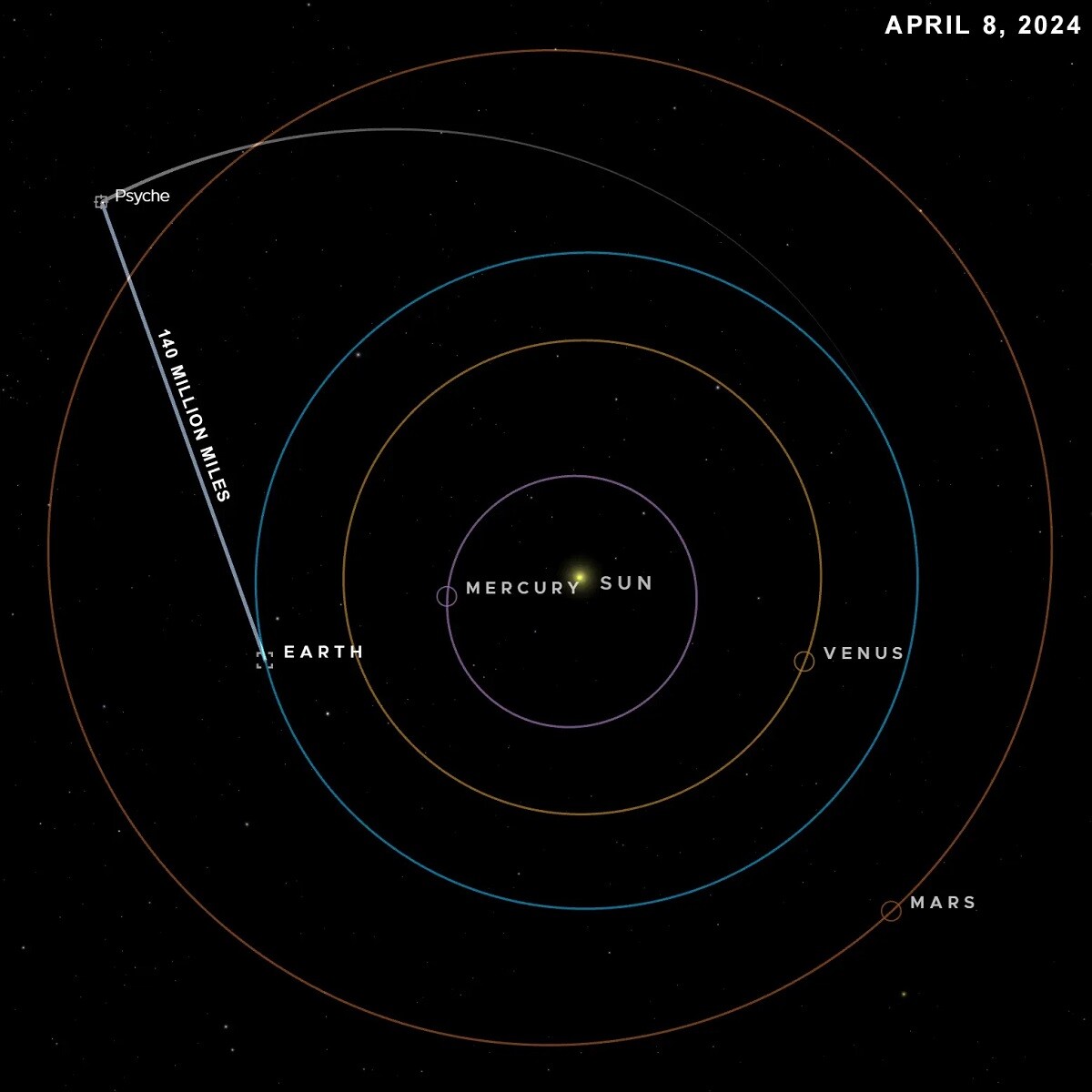
On April 8, 2024, a near-infrared laser left NASA’s Psyche spacecraft from about 140 million miles away, one and a half times the distance from Earth to the Sun, and the photons landed. The instrument doing the sending was Deep Space Optical Communications, DSOC, a technology demonstration bolted to a probe whose real job is a metal asteroid. Radio has carried spacecraft data for sixty years. A laser is a tighter beam, easier to lose, and, when it locks, fast enough that a future crew on Mars could send video instead of a drip of stills. That April pass moved test data at up to 25 megabits per second. To keep the comparison honest, Psyche also sent a copy of the same engineering data on its ordinary radio, so the two pipes could be scored side by side.
“This achievement showcases our commitment to advancing optical communications as a key element to meeting our future data transmission needs,” then-Administrator Bill Nelson said at the time. Dr. Abi Biswas, DSOC’s project technologist at the Jet Propulsion Laboratory, put it in mission language. The experiment was there to pave a road for Artemis and, later, for people on Mars. The road turned out to be shorter than the spacecraft’s cruise, and longer than anyone’s skepticism. DSOC flew on Psyche from launch on October 13, 2023, worked past every goal the project had written down, and was switched off as a demonstration on September 2, 2025. The spacecraft kept going. In May 2026 it used Mars itself as a slingshot. The confirmation that the slingshot had worked came the old way, by radio.
一只猫,然后是历史记录
DSOC’s showpiece arrived early. On December 11, 2023, the flight laser transceiver streamed a 15-second ultra-high-definition video of an orange tabby named Taters chasing a laser pointer. Taters lives with a JPL employee. The file had been loaded before launch. It left the spacecraft from about 19 million miles, roughly 80 times the distance to the Moon, at the system’s maximum 267 megabits per second, a household broadband rate, and took 101 seconds to reach the Hale Telescope at Caltech’s Palomar Observatory in San Diego County. Downlink on that pass was decoded in real time. The project team at JPL watched a cat video arrive from deep space and treated it, correctly, as an engineering result.
The distances after that stopped being a stunt. In the summer of 2024 DSOC held a link from around 240 million miles and then from nearly 290 million miles, about as far as Mars ever gets from Earth. On December 3, 2024, it downlinked Psyche data from about 307 million miles, 494 million kilometers, farther than the average Earth-Mars gap and a record for optical communications. Peak rates told the same story in reverse. Nearer in, the ground laser receiver saw 267 megabits per second. Out around 249 million miles the downlink was still 8.3 megabits per second at the peak, with a sustained rate of 6.25. That is the number that matters for a Mars mission at its farthest, not the cat video at its closest. Over the two-year prime experiment the ground terminals took in 13.6 terabits. The flight terminal pointed with microradian accuracy. The kilowatt-class uplink lasers at JPL’s Table Mountain facility near Wrightwood, California, did it without lighting up an aircraft or a satellite by accident. A superconducting nanowire detector array caught photons that had crossed a large piece of the inner solar system.

NASA closed the books on September 2, 2025, with a 65th and final pass. The spacecraft was 218 million miles out, about 2.34 astronomical units. Acting Administrator Sean Duffy said the demo had put high-definition video from Mars inside the realm of hardware rather than slogans. Biswas was more cautious about a sequel. Redundant radios on Psyche made another laser pass unnecessary for the mission itself. There was no approved plan to turn DSOC back on. The earliest window anyone was willing to name, if a sponsor found the money, was late summer or early fall of 2026, after Psyche’s Mars flyby. That window has now arrived. Public updates from NASA after the flyby describe a healthy spacecraft, a good trajectory, and a return to solar-electric thrusting. They do not describe a laser link switched back on.
火星作为服装排练 无线电作为证人
On May 15, 2026, Psyche passed 2,864 miles above the Martian surface, 4,609 kilometers, high enough to miss the atmosphere and low enough for gravity to matter. Navigators at JPL had set the aim point so Mars would hand the probe about 1,000 miles per hour and tilt its orbital plane by about a degree relative to the Sun, with no propellant spent on the turn. Don Han, the navigation lead, said the Doppler from NASA’s Deep Space Network, watched in real time, confirmed the boost. Bob Mase, Psyche’s project manager, said the spacecraft was on the path it needed for a rendezvous with asteroid 16 Psyche in the summer of 2029, with orbital insertion targeted for August. Sustained thrusting on the solar-electric engines, the Hall thrusters that sip power from the arrays and accumulate speed slowly, was set to resume later in the fall of 2026.
The flyby was also a dress rehearsal. The team pointed the science instruments at a planet they already know so they could trust those instruments at a world they do not. The multispectral imager, a pair of cameras, returned a crescent Mars on approach at about 5:03 a.m. Pacific on May 15, then a fuller disk after closest approach, including the double-ring crater Huygens in the southern highlands. A time-lapse stitched from the month of approach, pass, and departure became the public face of the encounter. The gamma-ray and neutron spectrometer and the magnetometer were exercised against Martian ground truth. 美国航天局 说这些仪器是按设计进行的,并增加了一些其他轨道没有的几何测量数据。 没人指望有新的火星 他们需要一个校准的飞船。

The irony is the useful one. DSOC was built because radio is too thin for the data a human Mars mission will want to send home. The maneuver that actually bent Psyche’s path in 2026 was verified by that same radio, the Deep Space Network doing what it has done since the 1960s. Laser communications did not fail. They finished a demonstration, exceeded it, and then sat dark while the probe they rode on kept using the older pipe. JPL = DSOC ==. A July 2026 engineering write-up of the ground laser terminal said the same thing in more technical language: the two-year campaign showed optical links can support Mars and beyond, and turning a demo into an operational system is a different job, still ahead.
巡航结束时的小行星
Sixteen Psyche, the destination, is a large body in the main belt between Mars and Jupiter, and the reason the mission exists. If it is the stripped core of a planetesimal, an early planetary building block, it is the closest thing NASA can orbit to the metal under our own feet. The spacecraft will map it, read its composition with the spectrometer, and measure any magnetic field. Arrival in August 2029 is the science. Everything before that, including a cat video and a gravity assist, is the getting there. Other countries are not waiting. In August 2026 Chinese researchers reported a two-way laser link across the Earth-Moon distance, on the order of 248,000 miles, with a downlink around 100 megabits per second. That is cislunar, not deep space. It is still a sign that the radio era’s monopoly is being contested from more than one flag.
AEGIS联盟已经覆盖了这个问题的另一半,这不是速度而是记账. 更快的下行链路不会帮助 如果你已经失去了上面的线索。 这个 {\fn黑体\fs22\bord1\shad0\3aHBE\4aH00\fscx67\fscy66\2cHFFFFFF\3cH808080}你觉得呢 是目录,在一个物体。 军方的激光工作再次出现 X-37B QQ434 天的飞行后又进行了激光通信测试高频带链路的远端 任何人都会吃什么的问题 假火星泥土作物的瓦斯宁根研究番茄翻了一番,胡萝卜不见了 乐队不种食物。 它确实决定了人们吃它 是否能够向地球展示他们在做什么 比明信片更好的东西。
Psyche’s laser has already answered the question Nelson posed in April 2024. The photons arrived, the cat arrived, the record distance arrived, and 13.6 terabits of proof are on the ground. What has not arrived is a program that treats that result as the new default instead of a finished experiment. The spacecraft is healthy, the Mars pictures are in, and the metal world is three years out. The radio will carry the cruise. The laser is the part NASA has not yet decided to need again.
更多节拍是AEGIS联盟的 常规 办公桌。