NASA’s Psyche Laser Sent 13.6 Terabits From Deep Space, Then Mars Flung the Spacecraft Toward a Metal Asteroid

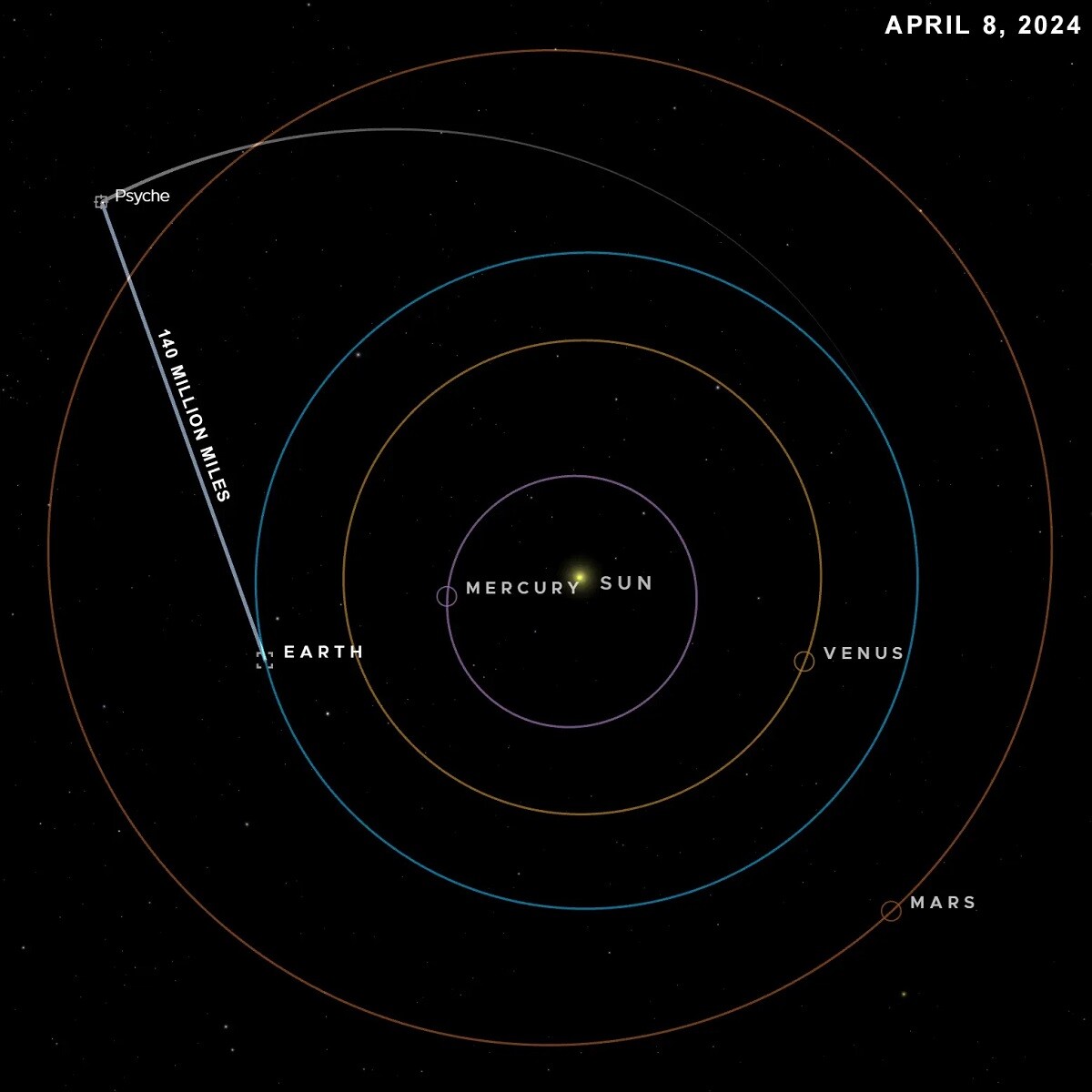
On April 8, 2024, a near-infrared laser left NASA’s Psyche spacecraft from about 140 million miles away, one and a half times the distance from Earth to the Sun, and the photons landed. The instrument doing the sending was Deep Space Optical Communications, DSOC, a technology demonstration bolted to a probe whose real job is a metal asteroid. Radio has carried spacecraft data for sixty years. A laser is a tighter beam, easier to lose, and, when it locks, fast enough that a future crew on Mars could send video instead of a drip of stills. That April pass moved test data at up to 25 megabits per second. To keep the comparison honest, Psyche also sent a copy of the same engineering data on its ordinary radio, so the two pipes could be scored side by side.
“This achievement showcases our commitment to advancing optical communications as a key element to meeting our future data transmission needs,” then-Administrator Bill Nelson said at the time. Dr. Abi Biswas, DSOC’s project technologist at the Jet Propulsion Laboratory, put it in mission language. The experiment was there to pave a road for Artemis and, later, for people on Mars. The road turned out to be shorter than the spacecraft’s cruise, and longer than anyone’s skepticism. DSOC flew on Psyche from launch on October 13, 2023, worked past every goal the project had written down, and was switched off as a demonstration on September 2, 2025. The spacecraft kept going. In May 2026 it used Mars itself as a slingshot. The confirmation that the slingshot had worked came the old way, by radio.
A Cat, Then a Record Past Mars
A peça do DSOC chegou mais cedo. Em 11 de dezembro de 2023, o transceptor laser de voo transmitiu um vídeo de 15 segundos ultra-alta definição de um tabby laranja chamado Taters perseguindo um ponteiro laser. Taters vive com um empregado da JPL. O ficheiro tinha sido carregado antes do lançamento. Ele deixou a espaçonave de cerca de 19 milhões de milhas, aproximadamente 80 vezes a distância para a Lua, no máximo 267 megabits do sistema por segundo, uma taxa de banda larga doméstica, e tomou 101 segundos para chegar ao telescópio hale no observatório palomar da caltech em San Diego. A ligação ao passe foi descodificada em tempo real. A equipe do projeto da JPL assistiu um vídeo de gato chegar do espaço profundo e tratou-o, corretamente, como um resultado de engenharia.
As distâncias depois disso deixaram de ser um truque. No verão de 2024, o DSOC manteve uma ligação de cerca de 240 milhões de milhas e, em seguida, de cerca de 290 milhões de milhas, até onde Marte chega da Terra. Em 3 de dezembro de 2024, ele baixou os dados da Psyche de cerca de 307 milhões de milhas, 494 milhões de quilômetros, mais longe do que a distância média Terra-Marte e um registro para óptica comunicações. As taxas de pico contaram a mesma história ao contrário. Mais perto, o receptor laser terra viu 267 megabits por segundo. Ao redor de 249 milhões de milhas, o downlink ainda era 8,3 megabits por segundo no pico, com uma taxa sustentada de 6,25. Este é o número que importa para uma missão de Marte na sua mais distante, não o vídeo gato no seu mais próximo. Ao longo dos dois anos de experiência primária, os terminais terrestres tomaram 13,6 terabits. O terminal de voo apontou com precisão microrradiana. O kilowatt-classe uplink lasers na instalação de Montanha de Mesa da JPL perto de Wrightwood, California, fez isso sem acender uma aeronave ou um satélite por acidente. Um detector supercondutor de nanofios capturou fótons que atravessaram um grande pedaço do sistema solar interno.

A NASA fechou os livros em 2 de setembro de 2025, com um passe de 65 e final. A nave espacial estava a 218 milhões de milhas, cerca de 2,34 unidades astronómicas. O administrador Sean Duffy disse que a demo colocou vídeo de alta definição de Marte dentro do reino do hardware em vez de slogans. Biswas foi mais cauteloso sobre uma sequela. Os rádios redundantes na Psyche fizeram outro laser passar desnecessário para a própria missão. Não havia nenhum plano aprovado para ligar o DSOC. A primeira janela que alguém estava disposto a nomear, se um patrocinador encontrou o dinheiro, foi no final do verão ou início do outono de 2026, depois de Psyche's Mars voar. Essa janela já chegou. Atualizações públicas da NASA após o flyby descrevem uma nave espacial saudável, uma boa trajetória, e um retorno ao impulso solar-elétrico. Não descrevem uma ligação laser ligada novamente.
Mars as a Dress Rehearsal, Radio as the Witness
Em 15 de maio de 2026, Psyche passou 2.864 quilômetros acima da superfície marciana, 4.609 quilômetros, o suficiente para perder a atmosfera e baixo o suficiente para a gravidade importar. Navegadores na JPL definiram o ponto de mira para Marte entregar a sonda cerca de 1.000 milhas por hora e inclinar seu plano orbital por cerca de um grau em relação ao Sol, sem propelente gastou na curva. Don Han, o líder de navegação, disse que o Doppler da Rede Espacial Profunda da NASA, assistiu em tempo real, confirmou o impulso. Bob Mase, gerente de projeto da Psyche, disse que a nave espacial estava no caminho necessário para um encontro com o asteroide 16 Psyche no verão de 2029, com inserção orbital alvo em Agosto. O impulso sustentado sobre os motores solares-elétricos, os propulsores Hall que saboreiam energia das matrizes e acumulam velocidade lentamente, foi definido para retomar mais tarde no outono de 2026.
The flyby was also a dress rehearsal. The team pointed the science instruments at a planet they already know so they could trust those instruments at a world they do not. The multispectral imager, a pair of cameras, returned a crescent Mars on approach at about 5:03 a.m. Pacific on May 15, then a fuller disk after closest approach, including the double-ring crater Huygens in the southern highlands. A time-lapse stitched from the month of approach, pass, and departure became the public face of the encounter. The gamma-ray and neutron spectrometer and the magnetometer were exercised against Martian ground truth. NASA’s account of the flyby said the instruments behaved as designed and added a few measurements from a geometry other orbiters do not have. No one expected a new Mars. They needed a calibrated spacecraft.

The irony is the useful one. DSOC was built because radio is too thin for the data a human Mars mission will want to send home. The maneuver that actually bent Psyche’s path in 2026 was verified by that same radio, the Deep Space Network doing what it has done since the 1960s. Laser communications did not fail. They finished a demonstration, exceeded it, and then sat dark while the probe they rode on kept using the older pipe. JPL lists DSOC’s status as past. A July 2026 engineering write-up of the ground laser terminal said the same thing in more technical language: the two-year campaign showed optical links can support Mars and beyond, and turning a demo into an operational system is a different job, still ahead.
The Asteroid at the End of the Cruise
Sixteen Psyche, the destination, is a large body in the main belt between Mars and Jupiter, and the reason the mission exists. If it is the stripped core of a planetesimal, an early planetary building block, it is the closest thing NASA can orbit to the metal under our own feet. The spacecraft will map it, read its composition with the spectrometer, and measure any magnetic field. Arrival in August 2029 is the science. Everything before that, including a cat video and a gravity assist, is the getting there. Other countries are not waiting. In August 2026 Chinese researchers reported a two-way laser link across the Earth-Moon distance, on the order of 248,000 miles, with a downlink around 100 megabits per second. That is cislunar, not deep space. It is still a sign that the radio era’s monopoly is being contested from more than one flag.
The AEGIS Alliance has covered the other half of this problem, which is not speed but bookkeeping. A faster downlink does not help if you have lost track of what is already up there. The Space Force’s reacquisition of a Cold War balloon satellite that had been missing for 25 years is that catalog, in one object. The military’s own laser work showed up again when the X-37B went back up with a laser-communications test after a 434-day flight. And the question of what anyone would eat at the far end of a high-bandwidth link is still the one in the Wageningen study of crops in fake Martian dirt, where a tomato doubled and a carrot lost. Bandwidth does not grow food. It does decide whether the people eating it can show Earth what they are doing in something better than a postcard.
Psyche’s laser has already answered the question Nelson posed in April 2024. The photons arrived, the cat arrived, the record distance arrived, and 13.6 terabits of proof are on the ground. What has not arrived is a program that treats that result as the new default instead of a finished experiment. The spacecraft is healthy, the Mars pictures are in, and the metal world is three years out. The radio will carry the cruise. The laser is the part NASA has not yet decided to need again.
More of this beat is on The AEGIS Alliance’s Ciência secretária.