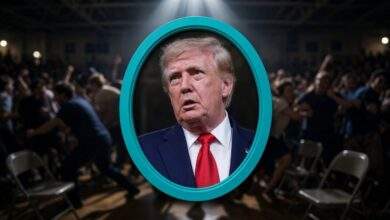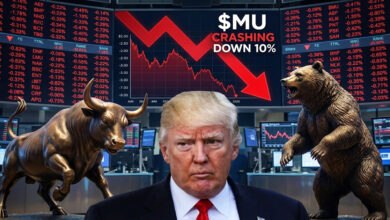
Trump Called Micron One of the Hottest Companies on Earth While Shares Fell About 10 Percent the Same Day


La lode presidenziale dovrebbe essere un'offerta. Il 1o luglio 2026, era una didascalia in un giorno rosso. Mentre le azioni Micron Technology stavano cadendo circa il 10,67 per cento, Donald Trump ha postato sulla Verità Social che il produttore di memoria era una delle aziende "HOTTEST" ovunque e Celebrato un "storico $250 milioni" impegno a trombare conti da CEO Sanjay Mehrotra. Ha firmato con l'età d'oro dell'America. 24/7 Wall St. put the drop on a name that had already run roughly 754 percent over the prior year and about 227 percent in 2026, with a market value near $1.17 trillion. The tape did not salute. L'Alleanza AEGIS is interested in what happens when industrial policy, a branded children’s account, and a president’s own brokerage statement share a publish button.
L'assegno era reale. Il 30 giugno, Micron ha detto che avrebbe messo $250 milioni in conti Trump, i veicoli 530A legati al 250 ° anniversario del paese. La società sarà abbinare i contributi dei dipendenti fino a $1,000 per bambino di età inferiore a 18 anni, e segnerà un deposito di $250 una volta per i bambini in luoghi in cui opera: Idaho, New York, Virginia, California, Colorado, Minnesota e texas. Micron ha detto che l'impegno era il più grande del suo genere da una società e potrebbe raggiungere fino a un milione di bambini. Mehrotra ha ringraziato il segretario del Tesoro Scott Bessent per "un altro modo significativo per sostenere i bambini e le famiglie". La maggior parte dei soldi, ha detto la società, sarebbe atterrare nella sua proprie città di fabbrica. Un chipmaker che scrive un assegno di nove cifre in un programma che porta il nome del presidente non è carità in un vuoto. È una società che finanzia un marchio, su una piattaforma che il presidente possiede, mentre il proprietario del marchio detiene lo stock.
He Had Already Called It Hot, the Day After He Bought More
July 1 was not the first caption. On March 26, Trump went on Fox News’ “The Five,” said he had just left Micron’s leadership, and called the firm one of the hottest companies. What he did not say on television, and what Yahoo Finance later laid out from the disclosures, is that he bought between $50,000 and $100,000 of Micron the day before. That purchase sat on top of three earlier buys. The reported range for the lot, from early March through March 25, runs from about $217,000 to $530,000. The shares then rose more than 230 percent off that March mention, most of it on the AI memory rally rather than on the sentence. A disclosure range is wide on purpose. Even the floor is enough to make a social-media blessing look like a conflict with a send button. The trust is run by his children. It is not blind. He knows what is in it.
Anyone who treats the June 30 pledge as a civic gesture and the July 1 post as a separate event is doing the company’s communications work. Retail traders screenshot the all-caps line. Institutions mark inventory. The gap between those rooms is the story. Markets have watched celebrity posts shove meme names around for a decade. A sitting president who discloses a six-figure position in a liquid large-cap, praises it on March 26, collects a branded donation on June 30, and praises it again on July 1 is a different animal. A follow-up post claimed the stock was up on the day. Coverage split on the exact print. The close did not. Down about 10 percent is the print that matters.
The business underneath the caption was not weak. On June 24 Micron reported fiscal third-quarter revenue of about $41.5 billion, against expectations near $35.8 billion, and earnings of $25.11 a share against a consensus near $20.78. The Motley Fool later noted revenue had more than quadrupled from a year earlier, with guidance around $50 billion and a gross margin near 86 percent for the following quarter. High-bandwidth memory for Nvidia-class systems, not a Truth Social adjective, is what produced those numbers. After a run that steep, a 10 percent giveback is what extended names do when the tape wants air. By July 17, Morningstar’s MarketWatch file had Micron down 26.5 percent for the month and still up about 197 percent for the year, with a forward price-to-earnings ratio that had compressed to 5.7. By July 19 the shares sat about 30 percent under a 52-week high near $1,255. More than $400 billion of market value had come off the name. Samsung and SK Hynix were down more than 20 percent from their own highs. Memory had entered a bear market while the order book still looked like a boom.
Nine Days Later the Number Added Three Zeros
On July 9 Micron said it would invest more than $250 billion in the United States through 2035, adding about $50 billion to a previously announced $200 billion domestic plan, with a stated aim of making 40 percent of its DRAM in the country and a jobs figure above 90,000. Business Insider said the shares popped as much as 9 percent that morning. Commerce Secretary Howard Lutnick praised the decision as proof that “America is where you should build.” Trump was back on the app calling it an effect with his name on it. That instrument is not the same as a $250 million deposit into a children’s account. One is a factory plan. The other is a check written toward a brand. Both arrived while the president was a disclosed holder.
The factory plan will be judged by concrete, power, and water, not by a video. In Clay, New York, CHIPS Act awards of up to $6.165 billion sit behind a campus of as many as four fabs, with about $4.6 billion tied to the first two New York plants, $1.5 billion to Idaho, and up to $275 million to Manassas, Virginia. Tree clearing on the Phase 1 and Phase 2 footprint wrapped in March 2026. Micron told residents they would see the first concrete by September 2026. On January 16, Neighbors for a Better Micron and Jobs to Move America sued in New York Supreme Court, asking a judge to void permits after challenging Onondaga County’s environmental review. Microsoft’s neighbors at Fairwater, in the Wisconsin noise case, already know the half of industrial policy that does not make the Truth Social post: a plant that runs all night, a grid that was not built for it, and a town left to litigate the hum.
The Market Traded Wafers, Not Compliments
The same physical scarcity sits under The AEGIS Alliance file on Google rationing Gemini for Meta. Chips, power, and racks are the constraint. Presidential adjectives are not. If Nvidia’s customers have booked the wafers, Micron’s tape will follow the booking. That is why July 1 is useful as a civic document. It showed a limit on the idea that the president can talk a liquid large-cap wherever he wants, even when he owns a piece of it. By the last week of September, traders were still treating the name as a live memory-pricing test, with the shares swinging through a wide band around $900 to $1,100 ahead of another earnings print, well under the summer peak and nowhere near a slogan.
Washington has spent two administrations trying to onshore advanced memory. Subsidies, defense talk, and a $250 billion pledge sit in that lane. The information flow is still the product. A president who buys the stock, praises the issuer, accepts a nine-figure branding gift, and then claims the shovel as his effect has already told the market what kind of disclosure environment this is. Ethics offices can study the ranges later. The July 1 close already priced the compliment near zero.
Hottest Is a Slogan
Related coverage lives on The AEGIS Alliance politica, businesse Stati Uniti d'America desks. The AEGIS Alliance will keep the March purchases, the June 30 pledge, the July 1 print, and the Clay permits on the same page. Hottest is a slogan. Ten percent down is a close. The only number that outlasts the post is whether a fab in Clay actually pours concrete, and whether the neighbors who sued in January are still in the room when it does.