An Ohio Smoker’s Tongue Grew a Green Coat After Clindamycin, and Brushing Fixed What an Antifungal Could Not

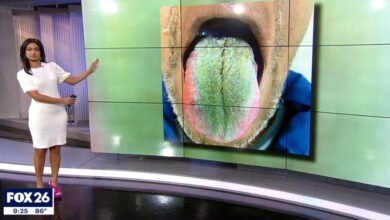
The photograph looks like a practical joke played on a medical journal. A 64-year-old man’s tongue, photographed in Ohio, is coated in a dense green mat that reads as hair, algae, or something growing in a gutter. It was none of those. It was his own tongue, specifically the filiform papillae on the top surface, which had stopped shedding, stretched far past their usual length, and trapped enough pigment, debris, and microbes to turn emerald. The picture ran in the New England Journal of Medicine in July 2023. The diagnosis was hairy tongue. The color was the rare part. The behavior that produced it was ordinary: cigarettes, plus a common antibiotic for a gum infection.
Eric Karr, D.O., and Brian Elliott, M.D., wrote the case up as an image, not a mystery novel. A man who still used tobacco came in with a two-week history of discoloration. On exam, the papillae were elongated and the coating was green. He could taste. He was not in pain. There were no other sores that suggested a spreading infection. The drama was almost entirely visual, which is why the picture escaped the journal and entered the feeds. Elliott later pointed at the image himself and said it had been a clinical challenge in the journal. The journal, a week after publication, listed the case among its most-viewed pieces.

The tongue was green and furry, closer to a film of growth than to a stain. (The New England Journal of Medicine)
The timeline matters more than the shock. Physicians at a primary care clinic at Wright-Patterson Air Force Base, near Dayton, saw him after the color had already been there for two weeks. About three weeks before that visit he had finished a course of antibiotics for a periodontal infection. Reporting on the case identified the drug as clindamycin, a workhorse antibiotic that also rearranges which bacteria get to live in the mouth. Soon after the color appeared, someone treated it as thrush, the yeast infection formally called oral candidiasis, and prescribed an antifungal. The tongue did not care. Antifungals are the right tool when yeast is the disease. They are the wrong tool when the disease is a failure of housekeeping on the tongue’s surface.
Filiform papillae are the small conical projections that give a healthy tongue its velvet. They are not the taste buds people imagine when they say the word papilla. Taste is mostly elsewhere. These structures are about a millimeter tall when the mouth is shedding them on schedule. Keratin, the same protein in skin and hair, builds them. Normally the tips wear off against food, the teeth, and saliva. When they do not, they can stretch toward a centimeter and beyond, and case descriptions put the extreme near 18 millimeters. At that length they act like a shag carpet. Food dyes, coffee, tea, tobacco, mouthwash, bacteria, and yeast settle in and name the color. Black is so common that the old name is lingua villosa nigra, black hairy tongue. The American Academy of Oral Medicine notes that the same carpet can come up brown, white, green, or pink, depending on the cause and on whatever the person has been rinsing or eating. Candy can do it. So can a colored mouthwash. Green is memorable because it is uncommon, not because it is a different disease.
Smoking does two jobs at once. It dries the mouth and it feeds a film of bacteria and tar that makes the overgrowth harder to miss. Antibiotics do a third job. They do not dye the tongue. They change the neighborhood. A drug aimed at infected gums can suppress the organisms that usually compete with the ones that stain, and it can coincide with a stretch of worse hygiene because the mouth already hurts. The Ohio patient had both triggers stacked: a finished course of clindamycin and a cigarette habit he was not ready to drop. Doctors who see this pattern often reach first for yeast, exactly as his first prescriber did, because a coated tongue is how thrush advertises itself. The miss is understandable and still a miss. Hairy tongue is a mechanical problem wearing a microbial costume.
The treatment matched the mechanism. Nobody scraped him in an operating room. He was told to brush the top of the tongue gently with a toothbrush four times a day, and he was told to stop smoking. Six months later the tongue was pink again. He was still smoking. That outcome annoys the morality play and instructs the clinic. Removing the carpet did not require a perfect patient. It required repetition. The papillae will shed if something wears them down often enough. A toothbrush is crude, cheap, and, in this chart, sufficient. Quitting tobacco would have lowered the odds of a sequel. It was not, in his case, the thing that erased the first chapter.
How common is a condition that can look this extreme and still be filed under reassurance? The estimates are messy because mild cases never reach a camera. Clinic samples sometimes find it in a fraction of one percent of mouths. Broader descriptions, including material from the American Academy of Oral Medicine cited by local physicians when this case broke, put a lifetime brush with it as high as about 13 percent of people. It clusters in men, in people over 40, and in anyone who smokes, drinks a great deal of coffee or black tea, breathes through the mouth, wears down their saliva with certain drugs, or has just taken a broad-spectrum antibiotic. Head and neck radiation is another classic precipitant. Cancer, dehydration, and a soft diet that never scrapes the tongue can contribute. The Ohio man sat in the middle of the cluster: older, male, a smoker, freshly off an antimicrobial.
Most people who develop it are not sick in the dramatic sense. Taste can dull. Breath can sour. A long carpet can tickle the palate or trigger a gag. Pain is a reason to look for something else, including yeast, geographic tongue, or a lesion that is not hair at all. Oral hairy leukoplakia, a different entity associated with immune suppression, fools people because the names share an adjective. Leukoplakia is not a keratin carpet stained green by tobacco. The journal that published the Ohio image has published that other diagnosis too. The photographs should not be swapped, and neither should the treatments.
A related mistake is to treat every strange tongue as a party story and stop. Researchers have been training software to read tongues for anemia, diabetes clues, and other illness, a line of work The AEGIS Alliance covered when imaging tools began scanning the tongue for disease. A green carpet is not that project. It is a reminder that the mouth keeps a diary of the last drug and the last pack. The diary is readable without an algorithm if a clinician asks what finished three weeks ago and whether anyone has brushed past the teeth.
Prevention is dull on purpose. The Academy’s advice is that brushing the top of the tongue belongs in ordinary hygiene, not in a rescue plan after a photograph escapes a journal. A scraper does the same job if the bristles make a person gag. Water, less all-day coffee when the mouth is already dry, and a conversation about tobacco do more than a second antifungal. Antibiotics remain necessary for real gum infections. The lesson is not to refuse clindamycin. The lesson is to warn the patient that the tongue may change, to skip the yeast drug unless yeast is actually there, and to hand over a toothbrush instruction before the coating becomes a news photograph.
Tobacco harm is a longer argument than one chart. Cigarettes did not invent this condition, and this man recovered without quitting, which is the sort of fact tobacco marketing would love to steal. It does not travel. Smoking remains a standing risk for the carpet’s return, for cancer, and for gum disease of the kind that got him the antibiotic in the first place. The AEGIS Alliance has argued for years that panic about nicotine alternatives has been aimed at the wrong target, including the record on vitamin E acetate and the lung injuries that were blamed, wholesale, on vaping. A green tongue is not a brief for any product. It is a brief for looking at what the mouth is actually growing.
There is a small human detail beside the clinical one. The patient is unnamed, as these images usually are. He did not become a campaign. He became a teaching file: wrong first drug, right second instruction, follow-up at half a year, habit intact, mucosa repaired. Hairy tongue is the sort of diagnosis senior physicians love because it lets them be calm in front of a frightened person. The calm is earned only after the antifungal reflex is questioned.
Anyone who wants the unpaywalled version of the logic can read the Academy’s hairy-tongue page and the journal’s image, filed as N Engl J Med 2023;389:e3, DOI 10.1056/NEJMicm2300789. The DOI is the adult way to meet the photograph. The adult way to avoid starring in the next one is simpler than a subscription. Brush the surface that the mirror is trying to tell you about. If a new medicine has just ended and the color is new, take the timeline to a clinician before you take another antifungal on a guess.
More reporting on the body, the drugs, and the claims made about both lives in health news from The AEGIS Alliance.










Come on now 😆
There’s some dog shit involved somewhere to be sure.
Yeah my bank account filled up with millions after years of spending all my money
Yeah I can now fly after drinking red bull
That tongue has never been brushed. No teeth either