A Stevenage-Built Rover Named Rosalind Franklin Will Drill Two Metres Into Mars Clay for Human Ancestors

A questão sob Oxia Planum é se alguma química parecida com a nossa, se ainda está lá em baixo, começou na Terra, começou em Marte, ou começou na mesma fria dispersão de rocha e gelo. Em 2 de junho de 2026, um jornal em Icarus Mapeou uma unidade de argila com mais de 600 quilómetros de diâmetro, através de mais de um quilómetro de altitude, da região de aterragem do rover em direcção a Mawrth Vallis. O ExoMars Rosalind Franklin Rover, construído pela Airbus em Stevenage, é a primeira máquina planejada para perfurar dois metros naquela argila. O lançamento é no final de 2028. Touchdown está planeado para 2030.
Susanne Schwenzer, professora de mineralogia planetária da Universidade Aberta e cientista interdisciplinar na missão, afirmou a versão mais nítida da aposta. "Se a vida emerge no momento em que pode, talvez tenha surgido lá e vindo para cá. Se a vida é a mesma lá, pode ser que todos nós somos do mesmo ancestral", disse ela. "É possível a panspermia? É possível que a vida viaje de um planeta para outro? Não sabemos, mas são todas perguntas que temos que responder." Um furo não é uma árvore genealógica. É a amostra suficientemente profunda para tornar a questão real.
Why the Rosalind Franklin Rover Has to Drill Past a Sterile Crust
Marte uma vez manteve lagos, rios, e possivelmente um oceano profundo, sob uma atmosfera e um campo magnético. Essa janela sobrepõe-se ao Bombardeamento Pesado Late, cerca de 4,1 a 3,8 bilhões de anos atrás, quando os impactos poderiam ter produzido aminoácidos. Marte arrefeceu mais rápido que a Terra. O dínamo falhou, o escudo magnético desmoronou, e o vento solar despojou ar e água. Há cerca de 3,7 bilhões de anos, a superfície estava morta. Desde então, os raios cósmicos quebraram moléculas orgânicas na camada superior em fragmentos, um laboratório se esforçaria para chamar um fóssil.
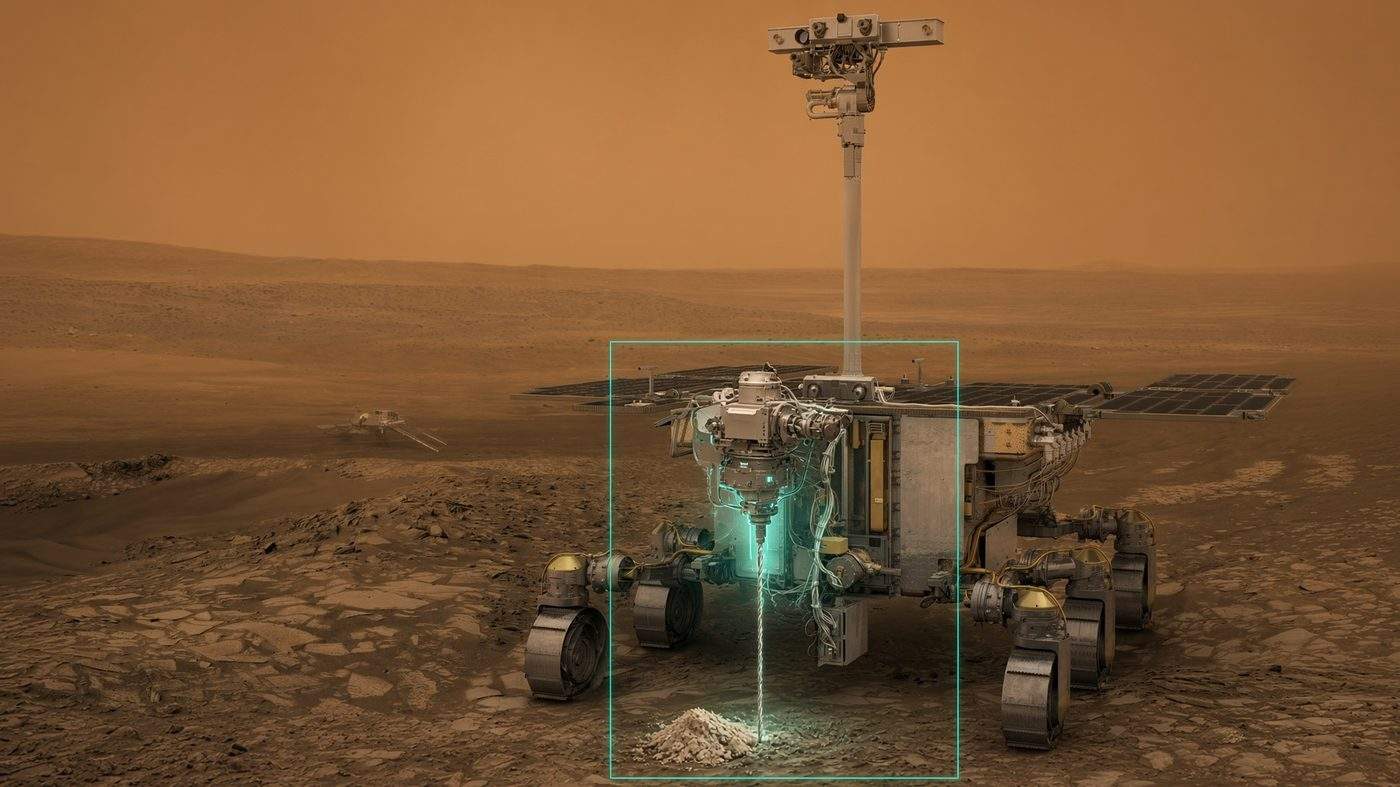
The European Space Agency notes que a caça mais profunda por moléculas orgânicas em Marte ainda é de cerca de 15 centímetros, uma marca definida pelos landers vikings. Mais tarde rovers abrasou pedras e escavou poeira. A broca de Rosalind Franklin combina três barras de extensão até que a corda tenha dois metros de comprimento, e a sequência é executada sem uma mão no interruptor. Um infravermelho na parede do furo registra minerais à medida que o pedaço passa. A amostra cai, em gravidade marciana, num braço coletor e na gaveta do laboratório analítico.
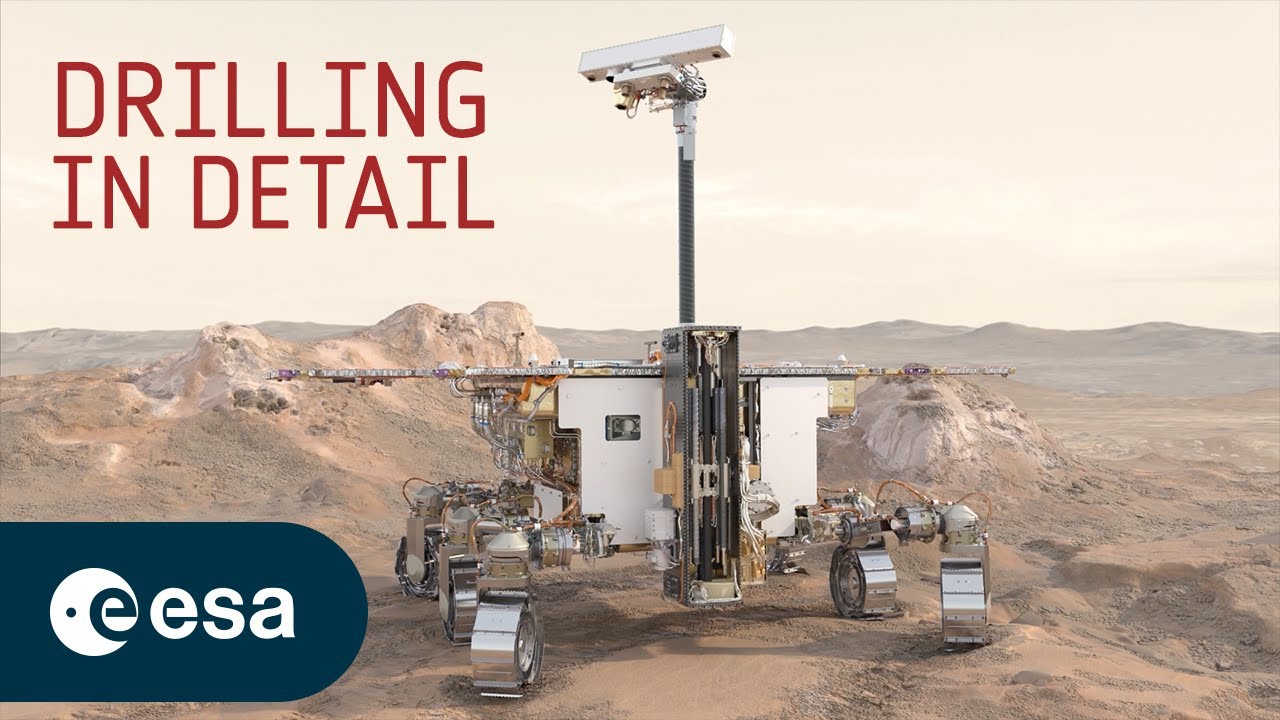
O número de planeamento da ESA é de cerca de 70 metros de condução num dia marciano. Os comandos saem do Centro de Controlo de Operações Rover em Turim, e um sinal de rádio demora entre quatro e 21 minutos para cada caminho. Nos dias de abertura de outubro de 2026, Airbus e ESA ensaiaram esse atraso com um protótipo chamado Charlie durante um julgamento de oito dias no deserto de Tabernas perto de Almería. As câmaras panorâmicas, o radar WISDOM e o espectrómetro infravermelho Enfys foram ligados ao circuito de Turim.
Oxia Planum Clay Is a Regional Water Record
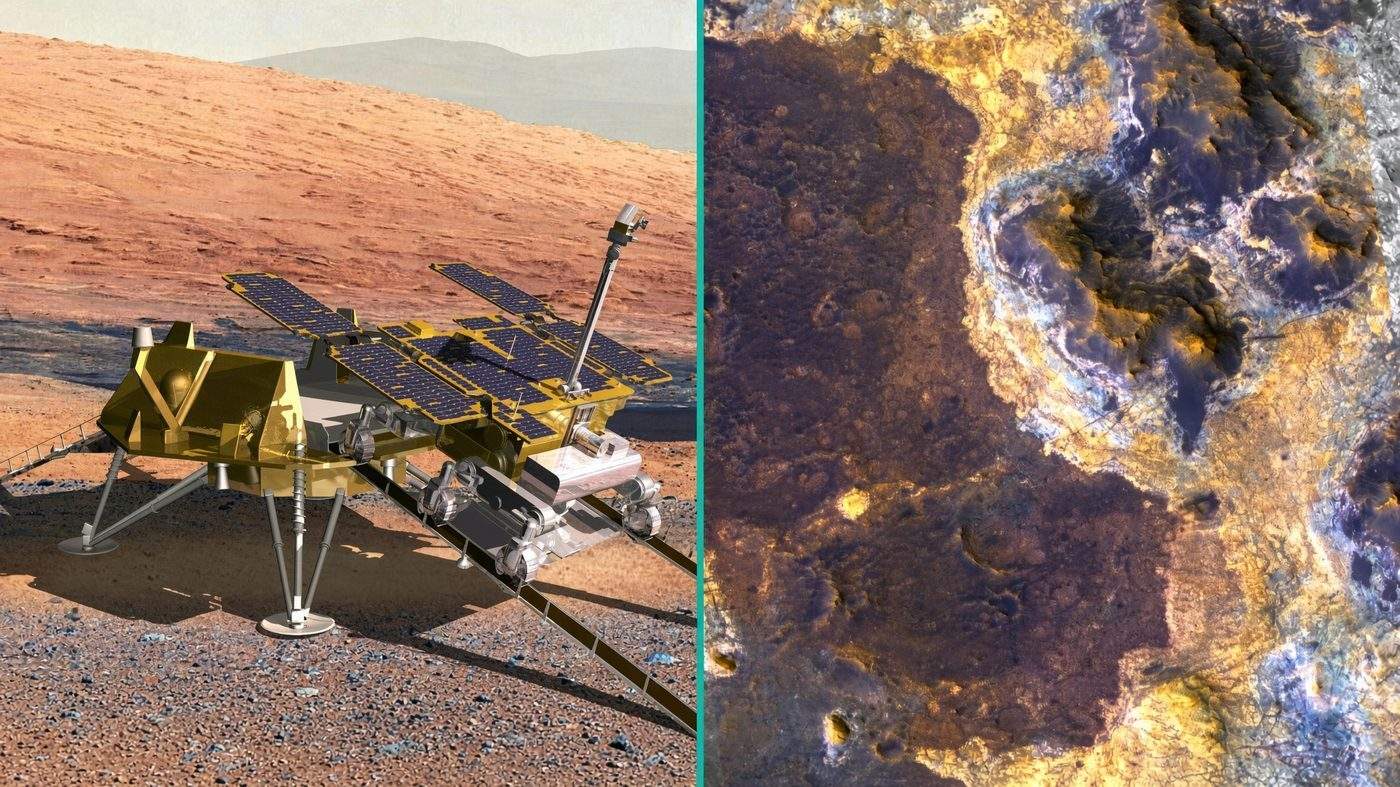
The landing ellipse sits near 18 degrees north, on the eastern edge of the Chryse basin. Inès Torres Auré of the University of Lyon, lead author of the Icarus estudo, disse Oxia Planum argilas formaram primeiro, cerca de quatro bilhões de anos atrás, e anterior aqueles em Mawrth Vallis, cerca de 300 quilômetros de distância. Uma paleosuperfície craterada entre as unidades marca uma pausa, depois uma mudança na química da água. ESA’s account of the paper, dated 4 June 2026, treats that sheet as the oldest target in the sequence.
Jorge Vago, the ExoMars project scientist, did not shrink the scale. “Because the area is so large, we are not talking about a localised occurrence, but rather a regional or global process that would have required immense amounts of water,” he said. Elliot Sefton-Nash, the deputy project scientist, added that warmth and nutrients on an early Martian seabed could have been habitats. The paper separates a basal magnesium-rich smectite from a later iron-rich nontronite that is widespread at Mawrth Vallis and only patchy southeast of Oxia Planum. The rover cannot walk 600 kilometres. It can test whether the orbital story survives a core.
A typical Mars transfer lasts about nine months. This cruise runs closer to two years so touchdown falls in northern-hemisphere spring, with sunlight on the solar arrays and clear of global dust storms. NASA’s Jet Propulsion Laboratory helped European engineers through earlier parachute failures. The main canopy, about 35 metres across, is heat-sterilised in the Netherlands so Earth microbes do not become the life the drill claims to find.
A DNA Pioneer’s Name on a Machine Built to Read Chemistry
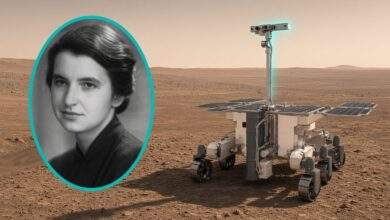
The rover carries the name of Rosalind Franklin, whose X-ray work at King’s College London, including Photograph 51, showed the helical structure of DNA. James Watson and Francis Crick built the famous model with data that included hers, and the Nobel Prize went to them after her death. The UK Space Agency has described the name as a link between a Mars life search and a scientist whose measurements changed how life on Earth is described. The link holds only if the instruments ask a molecular question.
PanCam, from University College London’s Mullard Space Science Laboratory, builds the maps that pick a drill site. Enfys, the infrared spectrometer tied to Aberystwyth University, reads minerals the wheels can reach. A Raman laser spectrometer checks chemical bonds once a sample is inside. NASA supplies the mass spectrometer and key electronics for MOMA, the Mars Organic Molecule Analyzer. WISDOM checks whether the surface mineral continues downward. CLUPI photographs cuttings before they enter the lab. With the rest of the Pasteur payload, eight instruments in all, they are a field kit for a claim orbit cannot settle.
The Launch Politics Kept Moving
Airbus finished the flight rover in Stevenage and delivered it to Thales Alenia Space in 2019. A 2022 launch was real enough that the vehicle was waiting. After Russia’s full-scale invasion of Ukraine, ESA ended the partnership with Roscosmos, which had been supplying the descent hardware. On 30 March 2025 ESA selected Airbus to design a European landing platform, with Stevenage on the structure, the braking propulsion, and the landing gear. The UK government said the contract would support about 200 skilled jobs. Sener has pointed to flight legs in the fourth quarter of 2026. In September, ESA showed leg deployment and backshell separation as hardware that had already moved.
The American share nearly vanished for a reason that had nothing to do with parachutes. In 2025 the Trump Administration proposed cancelling NASA’s contributions to Rosalind Franklin, inside a wider attempt to gut science missions. Those pieces are the launch, the braking engines, the radioisotope heater units that keep the rover alive through Martian nights, and the mass spectrometer inside MOMA. Cutting them would have left Europe with a finished rover and no honest way to land it or read its most important samples. Congress rejected the cuts in the fiscal year 2026 NASA budget. On 16 April 2026 NASA cleared the Rosalind Franklin Support and Augmentation project, known as ROSA, for implementation, and named SpaceX’s Falcon Heavy to fly it from Launch Complex 39A at Kennedy Space Center. It is the fourth rocket written into this programme. A rover that cannot stay warm does not drill.
What a Matching Molecule Would and Would Not Prove
Benoît Pouffary, who heads exploration preparation, research, and technology at ESA, has said the quiet part. “I do believe that life may have happened on Mars, it seems something that is credible,” he said. “Today our view is of Earth as a little world alone but if we find evidence there was life in another time, and another area of our solar system, it suggests life is everywhere, absolutely. The way we imagine our universe would be changed forever.” Schwenzer called that prospect “almost frightening to think about, because it changes everything.”
A chemical match is not a pedigree. Amino acids can form without a cell, and a film in a clay pore can look organised without being anyone’s ancestor. Panspermia also has a direction. Rock leaves Mars more easily than it leaves Earth, and meteorites from Mars already sit in collections here. A Martian origin for terrestrial life is a hypothesis with a transport path, not a verdict this rover can sign. The drill can say whether complex organics sit below the irradiated skin of one clay sheet that formed when both worlds were wet.

Work on Earth that only pretends to be Mars is the useful comparison. A PLOS ONE greenhouse trial found a tomato could double its fruit in simulated Martian soil while other crops failed, a result The AEGIS Alliance reported when NASA later paid menu prizes that still do not grow a meal in perchlorate. A laser on Psyche has already moved terabits across a Mars-like distance. Neither answers whether Oxia Planum was ever alive. The science desk, technology desk, e international file will keep the borehole and the budget together, inside the wider news section. A shared ancestor has to survive a mass spectrometer. An empty core would mean this seabed did not keep a chemistry we recognise. The rover still has to roll down a ramp in the Martian spring of 2030, carrying the heaters the Trump Administration was prepared to strike from the page.







One Comment