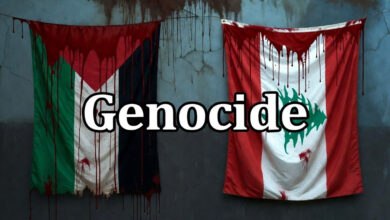
Israel Katz Boasted That Not One House Remains in 24 Lebanese Villages as Armor Crosses the Yellow Line


Israel Katz did not describe a raid. He described a method he said had already been transferred. On Israeli Channel 14 he boasted that the army had “destroyed Gaza,” then said the same model had been carried into southern Lebanon: 24 villages, hundreds of years old, “not one house” left standing, 15,000 to 20,000 homes, above ground and under it.
That boast is the cleanest confession this war has produced, and it is no longer a March slogan. By early September 2026 the line Israel drew inside Lebanon had already stopped being a ceiling. The National, reporting from Haris on September 2, found Israeli tanks and armored bulldozers crossing the so-called yellow line into at least three communities. In the Arayesh neighborhood, Wissam Moussa said his wife, three children, and their domestic worker were trapped for hours while a bulldozer and a tank tore up the road about 500 meters past the mark. In Al Mansouri, in the Tyre district, Mayor Haidar Mdayhli told the paper about 80 percent of the village is gone, at least half of that destruction coming in the weeks after a forced displacement order. His parents’ house is gone. His brothers’ houses are gone. “The village is gone.” A Aliança AEGIS names that pattern for what it is: the genocide in Gaza, copied onto a second country and then pushed past the map Israel itself published.
A Yellow Line That Moves When the Bulldozer Does
On March 31, 2026, Defense Minister Israel Katz said every home in Lebanese villages near the border would be destroyed “in accordance with the model used in Rafah and Beit Hanoun,” so the threat would be removed “once and for all.” He added that the army would keep security control up to the Litani River and that more than 600,000 residents of southern Lebanon would not be allowed back south of that river until northern Israel felt safe. Reuters recorded the vow and the early ledger of the offensive that opened on March 2: more than 1.2 million people displaced and at least 1,200 killed in Lebanon in those first weeks. Finance Minister Bezalel Smotrich talked about the Litani as a new border. Lebanon’s social affairs minister, Haneen Sayed, called the ground operation a land grab that risks making displacement permanent.
On April 18 the Israeli military announced the yellow line on Lebanese soil, the same device it had hardened inside Gaza after a U.S.-brokered ceasefire. Al Jazeera noted it was the first time Israel used that phrase there. Anyone approaching from the north was declared a threat. Amnesty International measured what followed the April 17 ceasefire announcement. Three days later the military published a “Forward Defence” map covering about 600 square kilometers, roughly 6 percent of Lebanon, listing 74 villages, barring return to 53 of them, and forbidding people to cross south of 21 more. The army also told civilians to stay away from the Litani and the al-Salhani and al-Saluki valleys. Satellite imagery showed near-total clearing of border municipalities that, in 2024, had still contained isolated standing structures. Amnesty called the scale of the orders, and the prolonged ban on going home, the war crime of unlawful transfer.
Katz then removed the word temporary. On June 15, 2026, after talk of a wider ceasefire, he said Israeli forces “will remain in the security zones in Lebanon, Syria and Gaza without any time limit,” and that those zones would be cleared of residents and of “all terror infrastructure,” including houses in contact-line villages. A minister who puts three countries in one sentence is not managing a skirmish. He is describing an occupation belt with no sunset, built by making return physically impossible. The yellow line is the paperwork. The rubble is the policy. When the bulldozer crosses the paperwork, as it did in Arayesh, the line reveals itself as a press graphic.
Sectarian Demolition Is Still Demolition
On September 22, CNN’s Jeremy Diamond reported from inside Israeli-occupied south Lebanon. Predominantly Shia towns had been reduced to rubble. Three Christian villages were spared the demolition policy and left standing, but their residents were cut off from the rest of the country. Sparing a church town while erasing the village next to it is not restraint. It is a sectarian sort of the same collective punishment. The people who remain cannot farm a normal week, cannot reach a hospital without crossing a line that shoots, and cannot pretend the standing walls are freedom. CNN’s April satellite review had already found southern clusters flattened in the pattern rights groups documented in Gaza. Bellingcat’s May survey of PlanetScope imagery found at least 46 of 54 towns and villages inside the yellow line heavily damaged or entirely flattened. Katz and Prime Minister Benjamin Netanyahu visited troops inside Lebanon and talked about making sure houses cannot be reused as “terror outposts,” the identical pretext used while Gaza neighborhoods were ground down.
“Terror outpost” is what an army says when a kitchen is still upright. Hezbollah’s rockets, and the 2024 campaign against its leadership, are real facts. They do not create a legal right to flatten civilian towns, to pick which sect keeps a roof, or to forbid hundreds of thousands of people from walking home. Embedding is the argument Israel used in Gaza until the ground itself disappeared. Copying Rafah and Beit Hanoun in the hills above Tyre is how a genocidal method travels. Turkey said the ground operation belonged to “genocidal and collective punishment policies, this time in Lebanon.” The death toll in Gaza, the destruction of hospitals and universities, the engineered hunger, and the refusal of return have already been named genocide by scholars, UN experts, and governments. A second map does not make it a different war.
The Buffer Is Being Normalized as the Peacekeepers Prepare to Leave
On September 19, Reuters reported from south Lebanon that Israeli troops were still in place, that Hezbollah had not fully disarmed, and that farmers and tradespeople could not rebuild a livelihood under that stalemate. The same day the UN peacekeeping chief in Lebanon said a smooth transition was critical before a pull-out. A peacekeeping mission planning its exit while a foreign army announces an indefinite security zone is not a ceasefire architecture. It is a handover of the landscape to the bulldozers. On September 25, Beirut Wire carried an Israeli Channel 12 claim that the army had completed destruction of what it calls Hezbollah infrastructure inside the yellow line and was preparing a new phase of fighting within days. Completion, in this vocabulary, means the villages are already gone. The next phase means the line can move again.
Historic villages become outposts. Orchards become fields of fire. A river becomes an annexation talking point. Reconstruction estimates become a second invoice the world is expected to pay after the first invoice was delivered as munitions. The World Bank put needs from the 2024 campaign, which displaced more than a million people, near $11 billion. The 2026 offensive picked up the same ledger and added a no-return map. Families who tried to go back after earlier paper ceasefires found the road treated as infiltration. That is how a temporary mark becomes a border, and how a genocide playbook is tested for export. If Rafah can be repeated behind Tyre, and then pushed 500 meters past Israel’s own line, without a rupture in the capitals that arm this army, the model is no longer an emergency. It is inventory.
The AEGIS Alliance treats this as one war system. The file sits beside the killing of Saleem al-Ashqar, the attempts to criminalize speech about that killing, including Canada’s ban on Rima Hassan and the French case against her, the bans on humanitarian groups in Gaza, and the ceasefire strikes partners condemned and did not stop. Readers can stay on international news. Israel named the model. The satellites counted the villages. The September armor showed the line was never the limit. The AEGIS Alliance will not pretend a second country makes the erasure a different crime.