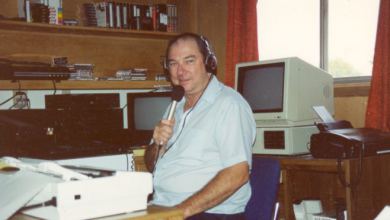

EAGAR, ARIZONA — On the night of June 28, 2001, Milton William Cooper sat in a studio he had built in the den of a hilltop house at 96 North Clearview Circle and told the audience of The Hour of the Time that a catastrophe was coming. “Something terrible is going to happen in this country,” he said. “And whatever is going to happen they’re going to blame on Osama bin Laden. Don’t you even believe it.” He said the target would be a large American city. He told people to be prepared for a major attack. He did not name an airline, a date, or the World Trade Center. Seventy-five days later the towers and the Pentagon were hit, and bin Laden’s name was on every screen in the country.
On November 5, 2001, a little before midnight, Apache County sheriff’s deputies shot Cooper dead in the yard of that same house. He was 58. The official ruling was justifiable homicide. He had shot a deputy in the head. His listeners still call the raid an execution he had described in advance, on the same show: they would come up the hill in the middle of the night and shoot him on his doorstep. Both versions are in the record. The AEGIS Alliance is not going to launder either one into a certainty it cannot prove. A broadcaster who put bin Laden’s name on a coming attack, then died in a gunfight with police eleven weeks after the planes, is a file that still belongs in public.
What the broadcast actually was
The June 28 show was not a sealed prophecy delivered in a vacuum. Cooper opened on something CNN was running, a report that a camera crew had reached bin Laden in a hideout and interviewed him with his lieutenants. He played pieces of CNN’s famous Peter Arnett package, the one shot in the Afghan mountains, and he asked the obvious question in his usual growl. The largest intelligence services on earth, with the biggest budgets in history, had failed to find bin Laden for years. A reporter with a crew, he said, had walked in. He treated that as a tell, not as journalism. From there he made the leap his audience still replays: nobody in U.S. intelligence was really looking, an attack was being prepared, and bin Laden would be the name attached to it afterward. “Don’t you even believe it.”
That is a weaker claim than the meme, and a more interesting one. Bin Laden was already a wanted man. He had been tied to the embassy bombings and, less than a year earlier, to the attack on the USS Cole. Donald Trump’s 2000 book The America We Deserve had already warned about a bin Laden strike on American soil. Cooper did not invent the threat. What he did, on a shortwave and satellite show most newspaper readers had never heard, was reject the coming official story before the official story existed, and he did it by date and by name. On September 11 itself he stayed on the air for hours. Archived audio has him, that day, arguing the towers came down by controlled demolition. He was not waiting to be vindicated. He was already building the next argument.
The man who wrote the book
Cooper was born Milton William Cooper on May 6, 1943, in Long Beach, California. He was a Navy veteran. He said he had held Top Secret, Q, and SI clearances while working at the CINCPACFLT command center at Makalapa, in Hawaii, and that what he saw there turned him. The Navy service is real. The clearances and the briefing-room revelations are his account, repeated until they hardened into biography. In 1991 he published Behold a Pale Horse, an underground bestseller that stapled leaked documents, UFO lore, a theory of secret societies, and a running indictment of the CIA and the Council on Foreign Relations into one paperback. It circulated in militia circles, in prisons, and on the early web. Mainstream obituaries later called him a militia theoretician. They were not wrong about the company he kept. They were incomplete about the book’s afterlife.
He was often loudly wrong. He warned about microchips, named apocalypse dates that came and went, and treated disagreement as proof of complicity. The useful instruction he gave his own audience is the part worth keeping: read everything, listen to everybody, and do not trust anything you cannot prove yourself. Applied to Cooper, that rule cuts both ways. It forbids turning a June broadcast into evidence of inside knowledge he never documented. It also forbids pretending the broadcast did not happen because the man was unreliable on other nights.
The warrants, the shot, and the story that replaced him
By the fall of 2001 the Apache County Sheriff’s Office was not theorizing about shortwave radio. Deputies had a warrant tied to aggravated assault, and Cooper had tax problems stacked beside it. He had talked on air about killing any officer who came to take him. Investigators believed the house on the hill was full of guns. The sheriff’s office, wary of a smaller Waco, did not knock at noon. Accounts of the operation say deputies drew him out late on November 5. Cooper got out of his vehicle and was nearly at the front door when he turned and fired. One round hit Deputy Robert Marinez in the head and left him gravely wounded. Deputy Joseph Goldsmith fired back, emptying his gun, nine shots. Cooper died in the yard. Some retellings put the death on November 6 because the shooting was so close to midnight. The date on the official incident is November 5.
Supporters still emphasize the details that look like a setup if you already believe one: unmarked vehicles, plain clothes, a night approach, a man who had just spent the summer saying an attack would be blamed on a CIA-linked bin Laden. The deputies emphasize a different detail, and it is not ambiguous. Cooper shot one of them in the head. A department does not need a conspiracy to return fire after that. Calling the shooting a murder, without new evidence, is a slogan. Calling it proof that the June 28 broadcast was empty is a different slogan. He had also said, on the air, that they would come at night and kill him on the doorstep. People who predict their own death at the hands of police, and who also promise to shoot police, create a fact pattern that can be read as prophecy or as a dare. The autopsy does not pick a reading.
What happened to the ideas is easier to track than what happened in the yard. Behold a Pale Horse became a source book for a later generation that had never heard an hour of his show. Researchers who mapped QAnon kept finding Cooper’s architecture underneath it: a hidden government, a coming reveal, a warning not to trust the name on the marquee. The anonymous poster who called himself Q did not cite Cooper. The audience often did. When The AEGIS Alliance wrote about the takedown of QMap, the line back to Eagar was already there. Cooper would have hated parts of what came next, and he spent real airtime attacking other broadcasters he thought were milking the same fears. Influence is not endorsement.
Twenty-five years after the planes, the broadcast is still passed around as a clip with the nuance stripped out. The honest version is shorter than the caption. A Navy veteran with a pirate radio show, a bestselling paperback full of claims he could not prove, and a warrant on the kitchen table told his listeners in late June 2001 that a terrible attack was coming and that bin Laden would be blamed. The attack came. He did not live to the end of the year. Read the transcript. Read the sheriff’s account. Do not outsource the conclusion to either one.
Related from The AEGIS Alliance: Hiding in Plain Sight, , Epstein autopsy, Jimmy Carter’s UFO encounter, and our QMap takedown.
If you speak up about future events that will happen the government will come after you and take you out and make it seem like suicide or they will just have someone take you out. This is very true.
The planes you saw were actually computer-generated images used to hide the explosive thermite when it was detonated
Typical.
He knew to much ?????
Lone Gunmen, x files spin off, first episode was about flying planes into WTC