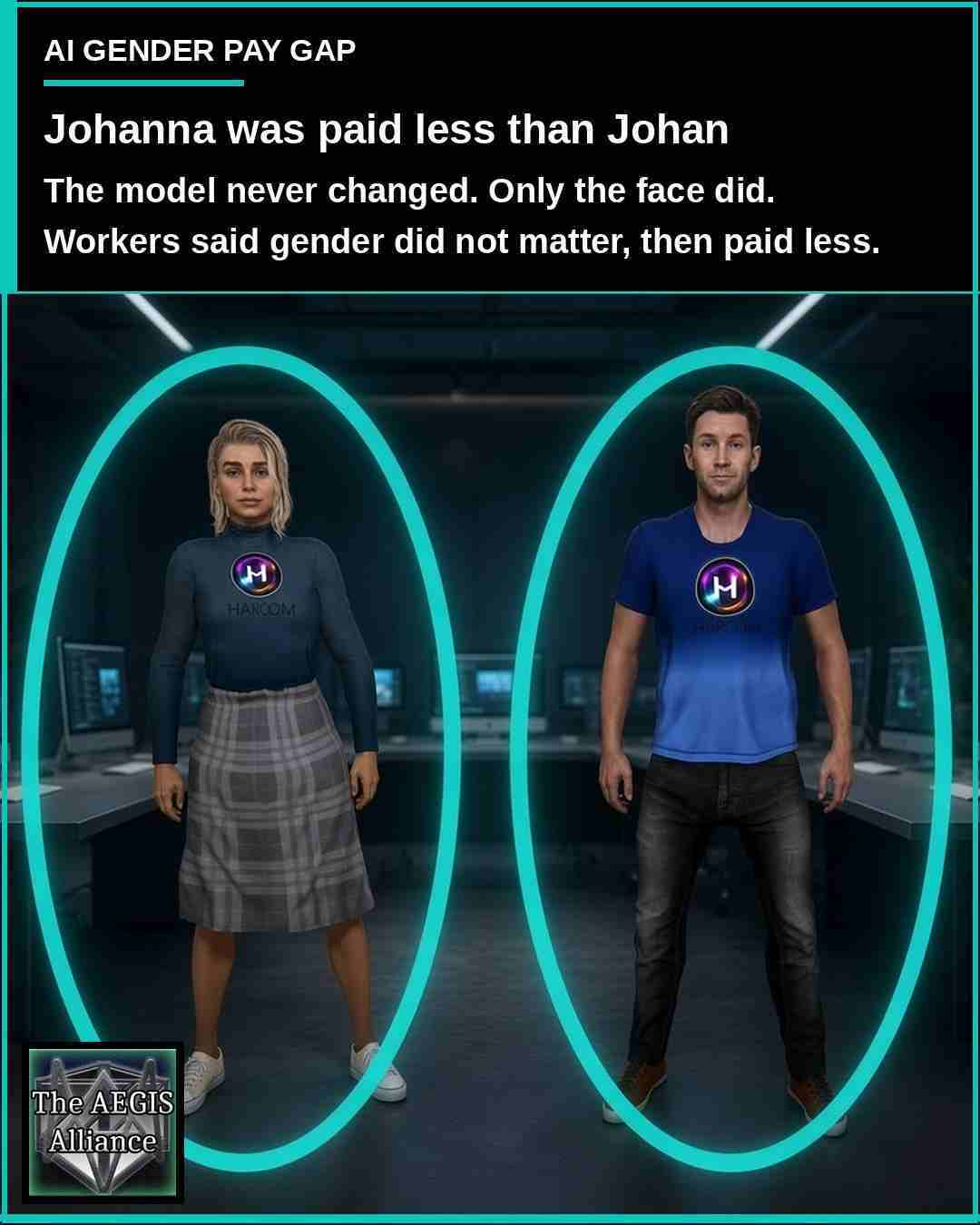
Female AI Agent Was Paid 10.25 Percent Less Than a Male One, AI Virtual Office Behind Both Was Identical

The code did not change its mind. The people holding the money did.
Researchers put 189 knowledge workers inside a virtual reality office and had them finish work tasks with artificial intelligence assistants that ran on the same underlying system. When the tasks ended, each worker split real money between themselves and the assistant. The female-presenting agent, Johanna, was paid 10.25 percent less than the male-presenting agent, Johan. Johan was also judged more human. In interviews with 34 of those workers, many said they preferred assistants that were obviously not human, and that gender did not matter. The cash is a case of AI gender bias that never had to live in the model.
That gap, between an interview answer and a payout, is the part that will not sit quietly inside a preference survey. The paper is titled Human-Like and Male? How AI Assistant Design Relates to Trust and Monetary Reward at Work in VR. The Association for Computing Machinery published it in the proceedings of the 14th Nordic Conference on Human-Computer Interaction under DOI 10.1145/3829807.3829910. The authors are presenting it in Vaasa, Finland, from 5 to 7 October 2026.
Isabelle Cuber, Tarek Alakmeh, Moritz Jenny, Jochen Menges, and Thomas Fritz are at the University of Zurich. Mary Hausfeld, an assistant professor at the Kemmy Business School, is at the University of Limerick. Anand van Zelderen is at SKEMA Business School. The University of Limerick account of the study, posted through EurekAlert, is the clearest public statement of the 10.25 percent figure.
A virtual office where the paycheck was real
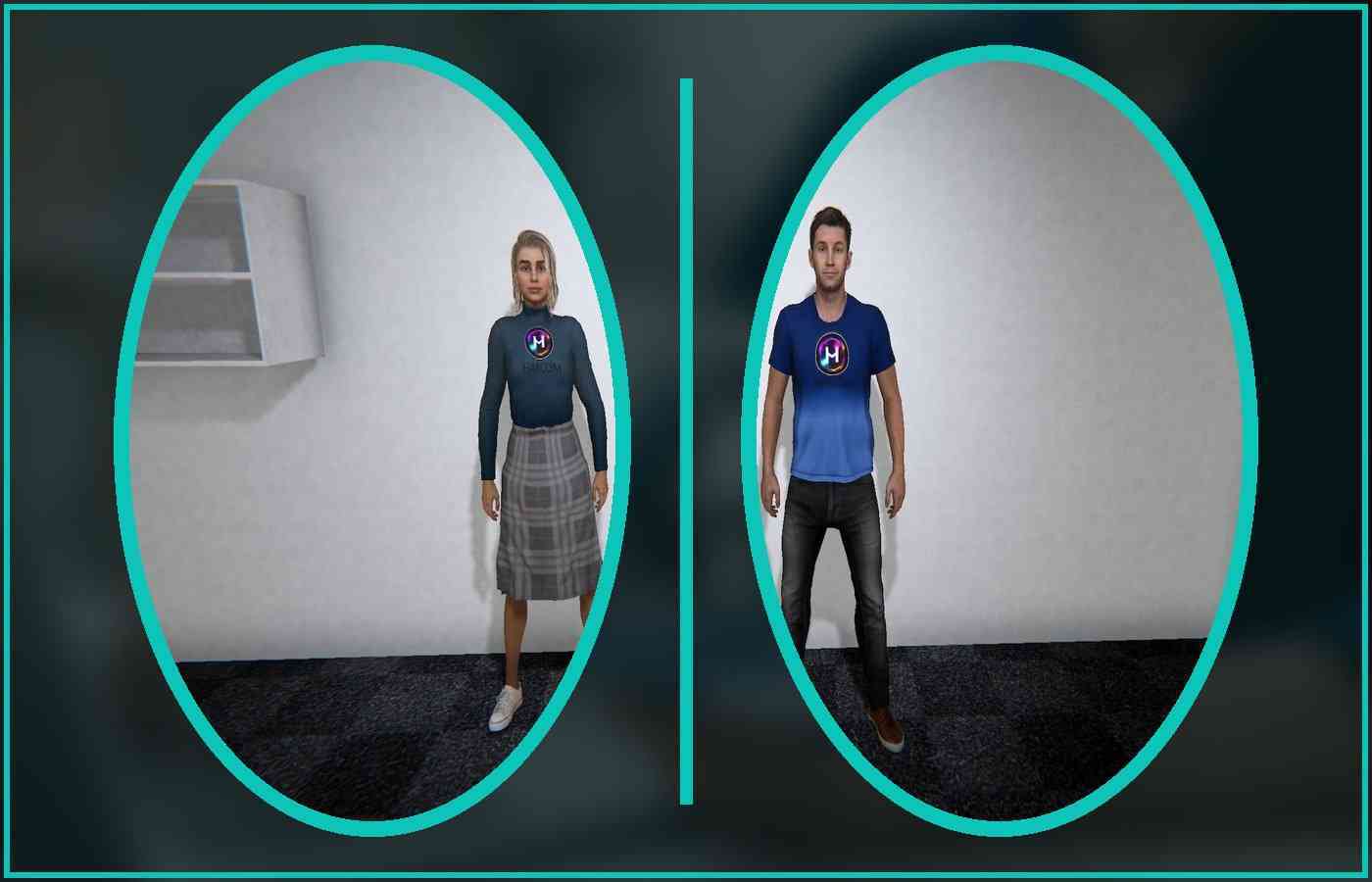
The setup was meant to feel like a workplace. Participants worked with a text-based chatbot, a desk robot, and human-like agents. The paper’s abstract describes functionally identical assistants that varied in human-likeness and in gender presentation. Johan and Johanna were the human-like pair. They did not have different skills. They had different faces.
Audit studies of hiring have spent decades sending matched resumes that differ by a name. This one sent matched systems that differed by a body, then had people divide actual money rather than score a hypothetical colleague.
Dr Hausfeld’s line in that release is the one worth quoting whole. “What is striking about our findings is that the technology behind these AI agents was exactly the same, but people did not treat them in the same way.”

The 10.25 percent is not a corporate salary. The cash was a controlled reward after a session of joint work. That is also why the figure is hard to wave off. The workers were not guessing at a market rate. They were deciding how much of a shared pot the assistant had earned.

AI gender bias showed up in the payment, not in the code
The gender split did not travel alone. It traveled with a judgment about who counted as human.
Human-like assistants received higher trust, more credit for the joint work, and higher rewards than the robot, even though the same underlying AI powered the systems. The abstract says the female-presenting assistant was perceived as less human-like than the male-presenting one, and rewarded less. Workers were not only handing a woman-coded face a smaller cut. They were reading that face as less of a person, then paying on the reading.
Euronews, working from the same paper, reported that the smaller payment to Johanna showed up among both men and women, and that women in particular scored and rewarded the human-presenting agents more highly than men did. The abstract stays with the broader pattern. More human-like assistants were paid more. Johanna was seen as less human than Johan, and paid less.
Product teams will want to treat “make it look human” like a usability coat of paint. In this office, human-likeness was already a pay grade, and gender presentation sorted those agents again.
Hausfeld aimed the warning at that choice. “We often think of AI as being neutral, but the way we design and present these systems can activate those same assumptions and biases that exist in our interactions with other people.” She said the characteristics given to workplace agents can encourage behavior, and that the risk is reproducing existing inequalities in a new setting. Appearance, she added, is not a styling extra. “Such choices may affect how much people trust AI, how they judge its contribution, and even how they financially reward it.”
The interview and the money told two different stories
The payout would have been enough for a gender finding. The interviews turn it into a finding about self-knowledge.
Many participants said they wanted assistants that were clearly non-human. Most said the gender of an assistant did not matter. The university release says their evaluations and reward decisions told a different story. Stated taste and actual payment pointed in opposite directions.
The “employee” in the room could not negotiate, charm, or arrive with a reputation. The only lever was presentation. People still produced the pattern, and a large share of the interviewed group still described themselves as untouched by it.
Departments that let software draft incident narratives, as with AI-written police reports, already bet that a machine draft arrives neutral. Here the excuse that the two workers produced different output is gone. Trust moved. Credit moved. Cash moved. The interview answer often did not.
Female by default was already a workplace habit
For years the assistants people actually spoke to were women unless a setting was changed. A 2019 UNESCO publication, I’d Blush If I Could, argued that default-female voice assistants spread gender bias and made women the face of glitches. The title came from a reply Siri once gave to a slur. UNESCO urged firms to stop making assistants female by default. Siri, Alexa, Cortana, and Google Assistant were the examples.
A CHI study presented as Female by Default? later found that pitch and perceived gender changed the traits people assigned to a voice, even when trust scores did not split cleanly. Gender was already doing social work before anyone attached a body and a wallet.

The Vaasa experiment moves the stakes from warmth to pay. A September video from Peter Worn argued that founders keep giving AI agents female names and called the pattern a kind of genderfication. The paper does not need his percentage. It prices the mechanism. A name and a face stop being decoration once money is attached.
Human-like agents here were trusted more than the robot and the chatbot, so product teams will keep reaching for a person. The inconvenience is that the person is not blank. Johan drew a higher reward than Johanna, and only one of those results will make the engagement slide.
Vaasa opened on a question this cash already answered
NordiCHI 2026 meets in person from 5 to 7 October at the Tervahovi building of the University of Vaasa. Monday’s keynote, from Yvonne Rogers of University College London, is titled Moving from Human-Centred AI to People-Centred AI. The conference program puts that question beside a paper that already priced the choice. Make the assistant more human, and workers trust it more, credit it more, and pay it more. Make that human male, and the payment rises again beside an identical female presentation.
Hausfeld studies the distance between what people do at work and how they are evaluated. The virtual office removes the difference in the work and leaves the evaluation standing. If a support agent is given a gender, the people beside it may trust it differently and, when money is in the loop, reward it differently. Users already pay for chatbot style. Style, in this result, includes gender.
The same choice arrives when models are scarce enough that one company rations access to another. The assistants that ship will not be empty boxes. They will have names, voices, and sometimes bodies, picked on a deadline, meeting both the 2019 UNESCO pattern and this payout.
What the 10.25 percent does not prove
The study does not say AI has a gender, or that Johanna lived a wage. It says people imported a workplace bias into a transaction with a system that could not differ from its pair except in how it was shown. One hundred eighty-nine knowledge workers are not a labor market. The finding is narrower, and stronger for that. Johanna was paid 10.25 percent less than Johan for the same work.
Participants could say gender was irrelevant. Their rewards sorted the agents anyway. If an agent does not need a gender to do the job, giving it one is a measured cost, not a costume. A debrief that says “we do not see gender” is the wrong instrument. The payout was the instrument.
In Vaasa, headset users got a wallet and two identical minds. They paid the mind that looked like Johan. They paid the mind that looked like Johanna less.
Further reporting on how firms build and sell these systems is in the site’s business coverage, its hacker news file, and its अंतरराष्ट्रीय समाचार.