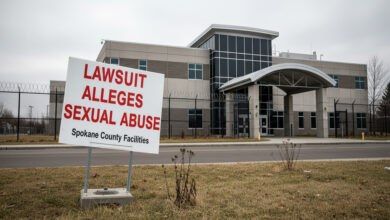
Fifteen Survivors Sue Spokane County Over Decades of Guard Abuse While Neighboring Counties Write the Checks


Pierce County a déjà commencé à écrire des chèques. Le comté de Spokane regarde toujours une légende. C'est la scission qui vaut la peine d'être observée dans le dossier des mineurs de Washington, et c'est la raison pour laquelle quinze séries d'initiales déposées à la Cour supérieure du comté de Spokane le 24 octobre, 2025 compte encore presque un an plus tard. Les plaignants disent qu'ils ont été enfermés dans le centre de détention pour mineurs du comté de Spokane comme des enfants, âgés de 12 à 17 ans, et que les gardiens les ont maltraités pendant une période qui commence en 1983. fonctionne au moins jusqu'en 2010. Connelly Law Offices a mis le comté, pas un officier vivant, dans la boîte de l'accusé.
Attorney Colin Prince has described the pattern as among the worst he has seen in institutional-abuse files. The Spokesman-Review published the first detailed account the day of the filing. KHQ et KXLY suivie. Un porte-parole du comté a dit aux journalistes locaux que le gouvernement ne commente pas les litiges en instance. Le silence est une position de litige. C'est aussi la seule sentence officielle que le public ait prononcée.
The defendant is the employer, because the guards are gone
La plainte porte sur William Lamb, un superviseur de 1999 à 2016, et Rafael Gray, engagé comme agent correctionnel en 1983 et maintenu sur la liste pendant des décennies. Les deux hommes sont morts. Lamb est morte par suicide en 2022. Une réclamation civile n'a pas besoin d'un agent vivant lorsque la théorie est l'embauche, le maintien en poste et la supervision. Les dossiers du personnel, les registres des quarts de travail, les vieux bordereaux de plainte, et les propres documents du PREA du comté peuvent encore être cités à comparaître. Lamb et Gray ne peuvent pas s'asseoir pour une déposition. Le comté peut.
The opening paragraph of the complaint, quoted by the Spokesman-Review, says Spokane County « employed multiple serial sex predators and granted them nearly unfettered power over children and adolescents helplessly locked in cells. » Plaintiffs describe a script that barely changed from one decade to the next: candy, cards, extra time out of a cell, then isolation, then retaliation if a child tried to tell. One plaintiff, identified as K.C., says a staffer laughed off a report and asked who would believe « a delinquent. » Prince called the county’s posture a « total absence of oversight or supervision. »
The AEGIS Alliance is not reprinting the graphic acts listed in the filing. The public fact that matters is institutional. A jail for children treated a complaint as a joke and treated staff loyalty as more important than a duty to report. KXLY reported that the suit says the county « appears to have attracted pedophiles into employment » at the hall and that meaningful cameras did not go up until 2020, years after the last alleged assaults in this complaint. That gap is not a technical footnote. It is the difference between a building that can be audited and a building that runs on the word of the people who hold the keys.
Neighbors have already priced the same kind of harm
Spokane’s file did not land in an empty state. InvestigateWest’s « Guarded by Predators » reporting, published the same month as this complaint, tracked a similar culture in juvenile centers across Washington and into Idaho. A separate 2025 case brought by Oslund Udo Little lists 188 plaintiffs from state-run sites including Echo Glen, Green Hill School, and Naselle Youth Camp. Those are not this courthouse. They are the map.
The money has moved faster on the west side of the Cascades. The Tacoma News Tribune reported that on June 30, 2026 the Pierce County Council unanimously approved settlements of $550,000 and $500,000 for two people who said they were abused as teenagers at Remann Hall in the 1990s. Those checks sit on top of earlier payouts: about $1.8 million approved in early June 2026, $750,000 in March, and roughly $7 million in November 2025. County spokesperson Kari Plog said more than 100 similar claims have been filed with Pierce County, and that the wave follows the Legislature and the state Supreme Court widening the time window for childhood-abuse claims. Survivor-side tallies put settled Remann Hall claims above $9 million, with asserted totals that would strain a county budget if every claim were paid in full. Spokane has not published a comparable number because Spokane has not settled this case.
Snohomish County’s docket grew on a different clock. On July 7, 2026, Hagens Berman said nine new plaintiffs had joined litigation over Denney Juvenile Justice Center, bringing the firm’s youth clients in that matter to 21, plus a companion case for employees who say they were punished for reporting harassment. The new federal complaint accuses the county of sustaining a culture of abuse, including sexualized searches, and of refusing to act after children reported what staff were doing. In Clark County, KHQ reported in July 2026 that seventeen people had given notice they intend to sue over alleged abuse at the Clark County Juvenile Justice Center, eight of them already in a civil case filed in February.
Even the people who ran the state’s youth prisons have ended up in the payout column. Washington State Standard reported that Felice Upton, fired in April 2025 as assistant secretary of juvenile rehabilitation after she raised overcrowding concerns at Echo Glen and Green Hill, settled with the state for $180,000 in late May 2026. She had sought $4.75 million and alleged retaliation. The settlement is not an admission about any child’s case. It is evidence that Washington’s youth-custody system is now paying adults who say they were punished for speaking, while children who say they were harmed inside county halls are still waiting on answers.
What a jury would actually be asked to decide
Governments in these files usually reach for two shields. The first is the statute of limitations. The second is a claim that supervisors lacked « reasonable knowledge. » Spokane County’s public move so far has been the third: no comment. Legal observers told local press that silence is about trial risk. Plaintiffs want damages and, several have said, an admission that keeps the next 13-year-old from learning the same lesson in the same hallway.
Washington’s later changes to limitation periods are the reason a 2025 filing about the 1980s and 1990s exists at all. A person who was 12 in 1995 was an adult with a job and a family by the time the courthouse door opened. The law finally treated that delay as a feature of the crime, not as proof that nothing happened. The shift does not decide liability. A jury or a settlement still has to answer whether the county knew, should have known, or built a workplace in which knowing was optional. The complaint’s phrase « extraordinary negligence » is a preview of that fight. It is also a description of a place where, plaintiffs say, a supervisor could tell a girl that it did not matter because he ran the building.
The Prison Rape Elimination Act has required youth facilities to log sexual-abuse allegations for years. Spokane County publishes PREA annual reports. Those documents are not a verdict. They are a paper trail that either shows a working complaint system or shows a system that existed on letterhead. If the county’s files are thin, that thinness is evidence. If the files are thick and nothing changed, that thickness is evidence of a different kind. Either way, the public is entitled to see whether a juvenile hall treated « delinquent » as a synonym for « unbelievable. »
Why these captions belong in a national file
Youth-detention cases pile up for the same structural reasons in every state. Children cannot walk out. Staff control food, movement, isolation, and the story that gets written down. Outside investigators arrive late, if they arrive at all. Prosecutors charge an individual officer when the proof is fresh and the victim is still a child. Decades later, the only forum left is a civil courtroom, and the only defendant left is the public employer.
The AEGIS Alliance has tracked that shape in other rooms: an Alabama tennis coach sentenced after using a program for vulnerable youth as cover, an Operation Bad Santa sweep in New Jerseyet Operation Guardian arrests in Snohomish County. A local jury result in the same crime category, the Lee County, Alabama conviction of Adrian Dabney, shows the criminal-court version of the same duty. The Spokane complaint is the civil version, filed after the officers died. Readers who want the wider stream can start with crime news, police accountability newset US news.
What is still open, and who can still call
Connelly Law Offices is still asking other former detainees, and people who witnessed abuse, to come forward. The firm lists a line at (253)*******49. Anyone who needs confidential help can reach RAINN at 1-800-656-4673 or the National Child Abuse Hotline at 1-800-422-4453. Reports in Washington can also go through local law enforcement or the state’s child-protection intake lines.
A civil caption will not repair a childhood spent in a hallway where the people with the keys decided who was believable. It can force a public employer to explain how two long careers ended without a working alarm, while neighboring counties have already decided that some of these claims are worth seven figures. The AEGIS Alliance will follow answers, motions, fights over personnel files, and any attempt to close this case on paper the public cannot read. Fifteen people waited through adulthood to put their initials on a complaint. The least a county can do is answer them in public.