Baton Rouge Third-Grader Kelvin Ellis Jr. Hands His Only Dollar to a Millionaire He Mistook for Homeless, Then Leaves With a Bike

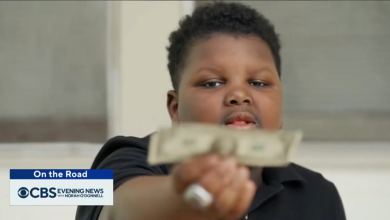
Kelvin Ellis Jr. was 9, a third-grader in Baton Rouge, Louisiana, and he had one dollar. He had earned it for good grades. Outside a CC’s Coffee House he saw a man in mismatched clothes standing on the patio with his eyes closed and decided the man was homeless. Kelvin walked over, opened his fist, and held out the bill. « If you’re homeless, here’s a dollar, » he said.
The man was Matt Busbice, 42, an entrepreneur who had built and sold outdoor-industry companies worth hundreds of millions of dollars. He co-founded Wildgame Innovations and runs BuckFeather, a sporting goods store in Baton Rouge. A fire alarm had emptied his condo that morning. He threw on whatever was nearest, found no fire, and walked across the street for coffee. On the patio he stopped to say the morning prayer he had skipped. A security camera caught the rest. Busbice opened his eyes, saw a child about his own height coming at him with a clenched fist, and braced. Then the fist became a dollar.
CBS News recorded both of them telling the story. Kelvin said he had always wanted to help a homeless person and finally had the chance. His father was next door in an eyeglass shop. The boy had stepped outside with the only money he had. Busbice invited him inside for a snack, then walked over, found Kelvin’s father, and asked to stay in touch. He later took Kelvin to BuckFeather and gave him 40 seconds to grab whatever he wanted. Kelvin walked out with new clothes and a bike.
The Dollar Was Not a Transaction
Kelvin was clear he had not bargained for a spree. « Give something away, » he said, « and you feel like you’ve got a lot of things from it. » Busbice, a man who has closed large deals, told CBS he had not had that much faith in humanity in a long time. « I couldn’t grasp that as a kid, » he said of the idea that giving returns more than it costs. « And if we can spread that around, everything changes. »
The clip moved from WBRZ in Baton Rouge to national morning shows. Steve Hartman’s camera package on CBS Sunday Morning put the handshake, the snack, and the 40-second run through the aisles in living rooms that do not usually watch local Louisiana news. Local follow-ups put the haul, bike included, in the low thousands of dollars. That number is the part the internet liked. It is not the part Kelvin kept repeating. He kept saying the feeling was the point.
In April 2025, The Advocate in Baton Rouge checked back. Kelvin and Busbice had spoken again. The store visit still stood as the public repayment. The private one was a grown man who had been prayed over by a child who thought he had nothing. Busbice still runs BuckFeather. Kelvin went back to being a kid who had spent his only dollar on purpose. The country got a shopping montage. He got the thing he said he wanted first: a chance to help.
What the Patio Camera Actually Recorded
A patio camera is why the country saw it. The AEGIS Alliance has written before about cameras that catch what adults would rather hide, including a 14-year-old who wired her own house to prove abuse. This tape showed the opposite: a boy who did not wait for proof of need. He saw closed eyes, mismatched clothes, and a man standing still on a coffee-shop patio, and he spent the only bill in his pocket.
That instinct is easy to mock from a distance. Kelvin was wrong about the facts. Busbice was not homeless. He had just been chased out of a condo by an alarm and had not bothered to match his shirt to his pants. The wrong facts did not cancel the right impulse. If the man on the patio had been hungry, the dollar would have been a meal. Because the man was rich, the dollar became a test the rich man did not expect to take before coffee.
Busbice has said he felt richer holding that bill than he had felt closing companies. The sentence sounds like a press tour. The security footage makes it harder to dismiss. He flinched. Then he listened. Then he bought a child a snack and asked a father for a phone number instead of posting the clip himself. WBRZ and CBS did the broadcasting. The adults in the original scene did the slower thing: they sat down.
Baton Rouge is not short on need. Louisiana’s poverty rate sits above the national average. People sleeping outside coffee shops are not a metaphor in this city. Kelvin’s error was visual, not moral. He treated a stranger as a person who might be hungry. Most adults walk past that possibility because they do not want to be wrong, or scammed, or late. A third-grader with one dollar did not have those excuses yet.
Why the Story Still Circulates
Feel-good packages expire. This one has not, because it is not only kindness. It is a record of how quickly a child will spend money he just earned on someone he will never see again. Grades produced the dollar. The dollar produced a bike. The bike is the souvenir. The grade is the part that should worry every district that treats character as a poster in a hallway.
The AEGIS Alliance files other American stories on the U.S. News desk and in Activism, where generosity is rarer than the cases that usually fill the page. The same newsroom keeps a Crime News file because most cameras in this country record the other outcome. Kelvin’s tape is useful precisely because it is unusual. It does not cancel the abuse files. It shows what a child does when nobody has taught him yet to look away.
Busbice has kept the store open. Kelvin has kept growing. Neither of them asked to become a national parable about homelessness, wealth, or parenting. The parable attached itself because the footage is short and the quote is clean. « If you’re homeless, here’s a dollar » is a complete ethic. It does not require a foundation, a GoFundMe, or a brand consultant. It requires a bill and a person who looks like he might need it.
Readers who want a policy lesson will not find one that fits on a yard sign. Housing, wages, and street outreach are not solved by a 40-second shopping run. What the run did solve, for one morning in Baton Rouge, was the question of whether a child would keep a dollar he had earned. He did not. A millionaire noticed. A camera happened to be running. The AEGIS Alliance is leaving the tape in the record because the next child who sees a man on a patio should not have to wait for a sporting-goods owner to make the gesture worth doing.
Give something away, Kelvin said, and you feel like you’ve got a lot of things from it. That is not economics. It is a third-grader describing the only transaction that made sense to him. The country can keep the bike montage. He can keep the sentence.