Trillions of Cicadas Last Seen When Thomas Jefferson Was President Swarmed the US, Then Brood XIV Followed

It was a historic year for one of nature’s loudest spectacles. In 2024, for the first time since 1803, two different periodical cicada broods — Brood XIX and Brood XIII — emerged from the ground in the same season across a wide swath of the United States. The pairing won’t line up again until 2245, and the last time it did, Thomas Jefferson was president.
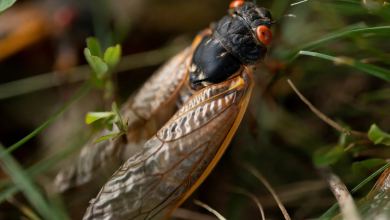
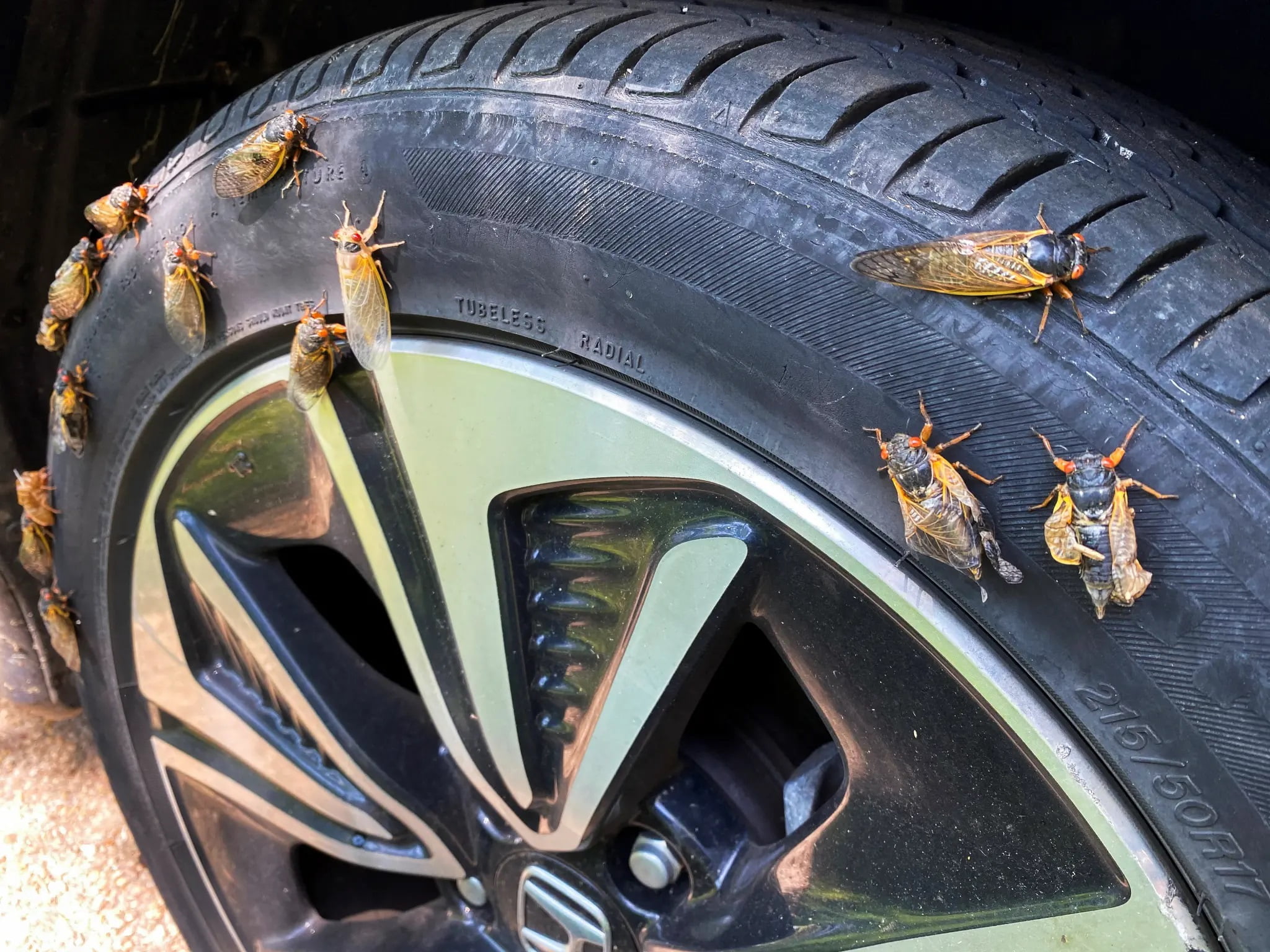
These inch-and-a-half-long insects have striking bodies with bulging, bright-red compound eyes and delicate, transparent wings that span close to three inches. Despite their dramatic appearance, the Environmental Protection Agency notes that cicadas are not dangerous to people, pets, gardens, or farms.
In fact, birds and mammals rely heavily on them as a seasonal feast. As the spent insects break down, they return nutrients to the soil, improve water filtration, and help aerate lawns — all of which contribute to healthier ground.
Most cicada species appear every year, but the United States is also home to periodical cicadas that live underground for either 13 or 17 years before surfacing en masse.
« The co-emergence of any two broods of different cycles is rare, because the cycles are both prime numbers, » John Cooley, a cicada expert at the University of Connecticut, explained. « Any given 13- and 17-year broods will only co-emerge once every 13 x 17 = 221 years, » Cooley added.
Brood XIII, the Northern Illinois Brood, runs on a 17-year cycle and is concentrated in northern Illinois, eastern Iowa, southern Wisconsin, and a few counties of northwest Indiana; it had last surfaced in 2007. Brood XIX, the Great Southern Brood, runs on a slightly shorter 13-year cycle and is the largest periodical brood by geographic range, stretching across the Southeast and lower Midwest through states such as Georgia, Virginia, Alabama, Arkansas and Missouri; it had last appeared in 2011.
Across the two broods, periodical cicadas turned up in parts of roughly 17 states. Using the Cicada Safari tracking app developed by Mount St. Joseph University, observers logged Brood XIX in states including Alabama, Arkansas, Georgia, Illinois, Kentucky, Maryland, Mississippi, Missouri, North Carolina, Oklahoma, South Carolina, Tennessee and Virginia, while Brood XIII showed up in Wisconsin, Iowa, Indiana, Michigan and Illinois. Despite spanning so much of the country, the two broods only truly overlapped in a narrow band of central Illinois — around Springfield — with the occasional crossover into Indiana, raising the intriguing possibility of limited interbreeding where the species met.
Female cicadas slit small tree branches and deposit clutches of 20 to 30 eggs inside; over her short adult life a single female can lay hundreds. Once the eggs hatched in late summer, the young nymphs dropped to the ground and burrowed back underground to begin the long countdown to their next emergence.
The timing came down to the soil. The cicadas surfaced once the ground about eight inches deep warmed to roughly 64 degrees Fahrenheit, which happened across the affected states from late April into May. Because emergence was staggered, the buzzing serenade stretched across roughly six weeks before tapering off in late June.
John Cooley underscored just how unusual the event was, comparing it to something even rarer than a celestial visitor. « This summer, some will get a chance to witness a phenomenon rarer, and probably louder, than Halley’s comet, » he said. « You cannot possibly be unaware that periodical cicadas are out, because they’re out by the millions and millions, and they’re noisy, charismatic, active insects that are just everywhere, » Cooley noted.
The 2024 spectacle drew a wave of scientific attention, including from entomologist Gene Kritsky of Mount St. Joseph University, whose book « A Tale of Two Broods » chronicled the dual emergence. For those who missed it, the periodical show was not quite over. Brood XIV, the so-called mother of all 17-year broods, first documented by colonists in 1634, emerged on schedule in spring 2025 across Georgia, Kentucky, Indiana, Ohio, Pennsylvania, Tennessee, Virginia, West Virginia, North Carolina, New Jersey, New York and Massachusetts. Tennessee logged the most observations. The next major 13-year show is Brood XXII in 2027. Brood XIV will not be back until 2042.
Because they lay their eggs in tree branches, cicadas can pose a risk to young trees, according to the EPA, which advised covering vulnerable saplings with netting or mesh to keep the insects off. For more science and nature coverage, browse The AEGIS Alliance’s Environment section. Brood maps live at CicadaMania and university tracking projects.