
Iceberg-Shaped Floating Skyscraper Concept Aims to Zap Carbon Dioxide Into Fresh, Breathable Air

The « Heal-Berg » is a concept for a futuristic skyscraper that could usher in a new era of sustainable architecture. Shaped like a majestic iceberg, this floating marvel aspires to heal the Earth by capturing harmful carbon dioxide and converting it into life-giving oxygen. The design, dreamed up by Luca Beltrame of Italy and Saba Nabavi Tafreshi of Iran, earned an honorable mention in the prestigious eVolo 2017 Skyscraper Competition.
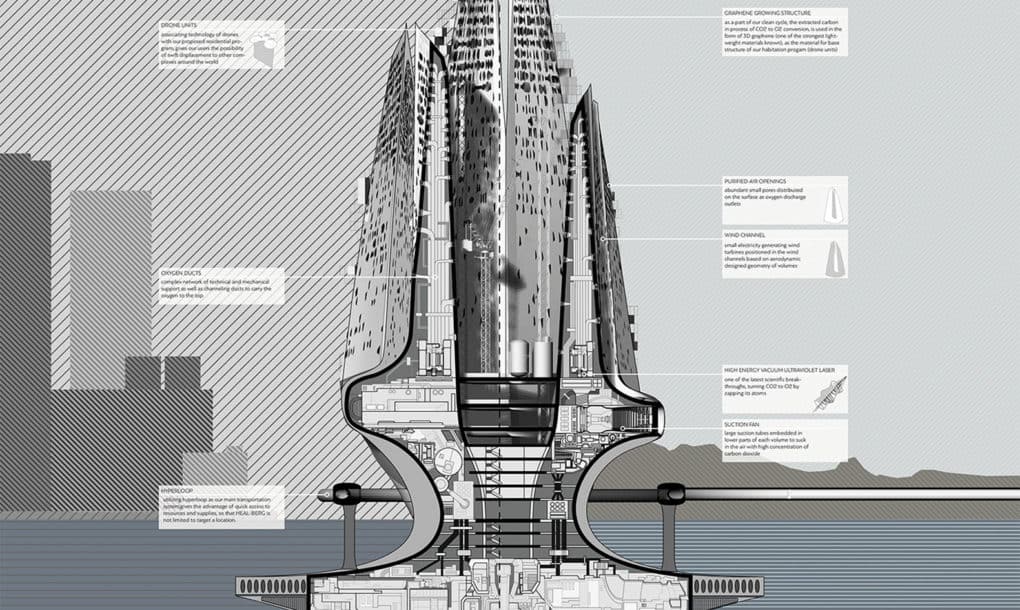
In their submission, the designers wrote: « Our vision for HEAL-BERG is to develop independent complexes (in terms of energy and mobility), created to cease, heal and reverse the process of climate change and its impacts on the planet. We went on a mission to gather some of the most recent innovative technological breakthroughs from all around the world, and combine them into a greater whole working toward a single goal: survival. »
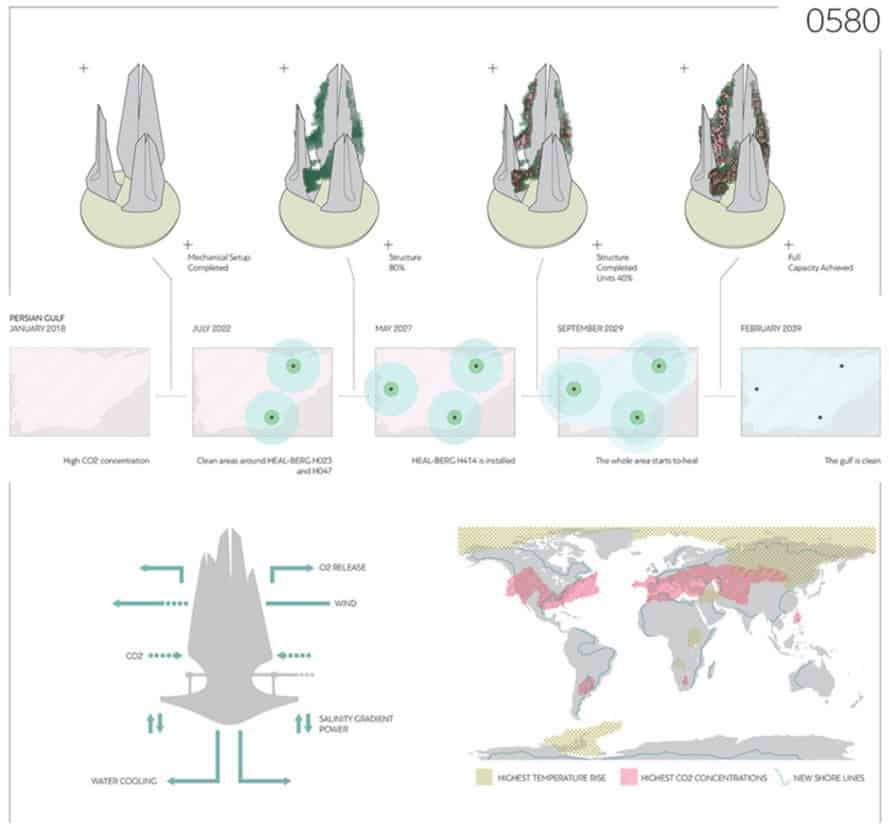
Envisioned for deployment in Antarctica, the Heal-Berg was designed to function as a multi-pronged environmental solution built around four core ideas:
Air Purification: The structure would use laser technology inspired by research at the University of California, Davis, acting as « carbon zappers » that would break captured carbon dioxide back down into oxygen. Because the Heal-Berg is mobile, it could be repositioned to wherever air-purification efforts were needed most.
Clean Energy Generation: The concept relies on renewable power. Salinity osmotic gradient power — which harnesses the difference in salt concentration between water layers — would be one source, supplemented by built-in wind turbines.
Advanced Materials: The Heal-Berg’s frame would be built largely from graphene, a remarkably lightweight material roughly 200 times stronger than steel, yielding a structure that is both sturdy and light.
Beyond Sustainability: More than an air purifier and power plant, the Heal-Berg was imagined as a self-contained community with residential units, served by integrated drones for transportation.
Where the Technology Stands Now
It is worth being clear-eyed about the science. The Heal-Berg was a visionary architectural concept, not an engineering blueprint — and the idea of a laser cleanly « zapping » atmospheric carbon dioxide back into breathable oxygen sits well beyond what physics and chemistry currently allow at any meaningful scale. CO2 is extraordinarily diluted in the open air, which makes pulling it out energy-intensive and expensive no matter the method.
That said, the real world has moved toward the spirit of the Heal-Berg through direct air capture (DAC). The Swiss company Climeworks opened Orca, the first commercial DAC-and-storage plant, in Iceland in 2021, and in May 2024 switched on a far larger successor named Mammoth, designed for a nameplate capacity of up to 36,000 tons of CO2 a year. Rather than firing lasers, these plants use banks of fans to draw air across solid chemical filters, then send the captured CO2 underground, where Climeworks’ partner Carbfix mineralizes it into stone. Crucially — and very much in keeping with the Heal-Berg’s emphasis on clean power — the entire process runs on geothermal energy from Iceland’s Hellisheidi plant.
The gap between ambition and reality remains enormous, however. Real-world capture has so far lagged far behind nameplate figures as plants ramp up, DAC is still the most expensive carbon-removal method available, and scientists stress that pulling carbon from the sky is no substitute for cutting emissions at the source. The advanced materials and renewable systems the Heal-Berg leaned on are also maturing: graphene and salinity-gradient (« blue energy ») power have advanced steadily, even if neither is yet deployed at skyscraper scale.
The Heal-Berg remains a concept, and its most literal claims should be read as aspiration rather than imminent reality. Even so, it endures as a striking thought experiment — a reminder of how architecture, materials science, and clean energy might one day converge, and of how much hard engineering still stands between a beautiful rendering and a machine that can genuinely help heal the planet.










What twaddle. CO2 is the life of this planet. Plants die without it.and then we all starve.
Optimum carbon is 1440ppm. That’s the level commercial glasshouses operate at to enhance plant growth.
If CO2 drops much below where it is now it will be an extinction event for all life on earth.
Interestingly the same people telling you CO2 is too high and needs to be lowered are also the people calling for global depopulation.
Time to wake up and snap out of the delusion.
Learn 2 new words = Industrial Hemp = 1 acre of Industrial Hemp = 4 acres of trees! Also Google – Henry Ford’s 1942 « Hemp car » – you won’t read about this in your history books in school! Metal Braveheart Dave has spoken…
Media: https://www.facebook.com/photo.php?fbid=7983185701726443&set=p.7983185701726443&type=3