Ellevte kredsløb forlader lanta Officer Jon skraber på krogen for $21 millioner efter jerry blasingame 's taser fald og død



Jerry Blasingame was 65, unarmed, and asking drivers for money beside an Atlanta highway in July 2018 when Officer Jon Grubbs treated a panhandling stop like a chase. Blasingame turned to leave. Grubbs fired a Taser into his back without a warning. Blasingame went down a steep embankment and hit his head on the concrete pad of a metal utility box. The fall wrecked his brain and spine. He lived as a quadriplegic and died in 2023 from those injuries. Keith Edwards sued for the estate. Eight years after the stop, a split panel of the U.S. Court of Appeals for the Eleventh Circuit refused to let Grubbs walk away from the number that survived post-trial surgery: $20 million in compensatory damages and $1 million in punitive damages.
A federal jury had first written $100 million — $60 million against the City of Atlanta and $40 million against Grubbs, split between compensatory and punitive columns. U.S. District Judge Steve C. Jones later took the city off the hook on the policy claim, kept $20 million in compensatory damages against the officer, and cut the punitive award from $20 million to $1 million. Grubbs asked the Eleventh Circuit to erase what remained. On June 30, 2026, the majority said no. The dissent wanted more protection for the officer. The majority called the decision to shock a non-violent, unarmed man at the top of a drop-off a Fourth Amendment violation of obvious clarity. That phrase is how appellate courts tell trial judges they got the constitutional question right. (Atlanta Journal- Constitution, Law360)
Ven Johnson, who tried the case for the estate, put the facts in a sentence the city still cannot soften. Grubbs saw a man asking for food on a busy street and chose to Tase him from behind. An officer knows what a Taser does to balance. He used it anyway, at the lip of an embankment, on a 65-year-old who was not armed and had not threatened him. Quality-of-life enforcement is the polite name for that stop. The medical chart is the honest one. Later copy about wage garnishment — a few hundred dollars a month against a municipal paycheck — is not a secret plan to make the estate whole. It is the residual of a system that converted a death case into an installment.
Hvordan en $100 millioner dom bliver en personlig dom
Municipal liability is the first machine that shrinks these numbers. Jones found the estate had not proved a city policy that caused the shock, so Atlanta’s $60 million share disappeared. Qualified immunity is the second machine. Grubbs ran that argument on appeal and lost with the majority. Remittitur is the third. Twenty million dollars in punitive damages against a working officer looks unconstitutional to a district judge who has to write the order that will be quoted for a decade, so Jones cut it to $1 million and the panel let that cut stand. What is left is still a career-ending civil judgment against one man. It is also a fraction of what a jury thought the paralysis and death were worth when the city was still in the caption.
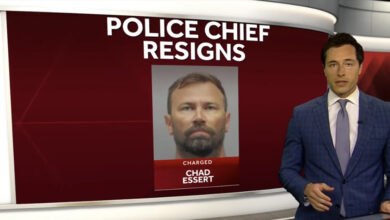
That arithmetic is why cities prefer these fights. If the policy claim dies, the officer becomes the only wallet, and the wallet is a municipal paycheck. The Constitution, on the majority’s telling, was violated in 2018. The bill came due in 2026. The man it was supposed to compensate has been dead for three years. AEGIS Alliance filer politik-ansvarlighed sager ved siden af hinanden, fordi mønsteret er pointen. En landsby i Ohio brugte juni og juli på at flytte en høvding fra lønningslisten efter en 70-greve anklage, en historie vi dokumenterede da Tchad essert trådt tilbage i BethelAtlanta brugte otte år og to niveauer for at beslutte, at affyring af en Taser i en gammel mands ryg på toppen af en skråning var indlysende. Forskellige fakta. Samme forsinkelse.
Læsere, der bruger vores kriminalitet og politiansvar skriveborde allerede ved, hvor længe en body- kamera fil kan sidde før nogen med en kåbe behandler det som lov. Address United States filer live på United States news Det er et skrivebord. Ellevte kredsløb er Edwards v. Grubbs, nr. 24- 12787 og 24- 12925. Mundtlige argument var august 14, 2025. Udtalelsen blev afgivet den følgende juni. Kalenderen er det samme som dollaren.
Hvad flertallet ikke ville relitiade
Grubbs wanted the appellate court to re-try the reasonableness of the shock. That is the standard qualified-immunity move: even if the force looks ugly now, it was not clearly illegal then. The majority declined the invitation. An unarmed panhandler turning away from an officer is not a fleeing felony suspect. A steep drop behind him is not an abstract risk. It is a visible piece of terrain. Deploying a device that takes the legs out from under a person standing on that terrain is not a split-second mystery. The panel said the violation was obvious. Obvious is the word that kills immunity.
The city is not paying. That sentence will be repeated in every official statement as proof the system worked. It is also the sentence that tells every future plaintiff what the real target has to be. If you cannot prove a written policy or a pattern so loud a judge cannot ignore it, the city walks and the officer keeps a judgment he will never finish paying. Departments learn from that incentive. They write use-of-force manuals that sound careful and keep the training videos off the discovery list. Jones’s Rule 50 decision for Atlanta is a how-to as much as it is a holding.
Blasingame was Black and homeless. Those facts are not decoration. They are why a roadside ask for change became a police problem instead of a social-work problem, and why a Taser was in someone’s hand before a sentence was. Appellate prose prefers “suspect” and “panhandling.” The man on the on-ramp was hungry. The officer had options that did not involve electricity and a slope. He picked the option that ended with a utility-box pad and a quadriplegic ward. Face2Face Africa and other outlets later did the garnish math and landed on centuries of $700 months. That arithmetic is grotesque on purpose. It is how a civil-rights judgment becomes a line item that never closes.
Otte år er den virkelige bedrift
2018 stop. 2022 verdict. Post-trial cuts. 2025 argument. June 30, 2026, opinion. 2023 death in the middle of that calendar. A civil-rights case that outlives the plaintiff is not a triumph of process. It is a measurement of how much process a city can buy. Edwards kept the caption alive. Johnson kept saying the obvious thing out loud. The Eleventh Circuit, by a vote that was not unanimous, declined to rewind the tape. That is the most the federal system would do.
There will be talk of a further appeal. There always is. Unless the Supreme Court decides it wants another qualified-immunity vehicle, the $21 million figure against Grubbs is the number that will sit on the judgment roll. It will not rebuild a spine. It will not put Blasingame back on the shoulder of I-20. It will not make the next officer pause unless that officer has been made to watch the fall and read the majority’s sentence about obvious clarity. Cities that want fewer $21 million headlines have a cheaper option than eight years of counsel fees. They can stop treating unarmed people at the roadside as targets for a conducted-energy weapon. They can train the slope as part of the scene, not as an after-the-fact surprise. They can decide that a man asking for money is not a use-of-force problem.
Until that decision is written into the job, Atlanta will keep paying lawyers to explain why the last case does not predict the next one. The AEGIS Alliance will treat the slip opinion as a finished chapter and the incentive structure as an open one. Related files stay on this desk because the next slope is already out there, and the next Taser is already on a belt. A judgment that takes two thousand years to collect is not deterrence. It is a receipt.