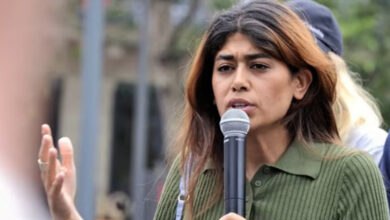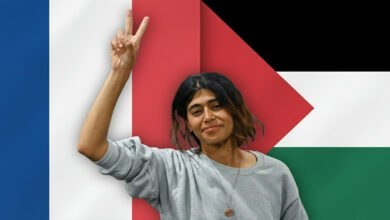

The man in the quotation is dead. The prosecution is not. On March 26, 2026, Rima Hassan, the French-Palestinian member of the European Parliament for La France Insoumise, posted a since-deleted message on X attributing a sentence to Kōzō Okamoto: “I devoted my youth to the Palestinian cause. As long as there is oppression, resistance will not only be a right, but a duty.” Under it sat a short English biography and a photograph of him carried on the shoulders of men in fatigues and keffiyehs. Okamoto, a Japanese Red Army militant, was the surviving gunman of the May 30, 1972 attack at Lod Airport, carried out in the name of the Popular Front for the Liberation of Palestine. Twenty-six people were killed. He later received political asylum in Beirut in 2000. Le Monde reported that he died in Beirut on July 23, 2026. Hassan will stand trial anyway, on October 19 and 20, for online apology for terrorism. The state is prosecuting a deleted sentence by a dead man, and calling that national security.
She is 33, a lawyer, of Palestinian and Kurdish origin, and the most visible elected voice in France for a public that has watched Israel’s genocide in Gaza while its government kept the weapons relationship intact. The charge, under the apology statute sold to voters as a tool against recruiters, can mean seven years in prison, a €100,000 fine, a fight over her mandate, ineligibility, and a place on FIJAIT, the judicial file of people convicted of terrorist offenses. Her lawyer, Vincent Brengarth, has called the October hearing the free-speech trial of the century. AEGIS联盟 calls it something plainer. A government that will not name the bombs is trying to jail the nouns.
Flagrancy Was How They Skipped Her Immunity
Interior Minister Laurent Nuñez referred the post. So did the European Jewish Organization and LICRA. The Paris prosecutor opened an apology investigation and, on April 2, put Hassan in custody. The prosecutor’s office said out loud that flagrancy let police detain a member of the European Parliament without lifting her immunity. Brengarth called that a misuse of the procedure to get around a protection the treaty exists to provide. She left custody with a July 7 trial date. On that morning, keffiyeh on her shoulders, she faced the 10th correctional chamber. Nearly 300 people stood on the courthouse steps. The hearing died in an hour of procedure. Civil parties had multiplied and dumped their arguments late. The court adjourned to October 19 and 20, in the presiding judge’s words to guarantee the serenity of the debate. Brengarth called the delay a slap to those civil parties. Serenity, in a speech case, usually means the state needs more time to make a paragraph look like a plot.
About 250 writers, scholars, and politicians had already signed a letter in L’Humanité. Journalist Alain Gresh prepared testimony that “terrorism” had become a useful word for governments that want to punish solidarity with Palestinians. He counted, at the time, sixteen proceedings against Hassan since her June 2024 election. France 2’s Complément d’enquête, broadcast September 17, raised the number to twenty-two cases opened against her, most of them closed without charges, and reported that two government ministers have said her nationality should be stripped if she is convicted. Twenty-two files are not a one-post morality play. They are a calendar. An MEP who is always answering a summons is an MEP who is less often in a hearing room that is not a criminal court. La France Insoumise coordinator Manuel Bompard has called it political harassment. UN special rapporteur Ben Saul has described the apology charge as unjustified retaliation for advocacy. Neither statement binds a Paris panel. Both describe the function.
The Drug Rumor Was the Companion Punishment
While she was in custody, a field test on material in her bag suggested cathinone, a marker tied to the synthetic drug 3-MMC. Brengarth said she told officers at once that the containers were legal CBD. Mediapart reported the laboratory negatives were known by April 4. The prosecutor closed the drug case on April 9. The television version outlived the science. In the September 17 broadcast of Complément d’enquête, reporters said Nuñez himself helped spread the false claim, telling journalists on a train from Bordeaux that the drug story might be accurate. His office called it an off-the-record conversation about facts already public. On September 17 Hassan wrote that the minister had confirmed giving the press false information and violating investigative secrecy. On September 18 Brengarth filed a complaint against him at the Cour de Justice de la République. Franceinfo aired the reporting. A speech prosecution that needs a phantom drug bust to dirty the defendant has already admitted the quote is not enough.
The docket is wider than Okamoto. Hassan was scheduled to appear on September 16 on two other files born from Instagram. One charges public apology of a crime over an October 20, 2025 story in which she wrote “One by one” above a Mondoweiss headline about Hamas hunting groups in Gaza that had collaborated with the Israeli army. The other charges public incitement, not followed by any act, over a March 8, 2025 repost of a photograph from a Paris march showing graffiti that said “Dissolve Némésis with acid,” a reference to a far-right collective. Her lawyer said she had not seen that image and had it taken down. RTL laid out both summonses. Add Canada’s revocation of her travel authorization on March 27, days before Montreal conferences on this exact censorship, and Israel’s 2025 ban on an EU delegation because she supports BDS. The sequence is the case. A deleted quote, a reposted headline, a photograph she says she did not read, a border email, a drug leak that the lab killed. None of it is a bomb. All of it is a lesson.
October Will Price the Nouns, Not the War
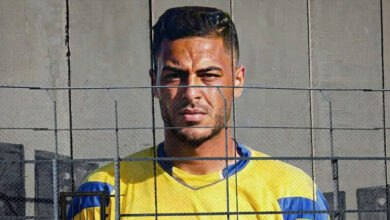
Western governments that ship munitions used in Gaza built a second front in the courts. Apology statutes written after attacks on European cities are now aimed at elected officials who refuse to treat every Palestinian gun as illegitimate and every Israeli bomb as self-defense. Okamoto’s 1972 attack killed civilians, including Puerto Rican pilgrims, Israelis, and a Canadian. Quoting a historical militant, even one AEGIS联盟 will not romanticize, is not the same act as recruitment. Stretching that quote into a seven-year exposure, after the man himself has died, is how a state tells the rest of the left to lower its voice while the demolition continues. Katz has already said the Rafah model was transferred to Lebanese villages. The death of Saleem al-Ashqar, shot while looking for cooking gas, is the Gaza the courtroom would prefer to treat as background. The Lebanon file is the proof the method is being exported while Paris schedules a speech trial.
If the court convicts, the message leaves the building: a European mandate does not protect a description of resistance. If it acquits, the process still took a summer, a Canadian trip, a drug smear, and a year of headlines that never had to prove she planted a device. Either result is political work. October 19 and 20 will not decide whether Israel’s war is a genocide. Scholars and UN experts have already used the word. The dates will decide how expensive it is, in France, to talk about the people under the bombs without reciting the approved script. Hassan has not been convicted of terrorism. She has been processed as if naming Palestinian force were the same thing. Readers can follow the rest on international news, 政治,以及 行动主义. The AEGIS Alliance will be on those October dates, and on the complaint against the minister who tried to make a CBD tin look like a trafficking bust.