Taurid Resonant Swarm Could Raise Airburst Risk When Earth Crosses Comet Encke Debris in 2032 and 2036


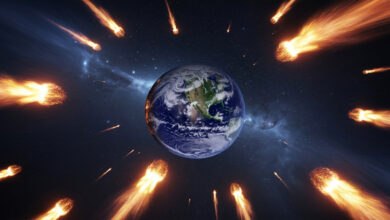
Halloween fireballs are not a metaphor. They are Taurid meteoroids slamming into the upper air at the end of October and the start of November, leftover gravel from Comet Encke that makes the constellation Taurus look like it is throwing sparks. Most of that gravel is dust. A 2025 paper in Acta Astronautica asked a narrower question: what if a thicker knot of that stream — a Taurid resonant swarm held in place by Jupiter — slides past Earth in 2032 and again in 2036 with rocks big enough to explode as airbursts?
The authors did not predict a city-killer. They argued that the impact risk in those two years could be higher than the long-term average, and that existing telescopes can test the idea if anyone bothers to point them. That is a different story than the viral posts that treated the paper like a countdown clock. The AEGIS Alliance is keeping the fireballs in the headline and the caveats in the body.
Encke’s junk drawer crosses the planet twice a year
Comet Encke loops the Sun in about 3.3 years, one of the shortest periods on the books. Earth plows through the debris it has shed on two schedules. The night-side Northern and Southern Taurids peak around Halloween and produce the slow, bright fireballs that get all the photographs. The daytime Beta Taurids arrive in June and are mostly lost in sunlight. The shower is rarely as dense as the Perseids or Geminids. It is famous because individual pieces flare hard enough to light a backyard. (ScienceDaily)
That brightness is also the hint that not everything in the stream is sand. Fireball networks and lunar seismometers have recorded spikes at times the resonant-swarm model said a denser clump should be nearby. Mark Boslough, a research professor at the University of New Mexico, put the state of the evidence this way: the swarm is theoretical, “but there is some evidence that a sparse swarm of small objects exists because bright fireballs and seismic signatures of impacts on the moon have been observed at times that the theory has predicted.” (Phys.org, University of New Mexico)

Jupiter’s 7:2 resonance is the alleged shepherd
The proposed trap is orbital arithmetic. Objects in part of the Taurid stream complete seven trips around the Sun for every two orbits Jupiter makes. That 7:2 resonance lets the planet’s gravity herd debris into a moving clump instead of leaving it smeared around the whole path. If the clump is real, Earth would pass within about one degree of it on the inbound leg in November 2032 and again on the outbound leg in June 2036. Those are the windows Boslough, Peter G. Brown, David Clark, Paul Wiegert, and Quanzhi Ye flagged in “2032 and 2036 risk enhancement from NEOs in the Taurid stream: Is there a significant coherent component to impact risk?” presented with the 2025 Planetary Defense Conference in Cape Town. (Acta Astronautica, Discover Magazine)
A one-degree miss in orbital terms is still a close pass for a stream, not a collision course for a named asteroid. The hazard, if any, is statistical: more Chelyabinsk-class or Tunguska-class bodies in a small slice of time than the background rate would suggest. Chelyabinsk in 2013 was a roughly 60-foot rock that burst over Russia with about half a megaton of energy, blew out windows, and sent some 1,500 people for medical care. The 1908 Tunguska blast flattened forest across a wide stretch of Siberia and is often discussed as a possible Beta Taurid. Neither event ended a civilization. Both events ruined a region. (Newsweek)
What the paper does not claim
The team found no object in the Taurid stream large enough to cross a global-catastrophe threshold. Boslough has said any large asteroids hiding in a swarm “are not likely to be world enders.” The average probability of a damaging strike stays low even if the resonant clump exists; “enhanced” is not the same as “likely.” The honest gap is the middle class of rocks — tens of meters across — that current surveys can miss until they are close. Those are exactly the sizes that make airbursts. (EarthSky)
Geometry decides how useful a search will be. The 2032 approach comes on Earth’s night side, which is the easy half of the sky for optical telescopes. The June 2036 approach comes from the direction of the Sun. Daytime fireballs would have to be exceptionally bright to be seen at all, and inbound objects on that geometry are harder to pick up in reflected light. That is one reason planetary-defense planners keep asking for infrared surveyors that can see heat instead of sunlight.
The test is a pointing schedule, not a bunker
Boslough’s operational line is blunt: “If we discover the objects with enough warning time, then we can take measures to reduce or eliminate the risk.” The measures he lists are the standard planetary-defense stack — surveys, characterization, modeling of blast effects, and either deflection or civil defense. He compares the work to earthquake and volcano planning: understand the tail risk, do not sell tickets to the apocalypse. (Scientific American)
NASA’s NEO Surveyor infrared telescope, aimed at a late-2027 launch window in current planning, is the instrument that would stretch warning times for dark, small bodies. Until it flies, the 2032 night-side pass is the cheaper experiment. Dedicated nights on telescopes that already exist can confirm a swarm, thin it out in the models, or fail to find anything coherent. A null result would still be news. It would mean the Halloween fireballs are a show and not a clustered threat.
The AEGIS Alliance has filed other sky stories that live in the same neighborhood of official caution and public overclaim, including the Pentagon UAP video releases and the Space Force recovery of a dead Cold War satellite. Those pieces are not Taurid science. They are a reminder that orbital objects get mythologized faster than they get catalogued.
How to watch without buying a helmet
For people who want the shower and not the briefing slide, the Taurids reward patience after midnight from a dark site. Boslough has pointed to Halloween night after 2 a.m., once the moon is down, as a clean window for a signature fireball. The meteors are slower than the August Perseids. They last long enough to turn a head. They are also sparse enough that a short look from a porch light will miss them.
None of that backyard advice depends on the swarm being real. The swarm question is for survey teams and for the 2032 observing season. If the clump is there, the first useful product is a list of objects with orbits, not a siren. If it is not there, the Halloween fireballs keep doing what they have done for as long as anyone has been looking up in late October: burn, fade, and leave the ground alone.
Until someone publishes a tracked Taurid on a collision course, the responsible headline is the one this paper actually supports. Earth will cross the stream in 2032 and 2036. The risk of an airburst in those years might be higher than average. The way to find out is to look, on purpose, with telescopes that are already paid for. Panic is not a survey strategy. Neither is ignoring a test that only comes around a few times a decade.