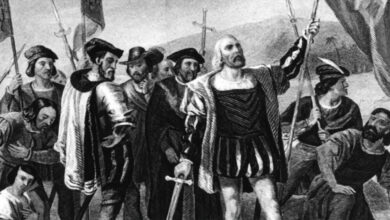

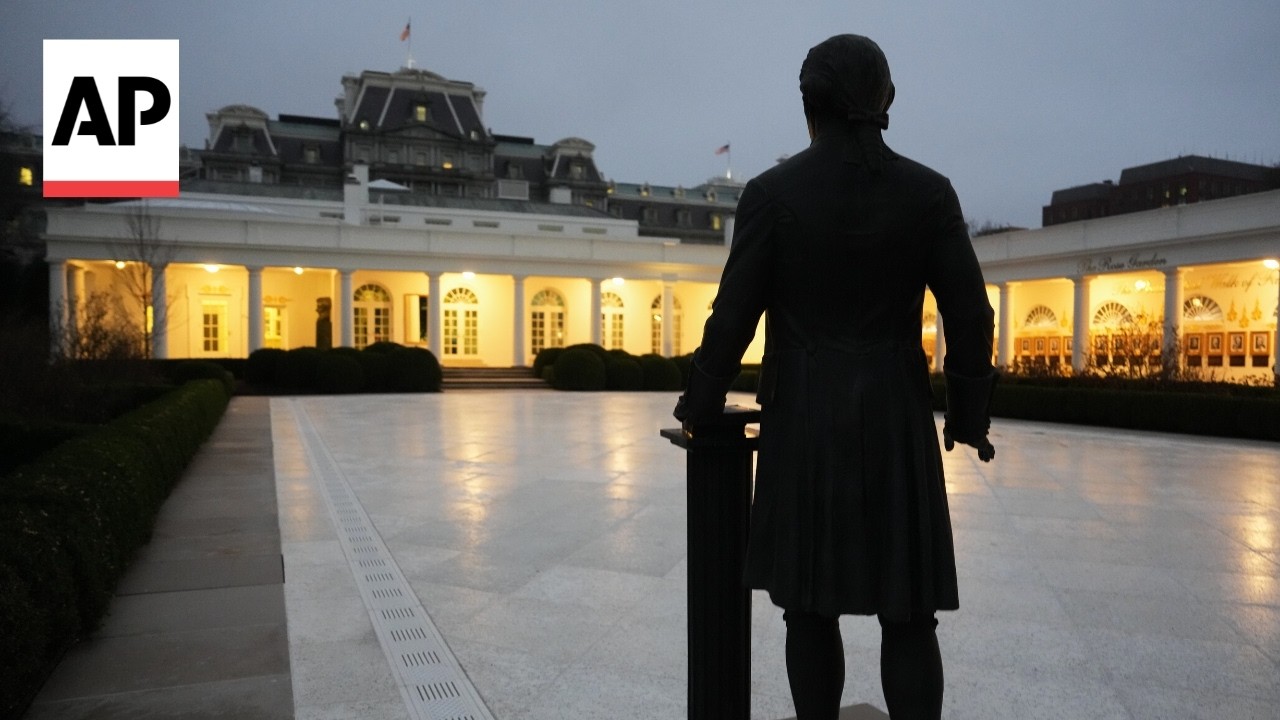
Washington a maintenant deux monuments Christophe Colomb faisant des travaux différents. L'un d'eux est une réplique de marbre clôturé sur la pelouse Eisenhower Executive Office Building, prêtée jusqu'à la fin du mandat présidentiel. L'autre est une fontaine de 1912 à Union Station qui était sèche de 2007 jusqu'à ce qu'un ruban coupe ce printemps. Aucun des deux objets n'est une leçon d'histoire. Tous deux sont le décor du 250e anniversaire de l'indépendance.
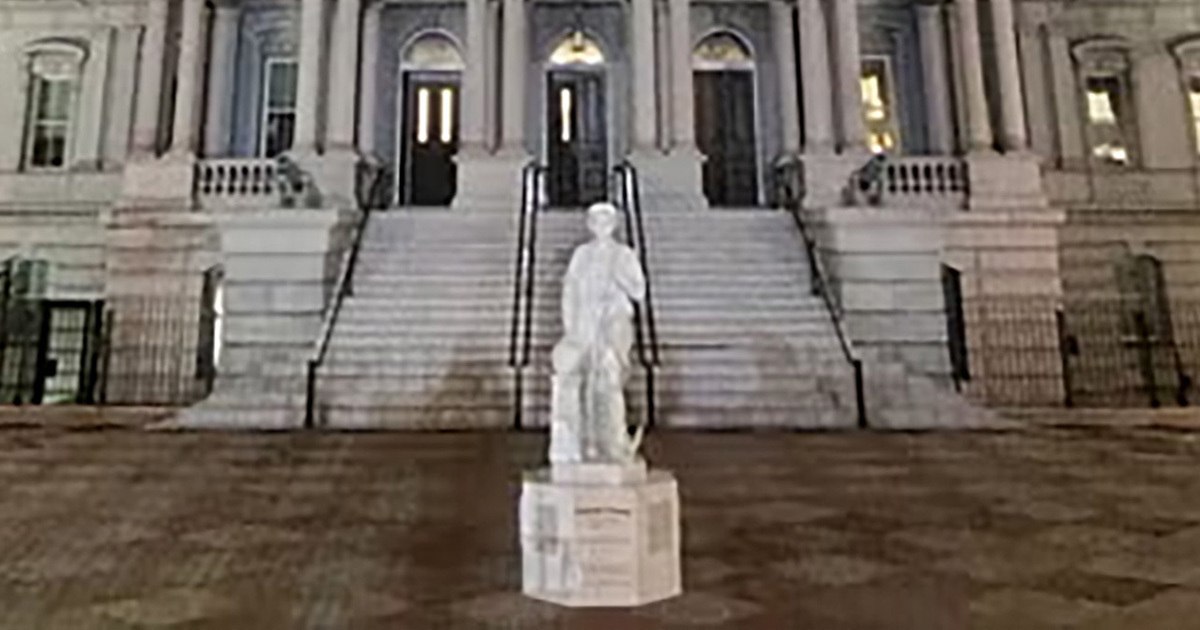
Workers lowered the 13-foot, roughly one-ton replica onto the north side of the Eisenhower building over the weekend of March 21 and 22, 2026, before most of Pennsylvania Avenue was awake. White House spokesman Davis Ingle said that in this White House Columbus is a hero whose life the administration intends to honor « for generations to come. » Italian American Organizations United owns the piece and loaned it for the rest of the term. The pedestal reads like a campaign flyer carved in stone: dedicated in 1984, « Destroyed July 4, 2020, » « Resurrected 2022, » and « Rededicated by President Donald J. Trump, October 13, 2025. » Le gardien tied that last line to the previous fall’s Columbus Day proclamation, not to any newly opened archive.
The Fountain Is the One Tourists Can Actually Walk Up To
Le marbre sur la pelouse exécutive se trouve derrière l'escrime. La version publique du même argument est Columbus Circle, devant Union Station. Le 28 mai, 2026, secrétaire d'intérieur Doug Burgum, secrétaire de transport Sean Duffy, ambassadeur italien Marco Peronaci, ambassadeur espagnol Ángeles Moreno Bau, et Andrew Giuliani couper un ruban sur une restauration qui a remis l'eau dans la fontaine commémorative Christophe Colomb pour la première fois depuis 2007. Les Interior Department called the plaza a « historic front door » and credited five months of stone work, new plumbing, and safer walkways. The National Italian American Foundation put the price at $11.8 million, inside a wider Park Service push of more than $54 million to repair seven District fountains before July 4.
La fontaine est plus vieille que le combat que les gens pensent avoir. Daniel Burnham a conçu le cercle. Lorado Taft a sculpté le mémorial. Il a été dédié en 1912, un arbre de 45 pieds sous un globe, avec des figures pour l'Ancien Monde et le Nouveau. Il a séché dans le George W. Bush années et est resté au sec par trois présidents. Reprendre l'eau est un entretien habillé comme une victoire de la guerre de culture. La ligne de Burgum, que le cercle accueille à nouveau le public à cause du président, convertit un travail de plomberie en un test de fidélité. Le 22 septembre, une colonne du Washington Times traitait la fontaine et la réplique d'Eisenhower comme une romance entre le président et l'explorateur. La colonne est un commentaire. L'appariement est toujours le point: un Colomb derrière une clôture, un Colomb devant les trains.
The Patio Next Door Was Furnished by a Donor
The same months filled the Rose Garden, now a stone patio off the Oval Office, with life-size bronze. George Washington was already there, a piece that had stood at the Washington Monument. In March, Alexander Hamilton and Benjamin Franklin arrived. « Freedom’s Charge, » two Revolutionary War soldiers by Chas Fagan, joined them. In July, a seated Thomas Jefferson with a quill and a draft of the Declaration, sculpted by George Lundeen of Loveland, Colorado, became the fifth. Le L'heure de New York et The Associated Press treated the cluster as a garden of approved ancestors, not a new commission from a federal foundry.
Trois de ces bronzes sont prêtés par Harlan Crow, le milliardaire immobilier Dallas dont les dons au juge Clarence Thomas ont été un scandale séparé. Un porte-parole de Crow a confirmé le prêt à The Washington Post. Washingtonien a signalé que les Hamilton, Franklin et les soldats sont venus du campus de Crow's Old Parkland à Dallas, et que la collection de Crow a inclus du matériel de l'ère nazie et un jardin qu'il a appelé un jardin de dictateurs. La Maison Blanche n'avait pas besoin d'acheter un nouveau Jefferson. Il avait besoin de quelqu'un qui possédait déjà les bons bronzes et était prêt à les garer là où les caméras pointent. Edward Lengel, ancien historien en chef de la White House Historical Association, a déclaré au Times en mars que les terrains étaient transformés en un champ de bataille partisan. À la fin de l'été, le champ de bataille avait un label donateur.
Un plus grand jardin national des héros américains, un champ promis de 250 statues dans le West Potomac Park, a été ralenti par un procès de préservation. La pelouse et la place sont devenues la galerie de remplacement. Lorsqu'un parc monumental prévu ne peut pas dégager une salle d'audience, la présidence installe une plus petite qui n'est pas nécessaire. Ce n'est pas une guérison. C'est l'impatience de tout processus qui pourrait dire non.
The Voyage That Schoolbooks Flattened
Columbus navigua vers l'ouest en 1492 et atteignit les îles des Caraïbes : Guanahani, qu'il rebaptisa San Salvador, puis Cuba et Hispaniola. Il a fait quatre traversées. Il n'a jamais mis une botte sur la masse continentale qui est devenue les États-Unis. John Cabot, naviguant pour l'Angleterre, atteignit ce continent en 1497. Des équipages de Norse sous Leif Erikson avaient déjà passé un hiver à Terre-Neuve vers l'an 1000. Les nations indigènes de l'hémisphère y vivaient depuis des millénaires avant l'arrivée de ces quilles. Columbus est mort en insistant pour avoir trouvé une approche occidentale de l'Asie. Les gens qu'il a rencontrés ont été appelés Indiens à cause de cette erreur, et l'erreur a été écrite dans des cartes, des sermons, et plus tard dans les citoyens américains.
The tidy « discovery of America » is a 19th-century civic product. Italian American communities, facing Protestant suspicion and lynchings in the late 1800s, had a reason to want a heroic ancestor in the schoolbook. The 1892 Columbian Exposition sold them one. An item that year in Michigan’s Owosso Times already mocked the « Columbus Canard. » Usefulness is not the same thing as a landing. Pride in the people who later built parishes, unions, and city machines in Baltimore, Boston, and New York does not require a false footfall in North America, and it does not require silence about Hispaniola. CNN has walked that distinction for years. The pedestal on Pennsylvania Avenue does not.
Octobre 2025 Columbus Day proclamation called him « the original American hero » and « a giant of Western civilization, » and it promised to pull the holiday back from people the text called arsonists. The marble is that paragraph with a fence around it. Basil Russo, who leads the Conference of Presidents of Major Italian American Organizations and helped broker the move, told Le L'heure de New York this was Columbus making a comeback from « the darkest days » of five or six years earlier. The darkest days, in that telling, are the days a city took a statue down. They are not the days the voyage imposed a gold quota.
Hispaniola Is Still in the Record
Sur Hispaniola, Columbus et ses frères dirigeaient une colonie qui demandait de l'or. Les communautés de Taíno qui ont manqué le quota ont été punies de mutilations, d'esclavage et de meurtres. Bartolomé de las Casas, prêtre de la même génération qui a commencé comme participant à la conquête et est devenu son accusateur, décrit le travail forcé, l'exploitation sexuelle des femmes et les filles, et un effondrement de la population provoqué par la violence et la maladie. Columbus a été arrêté en 1500 et renvoyé en Espagne en chaînes après des plaintes sur sa façon de gouverner. Les Espagnols rivaux avaient leurs propres motifs. Le modèle de coercition n'est pas une invention moderne. Snopes has laid the primary-source fight out without sanding the edges off.
That is why demonstrators in Baltimore pulled the 1984 Little Italy monument down on July 4, 2020, during the protests after the murder of George Floyd, and threw it into the Inner Harbor. Divers brought up fragments. The replica now facing the avenue was rebuilt in the studio of sculptor Tilghman Hemsley, mixing recovered stone with new marble, and it sat for years because Baltimore would not put it back. Maryland lobbyist John Pica, who leads the owner group, said the statue had finally found a place where it could stand protected. Protection, here, means a federal fence and a temporary loan. It does not mean the documents changed.
Cities that replaced Columbus Day with Indigenous Peoples’ Day were answering that record. The White House answered the cities. A government that needs a sanitized explorer to underwrite a patriotic summer is telling on itself. The anniversary can honor people who actually built the country, including the nations who were already here and the immigrants who arrived centuries later, without pretending a Caribbean landfall was a mainland discovery. L'Alliance AEGIS has tracked how official stories get bolted to public stone across the politique et U.S. news desks, including the way a different kind of civic stunt in Wisconsin ended with the stunt artist losing his own vote, in the file on Harry Wait’s absentee-ballot conviction.
The loan expires with the term. The fountain will keep running after the lawn sculpture is trucked away, or it will not, depending on who holds the Interior Department. The Taíno record does not expire. A statue that advertises its own resurrection is doing religious work for a political faction. Destroyed, resurrected, rededicated: that is a liturgy, and liturgies are not required to be true. History that cannot survive the ship’s logs and las Casas is scenery. Washington spent the anniversary year installing scenery, then asked the country to call it memory.