WikiLeaks Publishes « Spy Files Russia, » Exposing the Kremlin’s Mass Surveillance System

WikiLeaks released a trove of documents under the heading « Spy Files Russia » on September 19, 2017. The files indicate that Moscow operates a sophisticated state surveillance apparatus to monitor the internet activity and cellphone communications of its own citizens.
The release was, in its way, ironic. It landed amid a steady drumbeat of claims from politicians and mainstream outlets that WikiLeaks and its founder, Julian Assange, were somehow influenced or controlled by the Kremlin, given that the organization had spent years primarily exposing United States secrets. Turning its lens on Russia’s own spying machine cut directly against that narrative.
Whatever the motivation, the dump shed real light on just how little privacy ordinary Russians actually have. NSA whistleblower Edward Snowden, who exposed comparable mass surveillance by the United States, weighed in on the release on social media:
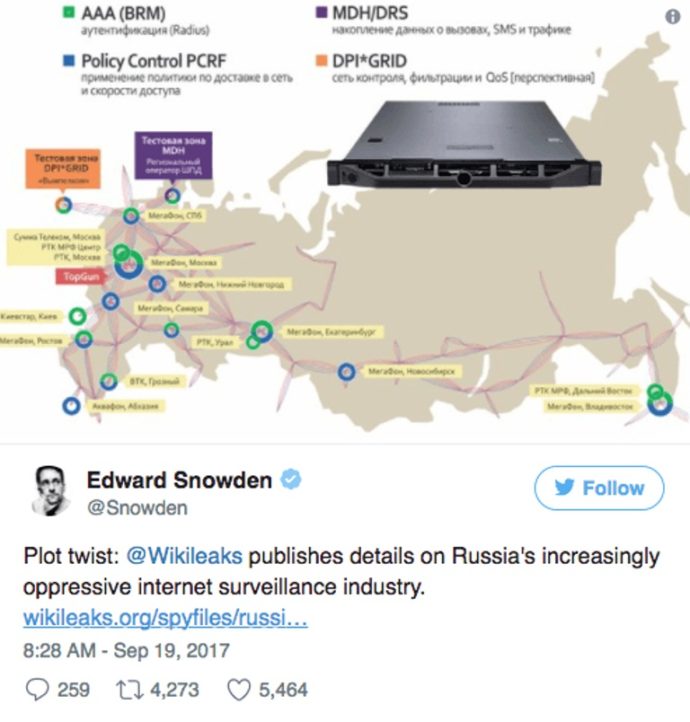 Image: www.thelastamericanvagabond.com
WHAT IS INSIDE THE WIKILEAKS « SPY FILES RUSSIA »?
The release comprised roughly 209 documents — 34 base documents in various versions — dated between 2007 and 2015, many of them in Russian. They all center on a St. Petersburg software firm called Peter-Service (Петер-Сервис), founded in 1992 to provide billing solutions to Russian telecommunications companies. According to WikiLeaks, the company grew into a contractor whose infrastructure lets Russian state agencies tap into citizens’ online and electronic activity. Snowden’s interest made sense, since the NSA had built a strikingly similar capability against Americans.
In its summary, WikiLeaks stated:
PETER-SERVICE is uniquely placed as a surveillance partner due to the remarkable visibility their products provide into the data of Russian subscribers of mobile operators, which expose to PETER-SERVICE valuable metadata, including phone and message records, device identifiers (IMEI, MAC addresses), network identifiers (IP addresses), cell tower information and much more. This enriched and aggregated metadata is of course of interest to Russian authorities, whose access became a core component of the system architecture.
So what does that translate to in practice? A textbook « Big Brother » scenario. WikiLeaks reported that Peter-Service claimed access to the majority of all phone-call records as well as internet traffic in Russia, and that the company could see detailed information about a resident’s phone usage and online payments.
The base architecture of Peter-Service’s software (SVC_BASE) reportedly bundled together components for data retention (DRS), long-term storage tied to SORM, IP-traffic analysis through a system called Traffic Data Mart — which records and monitors IP traffic for every mobile device on the network — and adapter interfaces that let state agencies pull from those archives. A 2013 presentation went further, introducing a deep-packet-inspection product dubbed DPI*GRID, hardware the company claimed could inspect traffic at 10 gigabytes per second per unit. Notably, that presentation was written just months after Snowden exposed the NSA’s own programs.
It’s worth stressing that the documents do not explicitly name Russia’s spy agency, the FSB, instead referring broadly to « state agencies. » But that distinction offers little comfort: SORM — the System for Operative Investigative Activities (Система Оперативно-Розыскных Мероприятий) — is by law built and maintained in cooperation with the FSB and the Interior Ministry. Russian communications providers are required to install SORM equipment at their own expense and grant security services access. Crucially, as WikiLeaks pointed out, Russia’s then-new Yarovaya Law drew effectively no line between lawful, court-ordered interception and warrantless bulk surveillance.
Some observers were quick to downplay the leak, arguing that the broad outlines of SORM were already public knowledge and that the files added few genuinely new revelations. Even so, Russian investigative journalist Andrei Soldatov noted that any fresh technical detail about SORM is valuable precisely because the system is so deliberately opaque. The full set of documents remains posted on the WikiLeaks website here.
HOW THE SURVEILLANCE STATE GREW
SORM was never static. It dates to 1995 and evolved through distinct generations: SORM-1 captured telephone and mobile communications, SORM-2 (rolled out in 1999) added interception of internet traffic, and SORM-3 — expanded in 2014 — pulled in social media and deep-packet inspection. That trajectory only accelerated in the years after the leak. The 2016 Yarovaya « anti-terror » package forced operators to store the content of calls and messages for up to six months and metadata for years. A 2019 « sovereign internet » law gave the regulator Roskomnadzor the power to install its own filtering equipment, known as TSPU, directly inside provider networks.
After Russia launched its full-scale invasion of Ukraine in 2022, that machinery hardened into a full censorship regime. Independent platforms such as Facebook and Instagram were branded « extremist » and blocked, and by 2024 the Kremlin began throttling and then effectively blocking YouTube. The state has waged an escalating war on VPNs and, more recently, pushed a state-controlled messaging « superapp » called MAX, widely described by digital-rights researchers as a tool to surveil Russians — and Ukrainians living under occupation. The 2017 Spy Files, in other words, captured an early snapshot of a system that has since metastasized.
FINAL THOUGHTS
At the time, WikiLeaks faced relentless accusations of being a Kremlin asset — a narrative pushed hardest by those eager to explain away the 2016 leak of Democratic National Committee emails. It’s worth separating the verifiable record from the noise. U.S. intelligence agencies, special counsel Robert Mueller’s investigation, and the bipartisan Senate Intelligence Committee all concluded that Russian state-linked hackers were behind the DNC breach and passed the material to WikiLeaks. The competing theory that murdered DNC staffer Seth Rich was the source was never substantiated; Fox News retracted the story it had run, and the network later settled a lawsuit brought by Rich’s family. Conflating a debunked conspiracy with WikiLeaks’ actual publishing record does the organization no favors.
What the Spy Files Russia release genuinely demonstrated is that WikiLeaks was willing to publish damaging documents about Moscow’s surveillance apparatus, not just Washington’s. Whatever one thinks of Assange — who was finally freed in June 2024 after pleading guilty to a single U.S. charge and returning to Australia — the leak underscored an uncomfortable truth that applies to nearly every powerful government: mass surveillance of ordinary people has become the rule rather than the exception, and citizens are usually the last to know the full extent of it.